

Aging bridges raise nationwide safety concerns
Aging bridges raise nationwide safety concerns
Posted May. 30, 2026 08:29,
Updated May. 30, 2026 08:29
“Could it really be that dangerous?”
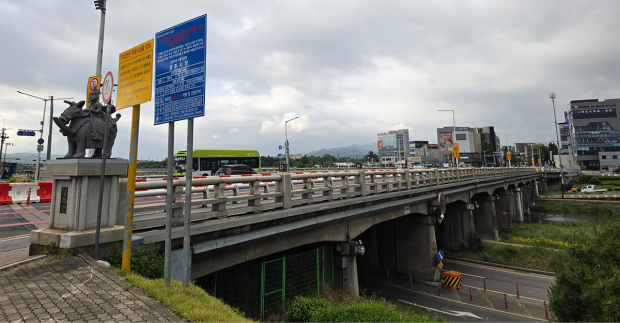
Park, a 54-year-old resident interviewed Thursday at Gyeongju Bridge in Gyeongju, North Gyeongsang Province, struggled to believe the bridge had received the lowest possible safety rating, requiring immediate closure, for three consecutive years.
“I drive through here almost every day and never knew,” he said. “Now I’m wondering if I should start taking a different route.”
Few pedestrians or drivers crossing Gyeongju Bridge, a six-lane structure with sidewalks on both sides, appeared to notice the yellow warning sign at the entrance identifying it as a “hazardous structure.” The sign urged motorists and pedestrians to use caution under the Facility Safety Act, but school buses, passenger cars and trucks continued passing through without slowing. Beneath the bridge, residents walked along the Bukcheon stream as usual.
● 117 unsafe bridges nationwide
According to the Korea Authority of Land and Infrastructure Safety, 104 of the country’s 37,915 bridges had received D grade in safety inspections as of March, while 13 were classified as E grade, the most critical level.
The inspections are designed to identify structural flaws and determine whether facilities such as bridges remain safe for public use. Local governments and agencies including the Korea Expressway Corporation regularly hire private engineering firms to conduct the evaluations.
D grade, the second-lowest on the five-tier scale, indicates severe defects requiring urgent repair and reinforcement. E grade signifies the highest level of danger.
Seosomun Overpass in Seoul’s Seodaemun District, where a collapse recently occurred, had shown warning signs years earlier. In 2019, concrete fragments fell from the structure, and a safety inspection later that year assigned it D grade. Repeated floor collapses and falling concrete eventually prompted authorities to order its demolition, with dismantling work beginning last year.
Gyeongju Bridge has received E grade for three straight years after inspections uncovered major structural defects, including cracked piers in 2023, insufficient reinforcing bars in key sections in 2024, and damaged bridge bearings last year.
Even so, authorities have continued allowing traffic while restricting only vehicles weighing more than 20 tons. An official in Gyeongju’s road management division said experts determined smaller vehicles could continue using the bridge without posing a serious risk, while heavy vehicles were limited to one lane in each direction.
The official said reinforcement work had been carried out every year since the bridge first received the E grade, but the structure had deteriorated too badly for repairs to improve its rating. Authorities are now planning to demolish and rebuild the bridge entirely.
The situation is similar at Maegok Bridge and Aengsan Bridge in Icheon, Gyeonggi Province, and Chundang Bridge in Hoengseong, Gangwon Province. All three restrict large vehicles based on height or weight, but ordinary traffic and pedestrians are still allowed to cross.
The remaining nine E-grade bridges have been closed to traffic, though demolition work has yet to begin at some sites. Gusamho Bridge in Ulsan’s Jung District, where part of the roadway sank during torrential rains in July last year, had already been shut down before receiving E grade in December, and partial demolition work has since begun.
Suha Bridge in Hongcheon County, Gangwon Province, first received E grade in December 2023. Reconstruction work began in September last year, and the bridge was demolished in late April. By contrast, demolition work has yet to start at Byeoram Bridge in Mungyeong, North Gyeongsang Province, and Dunri No. 1 Bridge in Yesan County, South Chungcheong Province.
● Budget shortages slow response
Local governments say securing reconstruction funding and dealing with complaints over traffic restrictions remain major hurdles.
An official in Gyeongju said the bridge is a major traffic artery used by about 30,000 vehicles each year, making a full closure difficult because of expected public complaints.
“Just completing the design and administrative procedures takes more than a year,” the official said. “The project is not eligible for central government funding, so the entire 48 billion won cost has to come from the city budget, which makes financing extremely difficult.”
An official overseeing Suha Bridge in Hongcheon County said bridge reconstruction projects place a heavy burden on smaller local governments. The official said demolition and rebuilding costs typically run about 2 billion won for shorter bridges and as much as 8 billion won for structures longer than 100 meters.
Experts warn that delaying repairs and reinforcement work on aging bridges can significantly raise the risks involved in eventual demolition and reconstruction, as seen in the Seosomun Overpass case.
Jung Jin-woo, a professor of safety engineering at Seoul National University of Science and Technology, said prolonged delays accelerate structural deterioration, making demolition and reconstruction more difficult while increasing the risk of unexpected deformation or instability during construction.
송진호 jino@donga.com



![[오늘의 운세/6월 14일]](https://dimg.donga.com/c/138/175/90/1/wps/NEWS/IMAGE/2026/06/13/134104335.1.jpg)




 About Dong-A Ilbo