

Kospi rally revives investment tax debate
Kospi rally revives investment tax debate
Posted May. 30, 2026 08:28,
Updated May. 30, 2026 08:28
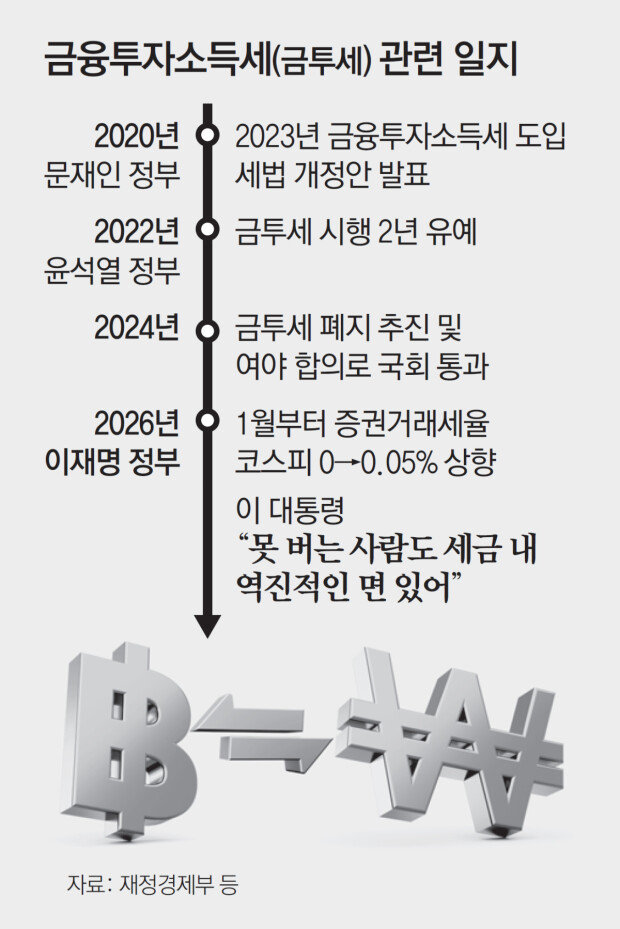
As the Kospi continues its record-breaking climb this year and vaults past the 8,000-point threshold, speculation is mounting that debate over reviving the abolished financial investment income tax could return to the policy agenda. With market conditions now far removed from the days when the benchmark index drifted in a stagnant range, some analysts say the issue warrants another look in the name of tax fairness.
Still, the proposal remains politically sensitive. Fierce resistance from retail investors could make both the government and lawmakers reluctant to reopen the issue too quickly.
President Lee Jae-myung raised the matter during a National Economic Advisory Council meeting on April 9, saying those who make money should pay taxes, while those who do not should not. He noted that the current structure carries a regressive aspect because investors pay securities transaction taxes regardless of whether they earn a profit. Eventually, he said, the securities transaction tax and capital gains tax should be adjusted together at similar levels.
Under the current system, capital gains taxes on stock trading profits apply only to major shareholders, including investors holding more than 5 billion won in a single stock or owning stakes above a designated threshold. Lee’s remarks were widely interpreted as signaling that taxes should be imposed on actual gains rather than transactions themselves, fueling renewed speculation that debate over the financial investment income tax could regain momentum.
The tax was designed to apply to profits earned from financial assets such as stocks and bonds. Introduced under the Moon Jae-in administration in 2020, it was initially scheduled to take effect in 2023. Its core provision called for a tax rate of 22.0% to 27.5%, including local income tax, on annual gains exceeding 50 million won from domestic stock investments.
Critics, however, warned that the measure could drive major investors out of the market and weaken local equities. In 2022, the Yoon Suk Yeol administration delayed implementation by two years, pushing the start date from 2023 to 2025. At the time, the Kospi remained stuck in the 2,000 to 3,000 range, while the so-called Korea discount, referring to the chronic undervaluation of South Korean equities, persisted as a longstanding market concern. The tax was ultimately scrapped in 2024 through bipartisan agreement. Securities transaction tax rates, which had been gradually lowered in preparation for the new system, were also raised this year to 2023 levels.
The government has so far signaled that no formal discussions are underway on reviving the tax. Deputy Prime Minister and Finance Minister Koo Yun-cheol recently told reporters the matter should be reviewed only after market conditions are fully in place, indicating there are no immediate plans to revisit it.
Still, some analysts say surging trading activity and rising securities transaction tax revenue could shape future discussions. Securities transaction tax revenue reached 2.8 trillion won through March, up 234.6% from 800 billion won a year earlier.
The government initially projected this year’s securities transaction tax revenue at 5.4 trillion won when drafting the budget, but later raised the estimate to 10.6 trillion won while preparing a supplementary budget in March.
Experts say South Korea eventually needs to overhaul its taxation framework to better uphold the principle that income should be taxed where it is earned. Kim Woo-chul, a taxation professor at the University of Seoul, said broader tax reform would be difficult without rationalizing the system through the financial investment income tax. He added that concerns among retail investors could be eased by offering near-exempt treatment to lower-income groups, including younger investors, while adjusting tax rates accordingly.
세종=김수연 syeon@donga.com


![[오늘의 운세/6월 14일]](https://dimg.donga.com/c/138/175/90/1/wps/NEWS/IMAGE/2026/06/13/134104335.1.jpg)



 About Dong-A Ilbo