

Yellow Envelope Law clouds Hyundai Mobis restructuring
Yellow Envelope Law clouds Hyundai Mobis restructuring
Posted May. 15, 2026 08:27,
Updated May. 15, 2026 08:27
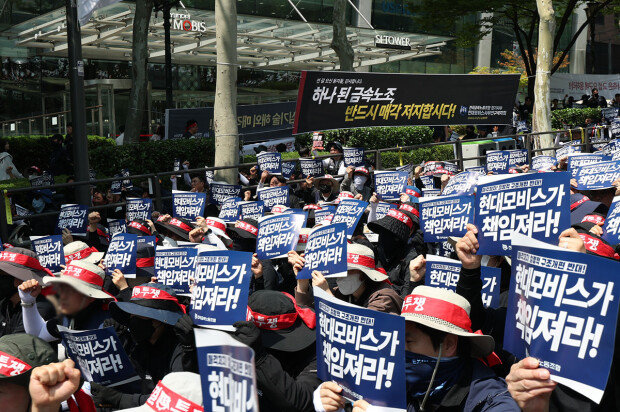
A restructuring effort at Hyundai Mobis, a core affiliate of Hyundai Motor Group, has run into turbulence as labor unions intensify opposition to the planned sale of its automotive lighting business.
Business divisions are routinely bought, sold and reorganized as companies adjust strategy and improve efficiency. But the dispute has taken on broader significance since revisions to South Korea’s labor law, widely referred to as the “Yellow Envelope Law,” came into force on March 10.
In January, Hyundai Mobis agreed to sell its lamp division to global auto parts supplier OPmobility, describing the move as part of a broader effort to sharpen its future business focus and boost efficiency.
The decision quickly triggered resistance from workers at Hyundai IHL, a Hyundai Mobis subsidiary that supplies products to the lighting business. Around 700 unionized employees have been staging a full-scale strike since late last month, arguing that the sale threatens their employment stability. The confrontation has since expanded beyond the subsidiary itself.
The Hyundai IHL union and its umbrella organization, the metalworkers’ union under the Korean Confederation of Trade Unions, are demanding direct negotiations with Hyundai Mobis, insisting the parent company bears responsibility for the fallout from the sale.
The union argues that the divestiture directly affects the job security of subsidiary workers and therefore qualifies as an issue requiring talks with the parent company, not just Hyundai IHL management.
The revised labor law broadened the scope of legal labor disputes from traditional issues tied directly to wages and working conditions to wider “decisions related to working conditions.” Labor groups are now using that expanded definition to justify demands for bargaining with parent companies.
Business groups had long warned that the law’s broader and less clearly defined strike provisions could hamper ordinary management activities such as restructuring and mergers and acquisitions. The Hyundai Mobis dispute is increasingly being cited as a case illustrating those fears.
Although OPmobility has pledged to maintain the current business structure, workforce and organization in compliance with South Korean law, the union has refused to back down.
Workers have also rejected compensation proposals from Hyundai Mobis and Hyundai IHL, including relocation incentives and consolation payments ranging from 100 million won to 150 million won per employee.
As the strike drags on, concerns are growing that parts shortages could disrupt vehicle production at Hyundai Motor Company and Kia.
Companies regularly reorganize business units to strengthen profitability, secure capital and prepare for future growth. Critics of the revised law argue those decisions fundamentally belong within the realm of management authority.
They contend that the law’s vague wording, particularly provisions recognizing parent companies as employers if they “substantively and concretely determine working conditions,” is creating mounting uncertainty across industrial sites.
Calls are growing for lawmakers to revisit the legislation before the broader side effects spread further through the corporate sector.








 About Dong-A Ilbo