

AI agents fuel debate over 'token economy'
AI agents fuel debate over 'token economy'
Posted March. 24, 2026 08:53,
Updated March. 24, 2026 08:53
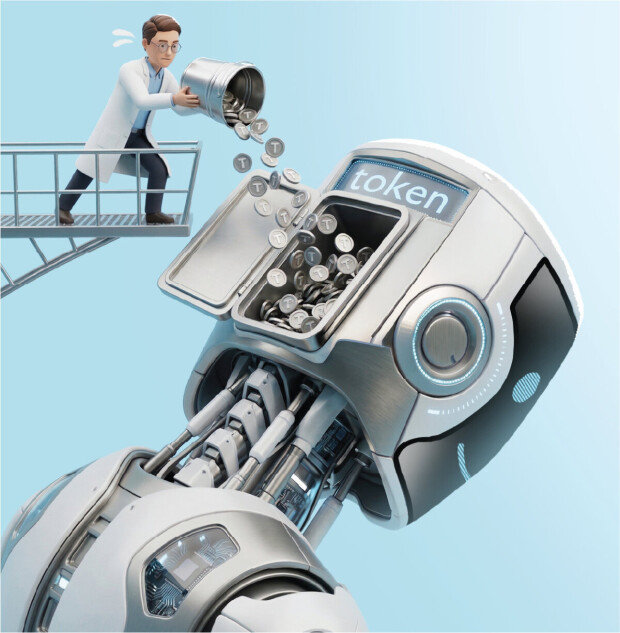
As artificial intelligence systems capable of acting autonomously, known as AI agents, gain traction, computing demand is surging and “tokens” are emerging as a defining concept across the IT industry. Tokens, the basic units used by AI to process data, have become a key gauge of usage. Competition over token consumption is beginning to surface among Silicon Valley engineers, and Jensen Huang has said companies should provide engineers with token resources. The implication is clear. Greater token access allows top talent to make fuller use of AI. His remarks have accelerated discussion of a so-called token economy.
● AI agents with autonomy drive sharp rise in token use
According to industry sources on March 23, token consumption has surged as Silicon Valley engineers rapidly adopt the AI agent OpenClaw. Data from AI tracking platform OpenRouter show weekly token usage jumping from about 1.62 trillion in March 2025 to 20.4 trillion in March 2026, roughly a 12-fold increase in a year.
The inflection point came late last year with the arrival of OpenClaw. AI agents, in simple terms, operate with a degree of autonomy. They go beyond answering prompts to executing tasks such as drafting emails or making purchases. To perform these functions, OpenClaw taps multiple AI models, including ChatGPT, Gemini and Claude. Running several models continuously and in parallel, it consumes far more tokens than a human user.
Even with intensive programming tasks using AI chatbots, a human typically uses only several million tokens a day. OpenClaw, by contrast, can consume billions, translating into costs that can reach thousands of dollars.
● Tokens gain traction as a form of compensation
Among Silicon Valley engineers, running OpenClaw around the clock to boost productivity is quickly becoming common practice. Some openly compare their token usage to their salaries, noting that their spending on services such as Claude rivals annual pay.
As tokens emerge as a core resource in the AI agent era, some companies are weighing plans to offer them as part of compensation. Huang said on March 16 at Nvidia’s annual developer conference, GTC 2026 in San Jose, that the company is reviewing a plan to provide engineers with token allocations equal to half their base salary.
According to compensation tracking site Levels.fyi, top-quartile software engineers earn about $375,000 a year. Providing half that amount in tokens would require companies to allocate roughly $187,500 per engineer in token resources.
Hwang Soo-wook, a senior researcher at Meritz Securities, said in a recent report that the rise of AI agents is pushing the global economy beyond the digital phase toward one defined by tokens. “The economy is shifting toward tokenomics,” he said. "The key to future AI factories will be the efficiency of token production.”
최지원 jwchoi@donga.com




![28년 묵은 판례가 만든 면죄부… ‘그놈’은 웃으며 법정 떠났다[히어로콘텐츠/히든③-下]](https://dimg.donga.com/c/138/175/90/1/wps/NEWS/IMAGE/2026/06/24/134169639.1.jpg)



 About Dong-A Ilbo