

Washington reaffirms denuclearization stance, open to talks
Washington reaffirms denuclearization stance, open to talks
Posted February. 28, 2026 08:40,
Updated February. 28, 2026 08:40
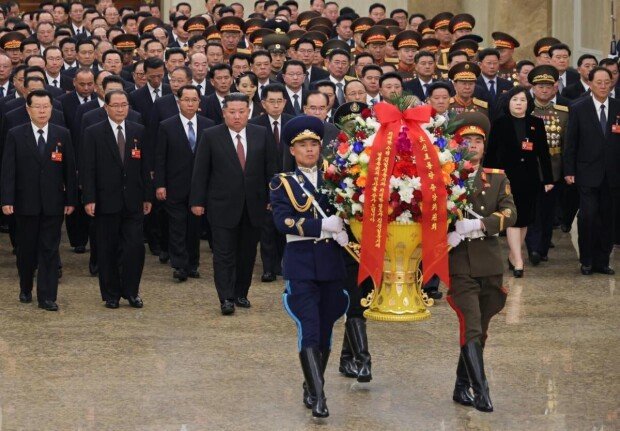
On Wednesday local time, the White House said U.S. President Donald Trump remains open to engaging in dialogue with Kim Jong Un without preconditions. The statement followed remarks by Kim at the Ninth Party Congress on Jan. 20 and 21 that “if the United States respects our country’s current status and withdraws its hostile policy toward North Korea, there is no reason for us not to maintain good relations with the United States.” The White House response was widely viewed as a reciprocal signal of willingness to engage. Some observers speculate that a North Korea-U.S. summit could be arranged during Trump’s expected visit to China from late next month to early April. The White House, however, stressed that there has been no change in Washington’s North Korea policy, including its commitment to denuclearization.
A senior White House official, responding to an inquiry from The Dong-A Ilbo about Kim’s remarks on bilateral ties, said that during his first term Trump held three historic summits with Kim that helped stabilize the situation on the Korean Peninsula and reiterated that he remains open to talks without preconditions. The official was referring to the three North Korea-U.S. summits held during Donald Trump’s first term, including the June 2018 Singapore summit, underscoring the administration’s continued openness to dialogue.
At the same time, the official said there has been “no change” in the Trump administration’s North Korea policy. Pyongyang has previously called on Washington to abandon denuclearization talks, recognize North Korea as a nuclear-armed state and ease sanctions as conditions for negotiations. The administration’s latest remarks are interpreted as signaling a preference to meet first and negotiate later without accepting those demands. They are also seen as reaffirming its adherence, at least for now, to the principle of North Korea’s denuclearization.
South Korea’s chief nuclear envoy, Jeong Yeon-doo, head of the Foreign Ministry’s Bureau of Diplomatic Strategy and Intelligence, also told reporters at the South Korean Embassy in Washington that the United States had confirmed it remains open to dialogue with North Korea without preconditions. A senior South Korean government official added that recent contacts with U.S. officials did not suggest any move toward recognizing North Korea as a de facto nuclear state, and that there was “no new development,” including on possible working-level talks between Washington and Pyongyang.
Nevertheless, with a U.S.-China summit scheduled for late next month to early April, speculation has grown that a meeting between the North Korean and U.S. leaders could take place on that occasion. In October last year, ahead of a visit to South Korea, Trump said, “Since I will be in South Korea, I could go straight there,” referring to North Korea. Although no meeting materialized, the remark signaled his willingness to visit North Korea directly if Kim Jong Un agreed to a summit. At the time, when asked what incentives he could offer to facilitate dialogue, Trump said, “We have sanctions. That is quite significant to start with,” hinting at the possibility of sanctions relief.
Jin-Woo Shin niceshin@donga.com


![[사설]“尹 계엄 하려 北 도발 유도”… 무지한 건지, 무모한 건지](https://dimg.donga.com/c/138/175/90/1/wps/NEWS/IMAGE/2026/06/12/134104085.1.jpg)



 About Dong-A Ilbo