

Government to curb foreign shipbuilding workers
Government to curb foreign shipbuilding workers
Posted February. 12, 2026 07:59,
Updated February. 12, 2026 07:59
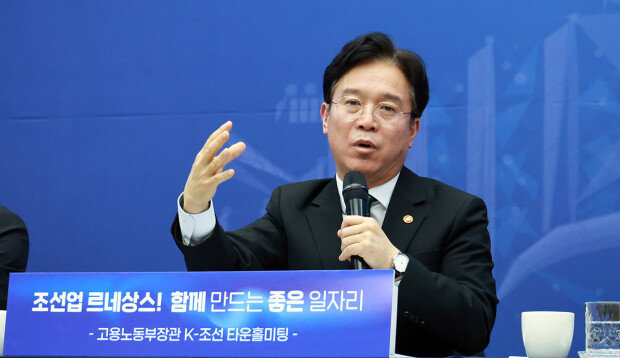
The government is preparing to scale back the employment of foreign workers in the shipbuilding industry while revamping the current visa framework. The sector is now in the midst of its first supercycle in a decade, prompting concerns that tightening access to overseas labor could deepen existing workforce shortages.
At a Feb. 9 town hall in Ulsan titled “Shipbuilding Renaissance, Creating Good Jobs Together,” Employment and Labor Minister Kim Young-hoon said allowing E-7 professional visas to expand without limit would be unsustainable, particularly if they begin to displace jobs at primary contractors. He said the ministry plans to coordinate with the Ministry of Justice to review the system.
Kim Tae-seon, a Democratic Party of Korea lawmaker representing Ulsan Dong-gu, expressed a similar view. He said the Ministry of Justice is preparing to scale back E-7-3 visas for welders and painters as much as possible under the current administration.
In 2022, the government scrapped the cap on E-7 visas to address acute labor shortages in shipbuilding, loosening regulations to facilitate the large-scale hiring of foreign welders and other skilled workers. As reliance on overseas labor deepened, however, concerns mounted that employment prospects for young Koreans were narrowing and that the windfall from the industry’s rebound was not sufficiently benefiting local communities. In response, the Lee Jae-myung administration has opted to reinstate certain restrictions.
Industry officials have expressed unease over the policy reversal. One shipbuilding executive said primary contractors are, in effect, likely to be barred from directly recruiting foreign workers. Given the sector’s cyclical order patterns, the official noted, managing workforce shortages and mounting wage pressures would prove difficult without continued access to foreign labor.
Jae-Hyeng Kim monami@donga.com

![전쟁이 앞당긴 태양의 시대…호르무즈 위기를 피한 나라들 [딥다이브]](https://dimg.donga.com/c/138/175/90/1/wps/NEWS/IMAGE/2026/04/08/133697952.1.jpg)
![해병대 전우 찾아갔다가…입 벌리고 양주 3병 들이부어 돌연사[더뎁스]](https://dimg.donga.com/c/138/175/90/1/wps/NEWS/IMAGE/2026/04/09/133648009.1.jpg)




 About Dong-A Ilbo