

Japan's ruling party wins historic landslide election
Japan's ruling party wins historic landslide election
Posted February. 10, 2026 08:35,
Updated February. 10, 2026 08:35

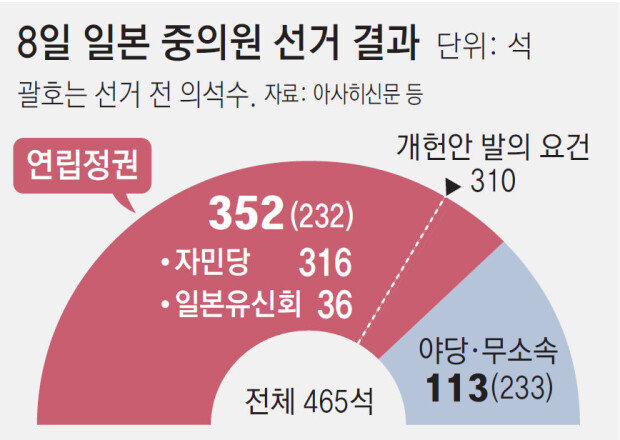
The ruling Liberal Democratic Party, led by Japanese Prime Minister Sanae Takaichi, won a landslide in Sunday’s House of Representatives election, capturing 316 of the chamber’s 465 seats, or roughly 68 percent.
The victory gives the party a 118-seat gain from its previous 198 and surpasses the two-thirds threshold of 310 seats needed to propose constitutional amendments. It also exceeds the party’s previous record of 300 seats in the 1986 general elections, marking its strongest showing since its founding in 1955.
The scale of the win positions Prime Minister Takaichi to push for constitutional revisions that could transform Japan into a war-capable nation, a goal even her political mentor, former Prime Minister Shinzo Abe, failed to achieve. Abe won 294 seats in the 2012 general elections, falling short of the two-thirds majority.
Appearing on Fuji TV and other broadcasters Sunday, the prime minister reaffirmed her commitment to constitutional revision, calling it official policy of the Liberal Democratic Party. She said she hopes proposals prepared by each party will undergo thorough review by the Diet’s Constitutional Review Committee. The ruling party is expected to pursue control of the committee’s chairmanship, currently held by the opposition, to speed up the amendment process.
Ahead of the election, the Liberal Democratic Party pledged to revise Article 9 of the Constitution, which renounces war, forbids the use of force, and prohibits maintaining land, sea, and air forces, as well as the right of belligerency. The party plans to explicitly enshrine the Self-Defense Forces in the Constitution, a move that would effectively position Japan as a war-capable nation while strengthening its defense posture.
To formally propose a constitutional amendment, at least two-thirds of both the House of Representatives and the House of Councillors must approve it, followed by a majority vote in a national referendum. While the Liberal Democratic Party and its coalition partner, the Japan Innovation Party, hold a combined 248 seats in the upper house, they do not hold a majority there. Attention is now on how Takaichi and the ruling party will build broader consensus for the proposed revision.
The election outcome has prompted assessments that Japan’s political landscape has shifted further to the right. In the House of Representatives, the Liberal Democratic Party and the Japan Innovation Party, which won 36 seats, now control a combined 352 seats, or 75.7 percent of the chamber. The centrist conservative Democratic Party for the People increased its representation by one seat to 28, while the far-right Sanseito party gained 13 seats, bringing its total to 15.
Conservative and right-leaning parties now hold 395 seats, or 84.9 percent of the lower house. By contrast, the Centrist Reform Alliance, made up of the main opposition Constitutional Democratic Party and the Komeito party, won just 49 seats, down sharply from 167 previously.
In-Chan Hwang hic@donga.com








 About Dong-A Ilbo