

Investors trigger KOSPI sidecars amid market swings
Investors trigger KOSPI sidecars amid market swings
Posted February. 07, 2026 08:08,
Updated February. 07, 2026 08:08
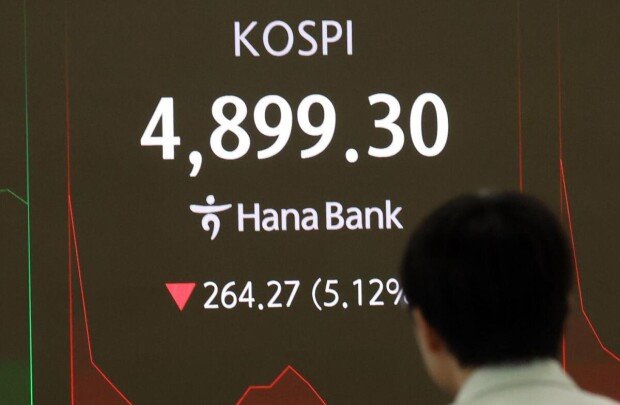
Concerns over massive AI investment by U.S. technology giants and weakening profitability pushed South Korea’s KOSPI below the 5,000 level for the first time in four days. Repeated bouts of so-called AI bubble speculation have sent the market on sharp swings, prompting the Korea Exchange to activate KOSPI sidecars, a mechanism that temporarily halts program trading, three times this week alone and underscoring growing investor uncertainty.
Risk aversion among foreign investors has intensified, leading to heavy selling of domestic equities and adding volatility to the foreign exchange market. Bitcoin briefly fell below 90 million won on local cryptocurrency exchanges, its lowest level in 16 months, while gold, silver and other precious metals also saw heightened price fluctuations.
On Feb. 6, the KOSPI closed at 5,098.14, down 1.44 percent from the previous session. The index fell as low as 4,916.84 during intraday trading, but aggressive bargain hunting by retail investors, totaling 2.1729 trillion won, helped limit the losses.
This month, the KOSPI has ranked among the most volatile major global stock markets. The Korea Exchange previously triggered both sell-side and buy-side sidecars on Feb. 2 and 3, and again imposed a sell-side automatic trading halt on Feb. 6.
The index’s heightened sensitivity to negative news reflects the heavy weighting of domestic semiconductor giants, which account for roughly 40 percent of the KOSPI and are closely tied to trends in U.S. technology investment. Whenever new AI technologies are unveiled or concerns emerge over investment costs or profitability, shares of Samsung Electronics and SK hynix tend to react sharply. Short-term trading by retail investors, who buy on dips and sell on rallies, has also amplified market swings.
Foreign investors, particularly sensitive to global AI growth projections, sold 3.3217 trillion won worth of KOSPI shares on Feb. 6. The resulting selling pressure increased demand for U.S. dollars, pushing the won-dollar exchange rate to as high as 1,471 won during the session.
Rising risk aversion has also weighed on digital assets. Bitcoin fell to 89 million won on domestic exchanges, its lowest level since October 2024. In commodities markets, gold futures declined 1.24 percent and silver futures dropped 9.11 percent on Feb. 5 on the New York COMEX.
지민구 warum@donga.com




![[사설]“尹 계엄 하려 北 도발 유도”… 무지한 건지, 무모한 건지](https://dimg.donga.com/c/138/175/90/1/wps/NEWS/IMAGE/2026/06/12/134104085.1.jpg)



 About Dong-A Ilbo