

Korea showcases world-class satellite technology with Arirang-7
Korea showcases world-class satellite technology with Arirang-7
Posted December. 03, 2025 08:20,
Updated December. 03, 2025 08:20
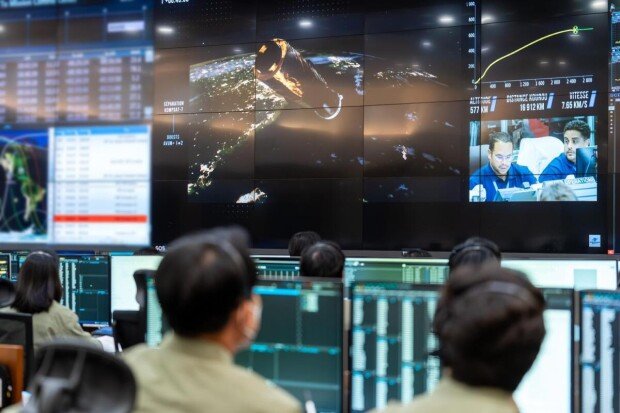
Following the launch of South Korea’s KSLV-II Nuri rocket, the Arirang-7 multipurpose practical satellite successfully reached orbit and completed its initial communications with ground stations.
The Korea Aerospace Research Institute (KARI) and the Korea Space Agency announced on Dec. 2 that Arirang-7 lifted off at 2:21 a.m. local time from the Guiana Space Center in French Guiana. In French Guiana, the local time was 2:21 p.m. on Dec. 1.
Arirang-7 was carried into space aboard Europe’s Vega-C launch vehicle. Lee Sang-gon, head of KARI’s Arirang-7 project, said, “The satellite was successfully launched at 2:21:25 a.m., as planned. About 44 minutes later, it separated from the launch vehicle and entered its designated orbit. Approximately 25 minutes after that, we confirmed that the satellite was functioning normally.”
The satellite conducted sequential communications with ground stations at Troll in Antarctica and Svalbard in the Arctic. After roughly ten sessions with international ground stations, it successfully connected with KARI’s Daejeon ground station at 1:40 p.m.
The successful launch demonstrates that South Korea’s satellite technology has reached a world-class level. Arirang-7 was entirely developed domestically, including the design, assembly, testing, and verification of its systems, body, and payloads. The satellite is equipped with high-precision observation capabilities. Its AEISS-HR electro-optical camera can detect objects as small as 30 centimeters, capturing ultra-high-resolution images capable of distinguishing between cars and trucks.
Lee Sang-chul, president of KARI, said, “Arirang-7, launched successfully thanks to years of investment and effort, is one of the world’s leading Earth observation satellites. The high-precision imagery it provides will allow us to create detailed maps, manage national territory, and respond to disasters entirely using our own capabilities. This achievement is highly significant.” He added that images from Arirang-7 are expected to be fully utilized starting in the second half of next year.
Meanwhile, KARI and the Korea Space Agency reported that nine of the 12 cube satellites launched during the fourth Nuri mission successfully established communications. The Nuri rocket successfully carried the Chaseong-3 next-generation medium satellite along with the 12 cube satellites on Nov. 27, placing all 13 satellites into a 600-kilometer orbit.
On the day of the launch, communications were established with five satellites: Etrisat (Electronics and Telecommunications Research Institute), JACK-003 and JACK-004 (Cosmoworks), Inharosat (Inha University), and K-HERO (KAIST). On Nov. 28, three satellites—Spirion (Sejong University), COSMIC (Ujurotech), and Sejong-4 (Hancom Inspace)—made first contact. On Nov. 29, Snuglight-3 (Seoul National University) successfully communicated for the first time.
Three satellites—EEE Tester-1 (KARI), PERSAT (Quaternion), and B-1000 (Spaceline Tech)—have yet to establish initial contact. Continuous communication attempts are planned for these satellites.
장은지 기자 jej@donga.com


![[단독]정동영 “北 구성 핵시설” 발언… 美 “정보공유 제한 방침”](https://dimg.donga.com/c/138/175/90/1/wps/NEWS/IMAGE/2026/04/17/133757485.1.png)




 About Dong-A Ilbo