

Seoul revives central control tower for science, AI
Seoul revives central control tower for science, AI
Posted November. 25, 2025 08:20,
Updated November. 25, 2025 08:20
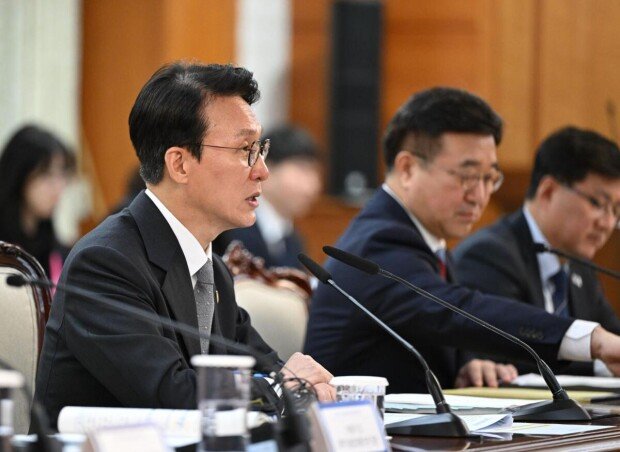
The government’s Ministerial Meeting on Science and Technology, which oversees science, technology, and artificial intelligence policy, was revived for the first time in four years. At its inaugural session on Nov. 24, officials discussed strategies to secure scientific talent, promote science-technology-AI integration, and innovate the STEM ecosystem.
The meeting was held at the Government Complex Seoul and chaired by Prime Minister Kim Min-seok, who oversaw approval of the agenda. The ministerial meeting was first established in 2004 under the Roh Moo-hyun administration but was suspended in 2008 during the Lee Myung-bak administration. It was restored in 2018 under the Moon Jae-in administration as a prime minister-level body but had not met since 2021. Its resumption after four years effectively reactivates the government’s central control tower for science and technology policy.
Prime Minister Kim said, “AI is a new growth engine that will drive innovation in our economy, a powerful force for national transformation and a core element of sustainable development. This cannot be achieved by a single ministry alone. I expect this ministerial meeting to serve as a dynamic hub for that effort.”
The government approved a strategy for securing scientific talent. To establish the prestige of respected scientists, “national scientists” will receive annual support of 100 million won per person along with state honors. Young researchers within seven years of earning their doctoral degrees who show potential to become leading national scientists will also be designated “young national scientists” and receive support. The government plans to attract a total of 2,000 overseas talents by 2030, with 70 percent expected to be Korean scientists.
To foster a growth ecosystem for STEM fields, the government will expand national scholarships, research living allowances, and housing support to strengthen the economic foundation for young researchers. Exceptional incentives will be provided to the top 1 percent of researchers, and dual appointments across universities, research institutes, and private companies will be encouraged. A new program will support distinguished scholars, allowing them to continue research after retirement by selecting leading experts in each academic field.
The government also plans to develop AI foundation models in six key scientific fields to promote science-technology-AI convergence. The six fields are bio and earth sciences, mathematics, materials and chemistry, semiconductors and displays, and secondary batteries. The government will secure 8,000 dedicated graphics processing units, or GPUs, to support the initiative.
In addition, the government unveiled a plan to rapidly implement AI-based public services across consumer, health, and safety sectors under the “Top 10 AI Projects for Public Life.” The initiatives include using AI to compare and analyze agricultural product prices and to analyze social network data of at-risk youth to support public safety efforts.
박종민 blick@donga.com


![스쿼트 개수는 ‘하체 나이’ 지표… 연령별 기준 몇 개?[노화설계]](https://dimg.donga.com/c/138/175/90/1/wps/NEWS/IMAGE/2026/05/08/133884776.3.jpg)


 About Dong-A Ilbo