

OptiQ-Labs Develops Laser System for Ion-trap Quantum Computers.
OptiQ-Labs Develops Laser System for Ion-trap Quantum Computers.
Posted November. 13, 2025 15:30,
Updated November. 13, 2025 15:44
- OptiQ-Labs has developed a high-precision ECDL system for ion-trap quantum computers, achieving a laser linewidth of 100kHz and offering stabilization services tailored to installation environments.
- The company completed its MVP and internal testing in September, with plans for official launch in the second quarter of 2026 and ongoing collaborations with research institutes and universities.
- OptiQ-Labs ultimately aims to advance from laser systems to developing a complete ion-trap quantum computer system.
OptiQ-Labs is developing an External Cavity Diode Laser (ECDL) system for ion-trap quantum computers. Ion-trap is one method of operating a quantum computer, where specific atoms are ionized and then trapped for use as qubits. A high-precision laser system is used to manipulate and control these ions. This is the role of the laser system OptiQ-Labs is developing.
OptiQ-Labs completed the development and internal testing of its Minimum Viable Product (MVP) this past September. Following performance verification and optimization, the company plans an official launch in the second quarter of 2026. OptiQ-Labs highlights its laser system's linewidth and stabilization service as key advantages. The company has achieved a laser linewidth of 100kHz, similar to globally commercialized products, and also provides stabilization services tailored to the quantum computer's installation environment.
After commercializing the laser system, OptiQ-Labs aims to develop an ionization system and, eventually, a complete ion-trap quantum computer. We met with Jay Chung, CEO of OptiQ-Labs, to discuss the company and its laser system.
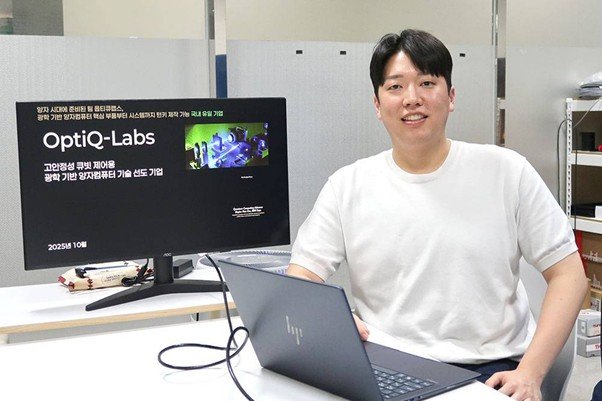
OptiQ-Labs: Providing Optical Solutions for Ion-Trap Quantum Computers
Please introduce yourself.
I am Jay Chung of OptiQ-Labs. I majored in Mechanical Engineering at Hanyang University and am currently in a doctoral program. I primarily researched numerical analysis-based digital twins. I met CTO Dong-wook Cheon, and while discussing our respective fields, we decided to found a startup ourselves. That led to the establishment of OptiQ-Labs this past February.
What motivated you to found OptiQ-Labs?
I had been thinking about starting a company for some time and had taken several entrepreneurship classes. Then I met CTO Dong-wook Cheon. He holds a Ph.D. in Atomic Energy Engineering from The University of Tokyo and has researched ion traps and optics for about 13 years. He also worked at the Japan Atomic Energy Agency (JAEA). When CTO Cheon was planning to return to Korea from Japan, he found no domestic companies specializing in ion-trap quantum computer hardware. Despite the growing interest in quantum computers, the situation was that we were reliant on imports for ion-trap-related hardware. So, we decided to establish a company in the ion-trap quantum computer field ourselves.
What is an ion trap?
An ion trap is one method for operating a quantum computer. Quantum computing is a technology that processes information using the principles of quantum mechanics, handling calculations with qubits. Qubits can be generated in various ways, such as superconductors, semiconductors, or neutral atoms, and ion-trap is one of them. The ion-trap method involves ionizing specific atoms, trapping them, and using them as qubits. Ion-trap quantum computers show strength in memory and quantum networking fields due to their high stability and scalability.
Please tell us about OptiQ-Labs.
OptiQ-Labs is a company that provides optical solutions for ion-trap quantum computers. Based on our proprietary optical technology, we are developing a special-purpose ECDL system, a core component of ion-trap quantum computers. The name "OptiQ-Labs" combines "Optic" from 'Optical' and 'Q' from 'Quantum'.
A High-Stability, Low-Linewidth ECDL System
Please explain the ECDL system OptiQ-Labs is developing.
Jeong: The laser system used in ion-trap quantum computers must be more stable and precise than those for general industrial use. This is because it needs to control individual ions. Consequently, there are not many companies worldwide that develop laser systems specifically for ion-trap quantum computers.
We possess the technology for ion traps and laser systems. CTO Cheon accumulated related technology and know-how at his previous research institute. Based on this, we are developing an ECDL system suitable for ion-trap quantum computers.
Our ECDL system has two main features. The first is linewidth. Laser systems for ion-trap quantum computers are divided into Littrow-type and Cat's eye-type. The Cat's eye-type is more stable and supports a lower linewidth, but it is more difficult to implement. It requires precise, sophisticated technology and technical know-how. That's why few places in the world develop Cat's eye-type laser systems. We are using the Cat's eye-type and have reduced the linewidth to 100kHz. This is a level similar to laser systems currently offered by global companies.
The second feature is the stabilization service. Existing laser system companies often just deliver the product. The purchasing company must perform the setup and stabilization for their quantum computer themselves. We provide an all-in-one solution that includes stabilization tailored to the quantum computer environment.
What is the development progress so far?
We completed the MVP development and internal testing in September and plan to conduct performance tests at the Korea Research Institute of Standards and Science (KRISS) in November. We aim to finalize testing within this year and begin sales by the second quarter of 2026. We are currently in discussions with research institutes involved in ion-trap quantum computing.
We are also participating in startup support programs such as the Ministry of SMEs and Startups (MSS) Preliminary Startup Package, the Incheon Creative Economy Innovation Center (Incheon CCEI) Pathfinder program, and the Korea Technology Finance Corporation (KIBO) Venture Camp. Additionally, we are involved in quantum-specific support programs like the Seoul Quantum Campus and the Quantum Computing Quantum Transformation Project.
Furthermore, we have signed an MOU with the University of London and are in discussions for an MOU with The University of Tokyo. Through these, we plan to verify the performance of our ECDL system and conduct joint research.
You are currently receiving support from the SeoulTech Preliminary Startup Package. What kind of support has that involved?
Thanks to the commercialization funding from the Preliminary Startup Package, we successfully developed our MVP and conducted internal tests. The educational programs, such as B2B corporate meetings, how to prepare IR materials, and B2B commercialization strategies for deep-tech companies, were also very helpful. We are currently in our seed investment round, and the program provided practical opportunities to meet with investors.
"We Will Develop Up to an Ion-Trap Quantum Computer System"
Finally, please tell us about OptiQ-Labs' future plans.
First, after commercializing the ECDL system, we aim to secure stable revenue by supplying it to university labs and government-funded research institutes domestically, and to leading quantum computing companies in the global market. We anticipate sufficient demand, especially from global companies, as they need to continuously add laser systems to increase their number of qubits.
Alongside this, we will continue technology development and advancement. We have currently reduced the laser linewidth to 100kHz, but we won't stop there. We aim to develop an ultra-precise laser system that lowers the linewidth even further while securing stability. While we are currently focused on laser systems for ion-trap quantum computers, our ultimate goal is to develop an ionization system using this technology, and eventually, the complete ion-trap quantum computer system itself.
By Man-hyuk Han (mh@itdonga.com)
- The company completed its MVP and internal testing in September, with plans for official launch in the second quarter of 2026 and ongoing collaborations with research institutes and universities.
- OptiQ-Labs ultimately aims to advance from laser systems to developing a complete ion-trap quantum computer system.
OptiQ-Labs is developing an External Cavity Diode Laser (ECDL) system for ion-trap quantum computers. Ion-trap is one method of operating a quantum computer, where specific atoms are ionized and then trapped for use as qubits. A high-precision laser system is used to manipulate and control these ions. This is the role of the laser system OptiQ-Labs is developing.
OptiQ-Labs completed the development and internal testing of its Minimum Viable Product (MVP) this past September. Following performance verification and optimization, the company plans an official launch in the second quarter of 2026. OptiQ-Labs highlights its laser system's linewidth and stabilization service as key advantages. The company has achieved a laser linewidth of 100kHz, similar to globally commercialized products, and also provides stabilization services tailored to the quantum computer's installation environment.
After commercializing the laser system, OptiQ-Labs aims to develop an ionization system and, eventually, a complete ion-trap quantum computer. We met with Jay Chung, CEO of OptiQ-Labs, to discuss the company and its laser system.
Jay Chung, CEO of OptiQ-Labs / source=IT dongA
OptiQ-Labs: Providing Optical Solutions for Ion-Trap Quantum Computers
Please introduce yourself.
I am Jay Chung of OptiQ-Labs. I majored in Mechanical Engineering at Hanyang University and am currently in a doctoral program. I primarily researched numerical analysis-based digital twins. I met CTO Dong-wook Cheon, and while discussing our respective fields, we decided to found a startup ourselves. That led to the establishment of OptiQ-Labs this past February.
What motivated you to found OptiQ-Labs?
I had been thinking about starting a company for some time and had taken several entrepreneurship classes. Then I met CTO Dong-wook Cheon. He holds a Ph.D. in Atomic Energy Engineering from The University of Tokyo and has researched ion traps and optics for about 13 years. He also worked at the Japan Atomic Energy Agency (JAEA). When CTO Cheon was planning to return to Korea from Japan, he found no domestic companies specializing in ion-trap quantum computer hardware. Despite the growing interest in quantum computers, the situation was that we were reliant on imports for ion-trap-related hardware. So, we decided to establish a company in the ion-trap quantum computer field ourselves.
What is an ion trap?
An ion trap is one method for operating a quantum computer. Quantum computing is a technology that processes information using the principles of quantum mechanics, handling calculations with qubits. Qubits can be generated in various ways, such as superconductors, semiconductors, or neutral atoms, and ion-trap is one of them. The ion-trap method involves ionizing specific atoms, trapping them, and using them as qubits. Ion-trap quantum computers show strength in memory and quantum networking fields due to their high stability and scalability.
Please tell us about OptiQ-Labs.
OptiQ-Labs is a company that provides optical solutions for ion-trap quantum computers. Based on our proprietary optical technology, we are developing a special-purpose ECDL system, a core component of ion-trap quantum computers. The name "OptiQ-Labs" combines "Optic" from 'Optical' and 'Q' from 'Quantum'.
A High-Stability, Low-Linewidth ECDL System
Please explain the ECDL system OptiQ-Labs is developing.
Jeong: The laser system used in ion-trap quantum computers must be more stable and precise than those for general industrial use. This is because it needs to control individual ions. Consequently, there are not many companies worldwide that develop laser systems specifically for ion-trap quantum computers.
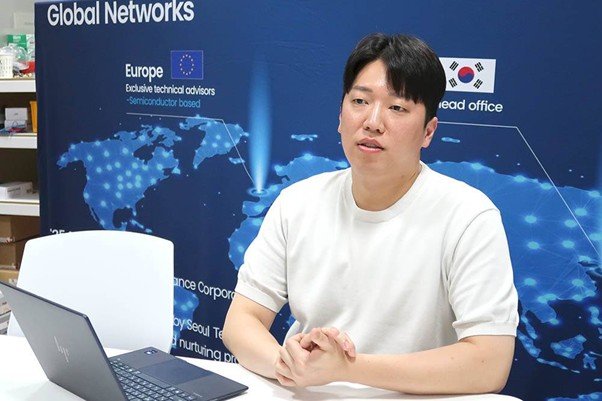
Chung explained OptiQ-Labs and ECDL system / source=IT dongA
We possess the technology for ion traps and laser systems. CTO Cheon accumulated related technology and know-how at his previous research institute. Based on this, we are developing an ECDL system suitable for ion-trap quantum computers.
Our ECDL system has two main features. The first is linewidth. Laser systems for ion-trap quantum computers are divided into Littrow-type and Cat's eye-type. The Cat's eye-type is more stable and supports a lower linewidth, but it is more difficult to implement. It requires precise, sophisticated technology and technical know-how. That's why few places in the world develop Cat's eye-type laser systems. We are using the Cat's eye-type and have reduced the linewidth to 100kHz. This is a level similar to laser systems currently offered by global companies.
The second feature is the stabilization service. Existing laser system companies often just deliver the product. The purchasing company must perform the setup and stabilization for their quantum computer themselves. We provide an all-in-one solution that includes stabilization tailored to the quantum computer environment.
What is the development progress so far?
We completed the MVP development and internal testing in September and plan to conduct performance tests at the Korea Research Institute of Standards and Science (KRISS) in November. We aim to finalize testing within this year and begin sales by the second quarter of 2026. We are currently in discussions with research institutes involved in ion-trap quantum computing.
We are also participating in startup support programs such as the Ministry of SMEs and Startups (MSS) Preliminary Startup Package, the Incheon Creative Economy Innovation Center (Incheon CCEI) Pathfinder program, and the Korea Technology Finance Corporation (KIBO) Venture Camp. Additionally, we are involved in quantum-specific support programs like the Seoul Quantum Campus and the Quantum Computing Quantum Transformation Project.
Furthermore, we have signed an MOU with the University of London and are in discussions for an MOU with The University of Tokyo. Through these, we plan to verify the performance of our ECDL system and conduct joint research.
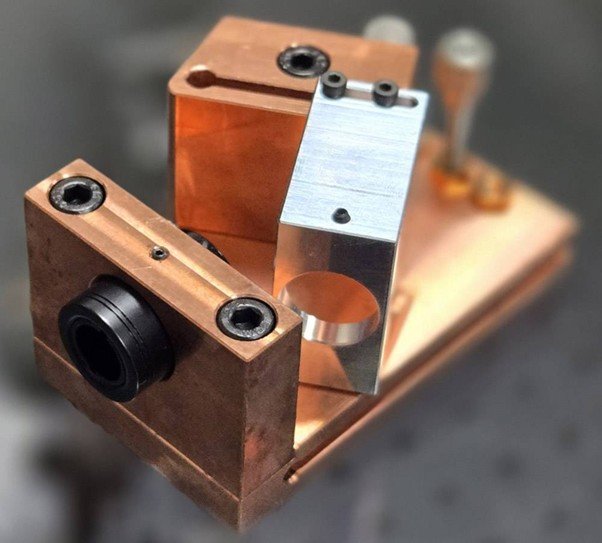
ECDL system MVP of OptiQ-Labs / source=OptiQ-Labs
You are currently receiving support from the SeoulTech Preliminary Startup Package. What kind of support has that involved?
Thanks to the commercialization funding from the Preliminary Startup Package, we successfully developed our MVP and conducted internal tests. The educational programs, such as B2B corporate meetings, how to prepare IR materials, and B2B commercialization strategies for deep-tech companies, were also very helpful. We are currently in our seed investment round, and the program provided practical opportunities to meet with investors.
"We Will Develop Up to an Ion-Trap Quantum Computer System"
Finally, please tell us about OptiQ-Labs' future plans.
First, after commercializing the ECDL system, we aim to secure stable revenue by supplying it to university labs and government-funded research institutes domestically, and to leading quantum computing companies in the global market. We anticipate sufficient demand, especially from global companies, as they need to continuously add laser systems to increase their number of qubits.
Alongside this, we will continue technology development and advancement. We have currently reduced the laser linewidth to 100kHz, but we won't stop there. We aim to develop an ultra-precise laser system that lowers the linewidth even further while securing stability. While we are currently focused on laser systems for ion-trap quantum computers, our ultimate goal is to develop an ionization system using this technology, and eventually, the complete ion-trap quantum computer system itself.
By Man-hyuk Han (mh@itdonga.com)



![“코 스프레이 2번 뿌렸더니 기억력 쑥”…치매 치료 가능성 [노화설계]](https://dimg.donga.com/c/138/175/90/1/wps/NEWS/IMAGE/2026/05/29/134018314.3.jpg)
![반도체로 부유해진 대만 경제의 그림자: 대만병과 거지 슈퍼맨 [딥다이브]](https://dimg.donga.com/c/138/175/90/1/wps/NEWS/IMAGE/2026/05/29/134015729.1.jpg)



 About Dong-A Ilbo