

China leads physical AI despite South Korea’s vision
China leads physical AI despite South Korea’s vision
Posted November. 10, 2025 08:36,
Updated November. 10, 2025 08:36
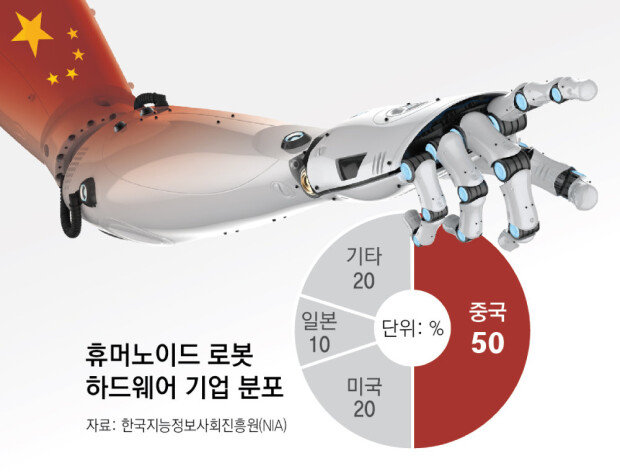
Although the government has outlined a vision to become a leader in “physical AI” alongside the three major global AI powers, analysts say China already holds a dominant position in the field. The country has rapidly expanded its ecosystem, securing an early advantage in hardware, a key component of the robotics value chain. Experts also note that China leads in talent acquisition, with 42% of global robotics students enrolled at Chinese universities.
● China dominates supply chain for 90 percent of robot components
According to a Nov. 9 report by the National Information Society Agency, titled "Current Status of the AI + Humanoid Robotics Industry Led by China," China is demonstrating a dominant position in the physical AI market, particularly in robotics. The country has strong capabilities in robot hardware and, following the introduction of DeepSeek earlier this year, has acquired AI technology that functions as the “brain” of robots, accelerating development.
China has localized 90% of the components used in robot hardware. According to Japanese consulting firm Nomura Research Institute, as of December last year, half of the companies developing humanoid robots, which resemble humans, were based in China. A South Korean expert explained, “Even if the same robot is manufactured in the U.S., the components would need to be sourced from China, which drives up costs. This is why China’s robotics ecosystem is expanding so rapidly.”
A vast amount of data also supports China’s robotics ecosystem. If AI serves as a robot’s “brain,” the data used to train it functions as valuable “textbooks.” Physical AI, in particular, requires real-world data tailored to the industrial environments in which it will be applied. Last year, China produced roughly 41 zettabytes of data, accounting for about 28% of the world’s total output. One Chinese robotics company backed by Tencent, Aegibot, established a “data collection factory” in Shanghai and deployed approximately 100 robots to gather up to 50,000 pieces of real-world data each day.
Industry observers note that as robotics becomes more widespread, training data will accumulate with the manufacturers. This could create a “rich-get-richer, poor-get-poorer” scenario between companies that secure data early and those that do not.
● China accounts for 42% of global university robotics students
China also dominates the talent pool. Last year, about 580,000 students were enrolled in robotics programs at Chinese universities, accounting for 42% of the global total.
In addition, China is pursuing the “Thousand Talents Plan” to attract highly skilled foreign professionals. Data obtained on Nov. 6 by Rep. Choi Su-jin of the People Power Party, a member of the National Assembly's Committee on Science and ICT, Broadcasting and Communications, and affiliated government-funded research institutes show that hundreds of researchers received emails related to the plan early last year. A survey of KAIST professors indicated that 149 faculty members received similar emails during the same period.
“Since the government is taking steps to foster physical AI, it is necessary to establish a governance framework overseeing talent development, large-scale investment, research and development, and regulatory improvements," a South Korean research institute official said. "Leveraging the country’s manufacturing strengths, it is essential to secure large volumes of data and carry out rapid testing and commercialization.”
최지원 기자 jwchoi@donga.com


![가장 흔한 ‘무릎 수술’, 하지마라?… 10년 추적 결과 “오히려 더 악화” [노화설계]](https://dimg.donga.com/c/138/175/90/1/wps/NEWS/IMAGE/2026/04/30/133840141.3.jpg)



 About Dong-A Ilbo