

South Korea-U.S. nuclear submarine deal may progress
South Korea-U.S. nuclear submarine deal may progress
Posted December. 26, 2025 09:04,
Updated December. 26, 2025 09:21
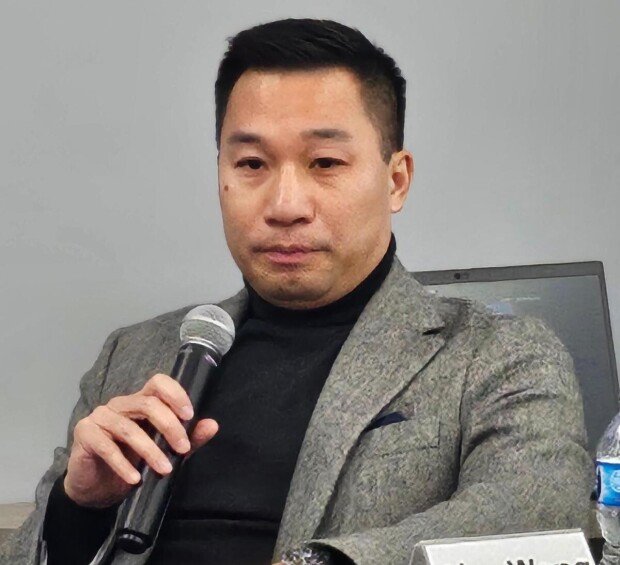
“A South Korea-U.S. agreement on nuclear-powered submarines will not exactly mirror the AUKUS model, but in many ways it will be simpler,” said Alex Wong, global chief strategy officer of Hanwha Group, in an interview with The Dong-A Ilbo. "Political direction and policy intent are aligned between South Korea and the United States, and their interests coincide.”
Under the AUKUS pact, Australia previously agreed to receive nuclear-powered submarines from the United States and later signed a separate deal allowing the transfer of military-grade nuclear material. South Korea recently reached a separate agreement with the United States to pursue nuclear-powered submarines. Wong said Seoul could advance more quickly than Canberra in key steps, including securing nuclear fuel supplies.
On the so-called parallel South Korea-U.S. submarine construction plan, Wong described it as “a fully viable approach,” adding, “Hanwha is ready to execute it if the South Korea-U.S. governments decide to proceed.”
Under the plan, South Korea’s nuclear-powered submarines would be built domestically, while U.S. nuclear-powered submarines would be constructed at facilities such as Hanwha Philly Shipyard using the MASGA fund, a South Korea-U.S. shipbuilding cooperation initiative.
Wong previously served as deputy national security adviser at the White House National Security Council during the early phase of Donald Trump’s second term, overseeing daily coordination of national security policy. During Trump’s first term, he was deputy special representative for North Korea policy at the U.S. State Department. He played a key role in North Korea-U.S. dialogue, including the 2019 leaders’ meeting at Panmunjom.
The interviews were conducted via video on Dec. 18 and in writing on Dec. 24, Eastern time.
Wong said, “The strongest binding force in international agreements comes when actions serve both sides’ interests. A nuclear submarine agreement benefits both South Korea and the United States.” He said South Korea could strengthen its military capabilities and enhance deterrence against potential aggression by acquiring nuclear-powered submarines. From the U.S. perspective, he emphasized that South Korea’s possession of nuclear submarines would strengthen allied capabilities and help maintain peace and prosperity in Northeast Asia.
Wong suggested that the Trump administration may have supported the move in part because South Korea’s nuclear submarines could help counter China’s naval power. The administration’s recently released National Security Strategy identified defending the First Island Chain and Taiwan from China as one of its core security objectives.
He said diplomatic consultations are ongoing between South Korea and U.S. authorities on detailed implementation measures to operationalize the nuclear submarine construction approved by President Trump, and he predicted the process would proceed more smoothly than in Australia’s case. Wong added that a key issue remains the nuclear fuel enrichment cycle, specifically how reactor fuel will be secured, and said the two governments are currently discussing possible implementation options.
Wong stressed that efforts to revive the U.S. shipbuilding industry are heavily influenced by security and strategic considerations. He said the United States has sought to maintain the world’s strongest navy for the past 70 years, and that sustaining and rebuilding the naval industrial base is tied to clear strategic and military interests. He added that the U.S. aims to preserve peace by strengthening key capabilities in coordination with allies such as South Korea and Japan. This suggests that South Korea-U.S. shipbuilding cooperation is directly linked to U.S. national security concerns, including strategic competition with China, beyond purely economic or industrial factors.
Wong said the Trump second administration placed high value on South Korea’s shipbuilding industry for its advanced manufacturing technology, adherence to schedules, and production efficiency. He noted that South Korean shipyards, including Hanwha, already participate in maintenance, repair, and overhaul work for U.S. Navy vessels. He predicted that future cooperation could include producing noncombat vessels, joint production, and, in the long term, even the construction of combat ships.
Regarding legal constraints under current U.S. law, including the Byrnes-Tollefson Act, which restricts the overseas construction of U.S. naval vessels, Wong said discussions are ongoing across the U.S. government, the national security community, and Congress on where to draw the line. He suggested there may be indirect ways to address the issue.
He also commented on President Trump’s Dec. 22 announcement of the “Golden Fleet” construction plan, in which Trump specifically mentioned that frigate production would be pursued in cooperation with Hanwha. Wong said Hanwha has the expertise and capabilities to build any force element required by the U.S. Navy under the Golden Fleet initiative.
Jin-Woo Shin niceshin@donga.com







 About Dong-A Ilbo