

Hwasong-20 ICBM revealed at North Korea parade
Hwasong-20 ICBM revealed at North Korea parade
Posted October. 13, 2025 07:36,
Updated October. 13, 2025 07:36
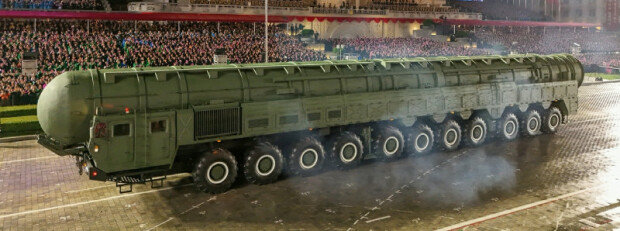
North Korea unveiled a new intercontinental ballistic missile, the Hwasong-20, on Oct. 10 during a midnight parade marking the 80th anniversary of the Workers’ Party. It was the first new ICBM shown publicly since the Hwasong-19 test launch last October. By displaying the missile at an event attended by senior Chinese and Russian officials, Pyongyang appeared to seek recognition as a nuclear power and to underscore a growing North Korea-China-Russia alignment targeting the United States.
North Korean state media, including the Korean Central News Agency and Rodong Sinmun, described the Hwasong-20 as the most powerful strategic nuclear weapons system. On the viewing platform at Kim Il Sung Square, Kim Jong Un stood with Chinese Premier Li Qiang on his right and Vietnamese Communist Party General Secretary To Lam and Russian Security Council Deputy Chairman Dmitry Medvedev on his left.
The Hwasong-20 appeared at the end of the parade, mounted on a transporter erector launcher. Its debut came about a month after Pyongyang revealed on Sept. 1 that it is developing a high-thrust solid-fuel engine for next-generation ICBMs. The missile is believed to be capable of carrying multiple warheads, more than the Hwasong-19. With its addition, North Korea now fields three types of solid-fuel ICBMs, the Hwasong-18, 19 and 20, all capable of rapid launch.
A South Korean military official said the Hwasong-20 is expected to undergo test firing soon. The Hwasong-18 was unveiled in February 2023 and launched five months later. On Sept. 9, Chinese President Xi Jinping sent a letter to Kim Jong Un, calling China and North Korea good comrades and pledging stronger strategic coordination on international and regional issues. Following a statement by Russia’s ruling party that appeared to recognize North Korea’s nuclear status, Xi’s message reaffirmed Beijing’s intent to deepen cooperation with Pyongyang.
Sang-Ho Yun ysh1005@donga.com





 About Dong-A Ilbo