

Musical ‘Dekabri’ explores conviction amid Russian rebellion
Musical ‘Dekabri’ explores conviction amid Russian rebellion
Posted September. 26, 2025 07:15,
Updated September. 26, 2025 07:15
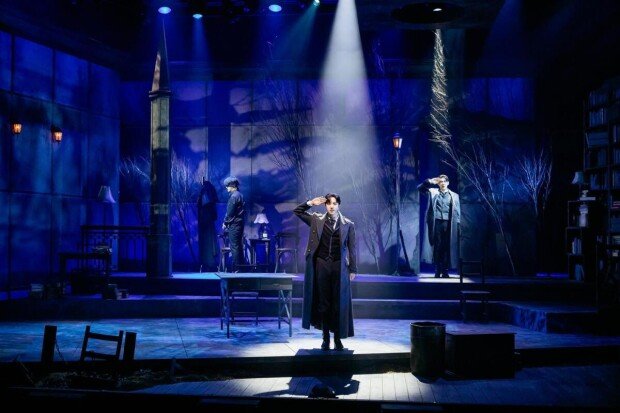
An era in which survival demands abandoning one’s convictions. Yet some cannot let go.
The world premiere of the original musical Dekabri, which opened Nov. 10 at NOL Seogyeong Square Scon 1 in Jongno, Seoul, is set shortly after the 1825 Decembrist Revolt, when young Russian officers called for the abolition of serfdom and the introduction of a constitutional monarchy. The production vividly evokes the dark, cold atmosphere of a Russia where constant surveillance was part of daily life.
The story centers on a triangular dynamic among three young men: Mikhail, Akaki, and Aleksei. Mikhail, a former writer turned Tsarist secret police officer, once believed literature could change the world. During the planning of the Decembrist Revolt, he even wrote a novel, The Stake, to enlighten the serfs. But after witnessing the uprising’s failure and the deaths of his comrades, he abandoned his convictions and served the Russian monarchy for more than a decade. One day, he unexpectedly rediscovers The Stake on the desk of his subordinate, Akaki.
Akaki, a former serf, is clumsy but resolute. He believes the novel must be widely circulated to awaken the oppressed. Mikhail tries to suppress the book as forbidden literature, but Akaki counters, saying, “This is not just ideological writing; it is literature that saves lives.” Through Akaki’s boldness, Mikhail confronts the enduring spark of his own convictions.
Aleksei admires Mikhail’s cold, analytical methods. Personally disdainful of serfs, he notices subtle changes in Mikhail after the rediscovery of The Stake and begins to follow him, driving tensions to a climax.
Dekabri’s strength lies in its nuanced portrayal of the three protagonists. Mikhail, who once abandoned his beliefs to survive, experiences a rekindling of his convictions; Akaki conceals his revolutionary identity while navigating daily life; and Aleksei’s only vulnerability is his loyalty to friendship. Their intersecting choices generate sustained tension throughout the story.
While the 19th-century Russian setting may feel unfamiliar, the universal theme of literature shining even under surveillance and oppression resonates. The story draws parallels to Korea under Japanese colonial rule, where armed resistance, efforts to effect change through education and writing, and quiet survival coexisted.
The stage design emphasizes restraint. Instead of relying on elaborate sets, lighting and carefully timed pauses evoke the “watchful gaze” of surveillance. Musical numbers performed by the protagonists, highlighting clashes of conviction, shift between lyricism and urgency. A four-member live band featuring keyboard, guitar, bass, and drums adds depth to the performance. Some numbers, however, may require repeated listening to fully register, making them moderately challenging. Dekabri runs through Nov. 30.
사지원기자 4g1@donga.com








 About Dong-A Ilbo