

VISION SPACE, “Digital Twin, a Game-Changing Technology in Industrial Automation”
VISION SPACE, “Digital Twin, a Game-Changing Technology in Industrial Automation”
Posted September. 25, 2025 14:10,
Updated September. 25, 2025 14:20
projections estimating the market to reach up to USD 259.32 billion
by 2032.
- VISION SPACE, a company founded by Won-seok Choi, develops digital twin
solutions for factories and industrial sites, partnering with major corporations
like Omron and Hyundai Movex.
- Their platform allows real-time monitoring and simulation for smart factories,
helping to optimize manufacturing workflows and enhance automation.
The digital twin is driving new waves of innovation in the global manufacturing market. Markets and Markets projects the digital twin market in manufacturing to reach USD 149.81 billion (approx. KRW 208 trillion) by 2030, while Fortune Business Insights forecasts USD 259.32 billion (approx. KRW 360 trillion) by 2032. Even by conservative estimates, the market will surpass KRW 200 trillion.
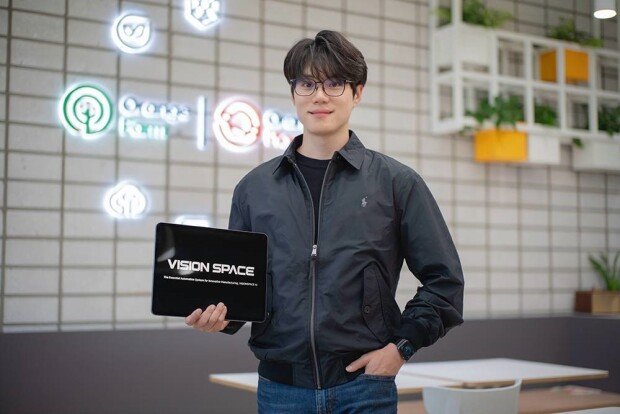
Won-seok Choi, CEO of VISION SPACE / Source=IT dongA
According to IMARC Group, Korea’s digital twin market reached USD 444.6 million (approx. KRW 619.9 billion) in 2023 and is expected to grow at an average annual rate of 23.56%, hitting USD 3.687 billion (approx. KRW 5.14 trillion) by 2033. Industry reports highlight the rise of Industry 4.0, integration of IoT and AI, and government-wide support for smart cities and factories as key growth drivers. The expansion of predictive analytics and optimization tools is also accelerating demand. As factories, once dominated by mechanical processes, undergo rapid digitalization, the digital twin market is surging.
Digitally Recreating Industrial Data in Real Time
A digital twin is a virtual replica of physical objects, systems, or processes. More than a simple 3D model, it incorporates real-world data and sensor input to mirror reality. In manufacturing, digital twins are widely used for real-time factory monitoring, city planning, and infrastructure management such as energy and utilities.
Though often associated with the metaverse, digital twin technology has been applied in industry for over 20 years. Michael Grieves, a product lifecycle management expert, first introduced the concept as the “information mirroring model” in 2002. NASA officially adopted the term “digital twin” in 2010 to monitor spacecraft and probes.
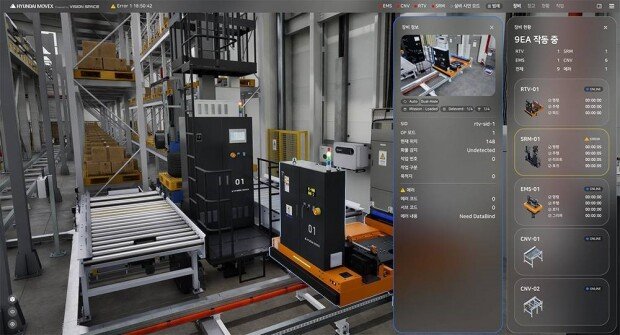
VISION SPACE’s integrated monitoring system TARS, powered by digital twin technology, mirrors the structure and operations of an actual factory / Source=VISION SPACE
The German government later adopted digital twins for smart factories as part of its Industry 4.0 initiative. From the mid-2010s, advances in industrial sensors and communication technology sped adoption, and more recently, deep learning and GPU advancements have enabled real-time replication of factories in virtual space.
From Car Designer to Innovator in Manufacturing
The global digital twin market is already crowded, with traditional players such as Siemens, Dassault Systèmes, Autodesk, and GE Digital, alongside big tech like Microsoft and AWS. Into this red ocean stepped VISION SPACE, founded by Choi.
Choi majored in industrial design and worked for over a decade as an automotive designer at a major Korean car manufacturer. While car designs constantly evolved, he felt manufacturing processes, logistics, and factory systems had stagnated. Seeking change, he founded VISION SPACE in September 2023.
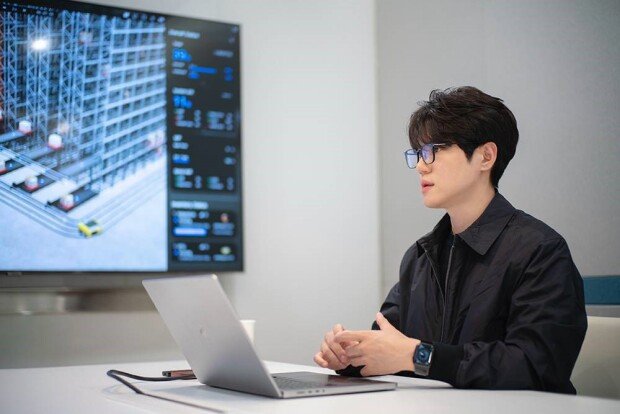
Choi founded VISION SPACE after recognizing opportunities to digitalize factories, logistics, and industrial operations / Source=IT dongA
“Even during my time at the automaker, I often visited factories on my days off out of sheer interest,” Choi recalled. “As a project manager, I studied not only research labs but also logistics centers, production lines, and distribution systems. I realized that analyzing logistics data, simulating layouts, and automating processes could spark real innovation. When NVIDIA launched Omniverse, I saw it as the breakthrough for realizing digital twins—and that’s when I decided to start the company.”
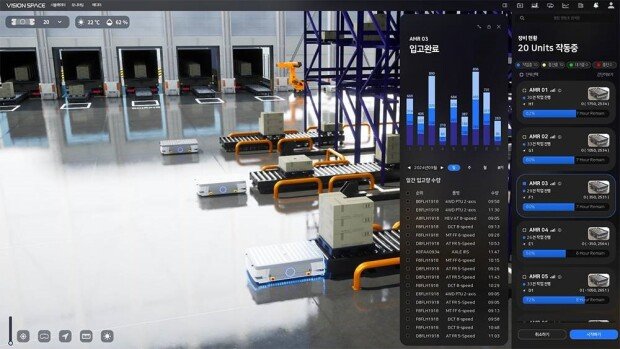
VISION SPACE’s 3D DES (Discrete Event Simulation) system, Tesseract / Source=VISION SPACE
VISION SPACE provides two core solutions: real-time monitoring and simulation for smart factories. Its platform allows automated factories and logistics centers to verify data in real time, adjust processes, and even redesign layouts. To build the necessary datasets, the company is partnering with Japan’s Omron, Hyundai Movex, and ReadN.
“Although we’re a startup, we are working with major corporations to collect industrial data,” Choi explained. “Our key partner Omron has provided us with testbeds and is helping expand adoption of our solutions. Hyundai Movex has applied our system to its logistics facilities and continues joint R&D with us.”
Choi actively promotes the service by attending domestic and international exhibitions in fields such as smart automation, logistics automation, AI solutions, IT, and startups. “Automation needs vary by sector,” he said. “This year alone, I attended 12 overseas exhibitions to gather insights and refine our services. Next year, we plan to co-exhibit with Hyundai Movex at Smart Factory + Automation World Korea and MODEX 2026 in Atlanta.”
Factory Automation and Data Management with AWS SaaS
VISION SPACE’s reach extends beyond smart factories and logistics. “Recently, a company asked us to create a digital twin of its 30-story headquarters,” Choi noted. “We’ve also applied digital twins to projects with LX Korea Land and Geospatial Informatix Corporation, as well as the new Dongjak District Office building. Beyond Hyundai Movex, we’ve carried out proof-of-concept projects with domestic food storage, vehicle body plants, and aviation logistics firms.”
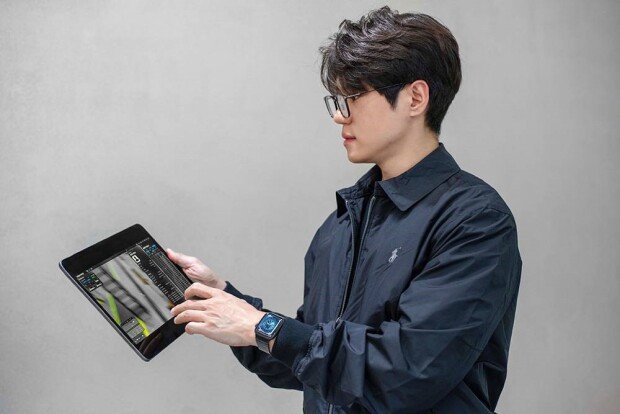
Managers can monitor factory operations remotely in real time using VISION SPACE solutions / Source=IT dongA
About 70% of users are managers. With automation data and coordinates logged in real time, they can oversee operations without being on-site—tracking what was moved, when, where, and for how long.
To ensure smooth processing of real-time data, VISION SPACE plans to offer its platform as SaaS on AWS. “Reflecting real-time factory data requires robust infrastructure,” Choi explained. “For example, Hyundai Movex robots generate input every 0.5 seconds. With hundreds or thousands of robots in operation simultaneously, AWS-level cloud services are indispensable.”
Enhancing Services Through AWS Global Collaboration
“We applied to the AWS Jungle program following a recommendation from AWS Japan,” Choi said. “Our project is to develop AI RAG (Retrieval-Augmented Generation)-based solutions for optimizing manufacturing workflows—in short, AI-driven simulations for automation. Although our development history is sh
ort, strong validation and use cases have earned us recognition.”
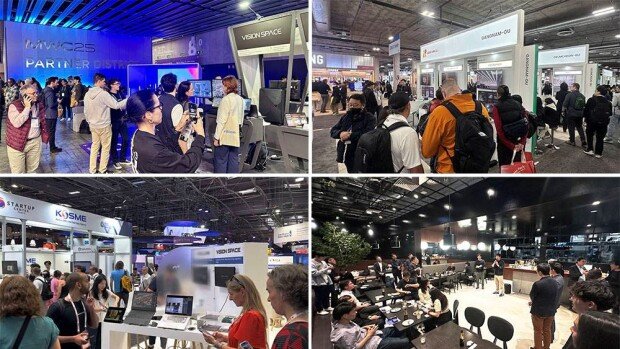
Clockwise from left: MWC 2025, CES 2025, Sushi Tech Tokyo 2025, VivaTech Paris 2025 / Source=VISION SPACE
“From backend developers to our CTO, we’ve received technical consulting from AWS,” he continued. “AWS recently entered the factory automation market and has shown strong interest in our solutions. They’ve connected us with Amazon Japan, Salesforce Japan, IMM, DG Daiwa, Honda Ventures, and others. AWS Korea also supports us with business, HR, and finance consulting. Meanwhile, our supervising partner, Seoul National University of Science and Technology, helps monitor expenditures and accounting and hosted a global collaboration training seminar in July.”
Overcoming Short Development Time, Expanding Collaborations
Despite progress, challenges remain in talent acquisition and technology. “For tech startups, attracting skilled engineers is the toughest part,” Choi admitted. “We place high priority on funding, infrastructure, and culture. We look for people who can embrace failure and adapt quickly. Every site and hardware environment is different, and deadlines are often tighter than expected. Overcoming such challenges defines VISION SPACE’s philosophy.”
He credited the company’s progress to the dedication of the five-member team, including CTO Kyung-tae Lee, senior researcher Sung-man Heo, and researcher Woo-young Lim.
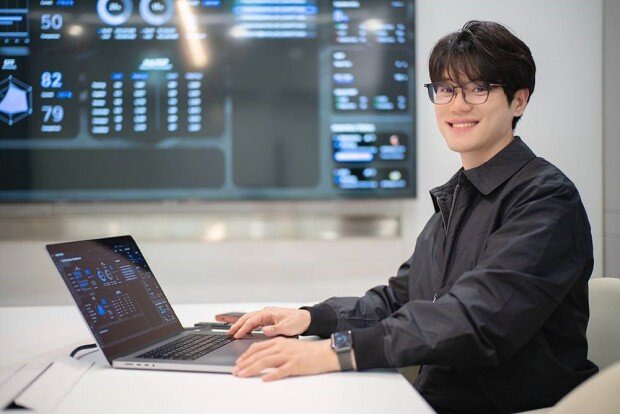
Choi aims to go beyond digital twins and lead the global robot operating system market / Source=IT dongA
Ultimately, VISION SPACE seeks to expand beyond digital twins to dominate the global robot operating system market. “By the end of this year, we plan to build over 200 robot protocol datasets and strengthen our capacity to respond to diverse scenarios,” Choi said. “The humanoid era is approaching, and companies with robust datasets will lead the field. Our ambition is to become the company that powers the operating systems of robots worldwide.”
By Si-hyeon Nam (sh@itdonga.com)
* This article was written with support from Seoul National University of Science and Technology.




![“달아서 피했는데”…수박, 식후 혈당 급등 때 혈관 보호 [건강팩트체크]](https://dimg.donga.com/c/138/175/90/1/wps/NEWS/IMAGE/2026/05/21/133969516.3.jpg)



 About Dong-A Ilbo