

Mudflat harvesting risks highlighted by officer death
Mudflat harvesting risks highlighted by officer death
Posted September. 17, 2025 07:42,
Updated September. 17, 2025 07:42
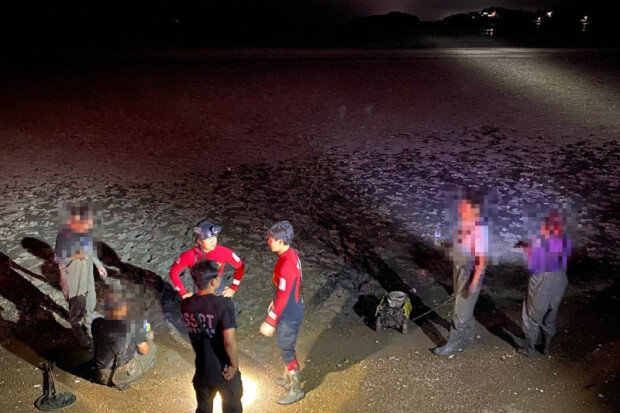
The death of Incheon Coast Guard officer Lee Jae-seok, 34, of the Yeongheung Substation, who was killed while attempting to rescue a Chinese man stranded on a mudflat, has renewed concerns about safety during mudflat harvesting. In the past five years, 38 people have died or gone missing after becoming trapped in mudflats.
Officer Lee responded alone in the early hours of Sept. 11 to rescue a 70-something Chinese man stranded while harvesting shellfish. The man had severely cut his foot on clam shells and could not move. Officer Lee put a life jacket on him and even removed his own gloves to cover the man’s foot before attempting an escape, but he was swept away by strong currents and died. At the time, the mudflat was at spring tide, when the difference between high and low water is greatest, and local authorities had advised against night-time harvesting.
Mudflat harvesting involves digging for or collecting seafood such as clams, octopus, and crabs. Many people do so at night, when clams and other seafood are more active. The danger rises when people enter without checking tide and current information. As the water rises, the mudflat’s terrain limits escape routes, and darkness makes it easy to lose direction. Yeongheung Island is a popular harvesting spot, and more than 200 people were reportedly on the mudflats the night before the accident.
Tidal currents can reach speeds of 7 to 15 kilometers per hour, comparable to the pace of a fast adult walk. If a person’s feet sink into the mud and movement slows, even a strong adult can quickly be swept away.
From 2021 through last month, there were a total of 288 mudflat entrapment incidents nationwide, 38 of which resulted in death or disappearance. There have been double-digit accidents each year, including 83 in 2021 and 67 in 2023. During the same period, the Coast Guard rescued 430 people.
The Coast Guard, in cooperation with local authorities including Incheon city, conducts preventive activities such as patrolling mudflats with drones and broadcasting warnings in hazardous areas. However, personnel and equipment remain insufficient compared with the growing number of visitors. Mudflats cover wide areas and often have limited visibility, making real-time monitoring difficult. In May, a revision to the Fisheries Resource Management Act was proposed in the National Assembly to allow local governments to restrict night-time harvesting, but it remains pending in committee.
In response to Officer Lee’s death, the Coast Guard placed three officials on administrative leave: the Incheon Coast Guard chief, the Yeongheung Substation chief, and the substation team leader, amid allegations of violating two-person team deployment rules and issuing instructions to withhold information about the incident.
Allegations also emerged that the Yeongheung Substation work log had been falsified. Four of Officer Lee’s colleagues held a press conference stating they had rested for six hours from 9 p.m. to 3 a.m., but the work log recorded six people taking three-hour shifts. Under substation operating rules, night-time rest periods are limited to three hours.
The Coast Guard has suspended the investigation team composed of six outside experts and is preparing a new, independent inquiry. This follows President Lee Jae-myung’s directive to have the case investigated rigorously by an external agency. A Coast Guard official said, “Once the direction is set, we will thoroughly uncover the facts.”
Meanwhile, some within the Coast Guard have criticized Officer Lee’s four colleagues who revealed the “withhold information” instructions during the press conference. The bereaved family requested restraint, stating, “The press conference had the approval of the Coast Guard chief.” Coast Guard Commissioner Kim Yong-jin resigned, taking responsibility for the incident.
인천=공승배기자 ksb@donga.com







 About Dong-A Ilbo