

Democratic Party demands resignation of Chief Justice Cho
Democratic Party demands resignation of Chief Justice Cho
Posted September. 16, 2025 07:47,
Updated September. 16, 2025 07:47
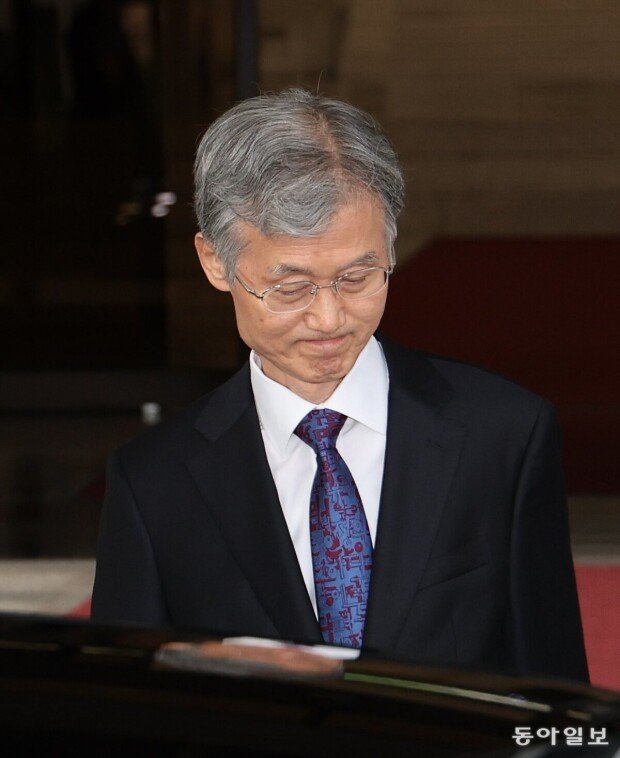
Amid growing calls from the Democratic Party for Chief Justice Cho Hee-dae to resign, this marks the first time that a resignation demand has come primarily from the ruling party rather than from within the judiciary. Within the courts, there is a sense of unease, with one official saying, “Until now, there had been an unspoken consensus that the principle of separation of powers should not be violated, but this time we are witnessing an unprecedented situation that ranks the subjects of the separation of powers,” referring to the recent developments.
In the past, there have been four notable “judicial upheavals” surrounding chief justices or external pressure, but all were largely internal efforts by the judiciary to resist yielding to the government or to demand self-correction. When Kim Myung-soo, appointed by former President Moon Jae-in, rejected the resignation of then-Busan High Court Chief Judge Im Seong-geun amid allegations of a “false explanation,” voices calling for the chief justice’s resignation arose mainly from within the judiciary. In April 2020, Kim was reported to have rejected Im’s resignation while being conscious of potential parliamentary impeachment discussions, leading to criticism that he was appeasing the ruling party. Although Kim denied having mentioned impeachment to Judge Im, related recordings were later released, fueling allegations of misleading explanations.
At the time, members of the judiciary protested, saying, “Is the chief justice trying to curry favor with the current government?” and “The chief justice is watching the ruling party’s moves,” effectively calling for his resignation on grounds of judicial independence. Politically, the People Power Party also demanded Kim’s resignation, but the criticism focused primarily on the appearance of “aligning with the ruling party.” Despite the pressure, Kim completed his full term.
Legal experts note that this is the first time the executive branch has publicly commented on the resignation of the head of the judiciary since judicial independence was codified in the Constitution. “Even under authoritarian regimes, the resignation of the chief justice was never openly discussed,” a judge at a regional court said. “There is a big difference between politicians chanting slogans and the presidential office issuing messages of support.”
A judge at the Seoul High Court questioned, “The judiciary is not an entity belonging to the government or the ruling party; it is independent under the separation of powers. Can they even ‘demand’ the resignation of its head? I am concerned that those in elected power are trying to place the judiciary under their control.”
In past cases where judicial upheaval arose from criticism of judges’ alignment with the government, two chief justices resigned. Kim Yong-chul, the ninth chief justice appointed by the Chun Doo-hwan administration, stepped down in 1988, and Kim Deok-ju, the 11th chief justice appointed by the Roh Tae-woo administration, resigned in 1993 before completing his term. Judges who participated in those judicial upheavals called for the chief justices to resign while advocating for the abolition of the Yushin Constitution.
최미송 기자 cms@donga.com







 About Dong-A Ilbo