

Kim Jong Un meets Xi, Putin as China-Russia ties deepen
Kim Jong Un meets Xi, Putin as China-Russia ties deepen
Posted September. 03, 2025 08:17,
Updated September. 03, 2025 08:17
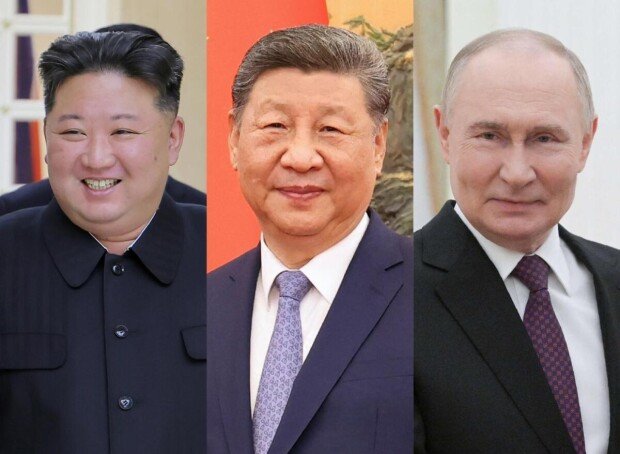
North Korean leader Kim Jong Un arrived in Beijing on Sept. 2 to attend China’s 80th Victory Day ceremony.
On the morning of Sept. 3, Kim is scheduled to stand alongside Chinese President Xi Jinping and Russian President Vladimir Putin at Tiananmen Gate in Beijing to observe a military parade. At a time when China is expanding its anti-U.S. coalition, the gathering of the three leaders signals a strengthening of their cooperative front against the United States, South Korea, and Japan.
South Korea’s National Intelligence Service said Kim may take an extraordinary step to showcase the solidarity among North Korea, China, and Russia.
Kim began his visit to China on the afternoon of Sept. 2 when he arrived in Beijing. He departed Pyongyang by special train the previous afternoon, crossed the North Korea-China border early on Sept. 2, and reached Beijing Railway Station around 4 p.m. local time. Accompanying him were Foreign Minister Choe Son Hui, Workers’ Party International Department Director Kim Song Nam, and Workers’ Party Deputy Department Director Hyon Song Wol. In his first appearance at a multilateral diplomatic event, Kim is expected to hold bilateral meetings with Xi and Putin during his stay.
Before Kim’s arrival, Xi and Putin held a bilateral meeting on Sept. 2 at the Great Hall of the People in Beijing, showcasing their solidarity. It was the first meeting between the two leaders in four months, since Xi traveled to Russia in May to attend the 80th Victory Day celebrations.
According to Russia’s state-run RIA Novosti, Putin said during the meeting, “The close communication between our two countries reflects the strategic nature of our relations, which are at an unprecedented level.” Xi responded, “China is ready to work with Russia to support each other’s development,” adding that “China-Russia ties have withstood the tests of the international situation and serve as a model.”
Before departing Pyongyang on Sept. 1, Kim visited a research institute linked to intercontinental ballistic missiles. According to the Korean Central News Agency on Sept. 2, he inspected the Chemical Materials Institute under the General Missile Bureau, where he reviewed the production of carbon fiber composites and high-thrust missile engines. The agency said, “The maximum thrust of the new solid-fuel engine using carbon fiber composites reaches 1,960 kilonewtons and is planned for use in the Hwasong-19 series of intercontinental ballistic missiles as well as the next-generation Hwasong-20.”
This disclosure indicated that North Korea is developing the Hwasong-20 as an upgrade of the Hwasong-19, which it test-launched in October last year. Kim’s moves, coming after his inspection of an automated missile production line on Aug. 31, seem intended to underscore his country’s status as a nuclear power on the eve of his visit to China.
Oh-Hyuk Kwon hyuk@donga.com


![가장 흔한 ‘무릎 수술’, 하지마라?… 10년 추적 결과 “오히려 더 악화” [노화설계]](https://dimg.donga.com/c/138/175/90/1/wps/NEWS/IMAGE/2026/04/30/133840141.3.jpg)
![[횡설수설/우경임]고1 男 173cm, 女 161cm… 미국만큼 큰 키](https://dimg.donga.com/c/138/175/90/1/wps/NEWS/IMAGE/2026/04/30/133845047.2.jpg)



 About Dong-A Ilbo