

South Korea, U.S. reach agreement on trade and alliance
South Korea, U.S. reach agreement on trade and alliance
Posted August. 27, 2025 08:14,
Updated August. 27, 2025 08:14
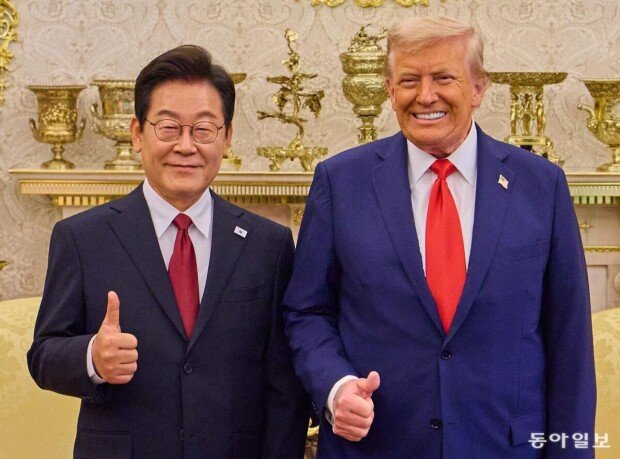
U.S. President Donald Trump said a deal with South Korea has been finalized and that the United States will move forward with the agreement accepted by South Korea. His remarks came as the Trump administration pressed for revisions to a tariff deal ahead of the South Korea-U.S. summit. Trump made clear he would maintain the framework of the agreement, which reduces reciprocal tariffs from 25 percent to 15 percent.
At a proclamation signing ceremony at the White House in Washington on Aug. 25, following his meeting with South Korean President Lee Jae-myung, Trump was asked whether the trade negotiations with South Korea had concluded. He replied, “I think we have finished the negotiations,” making the remarks.
On July 30, South Korea agreed to reduce the tariff rate from 25 percent to 15 percent in exchange for investing $350 billion in U.S. shipbuilding and related industries and purchasing $100 billion worth of liquefied natural gas and energy.
During an in-flight press briefing on Aug. 24 en route to Washington, D.C., President Lee said, “There is clearly a view in the United States that the outcome of the tariff negotiations with South Korea was not favorable to them, and calls are emerging to change the terms of the agreement.”
After the summit, Lee said in a special lecture hosted by the Center for Strategic and International Studies that “defense spending will be increased.” The second Trump administration has pressed allies from the outset to raise defense expenditures to around 5 percent of gross domestic product, similar to the North Atlantic Treaty Organization. Lee’s remarks were seen as a response to that demand.
National Security Adviser Wi Sung-lac said, “There was also some progress on the modernization of the alliance.” At their first summit, the two countries reached broad consensus on the key issues of tariffs and alliance modernization. However, detailed matters, including investment in the United States and the strategic flexibility of U.S. Forces Korea, were deferred to follow-up negotiations, where tough bargaining at the working level is expected.
Accordingly, South Korea and the United States are expected to continue follow-up negotiations on major trade and security issues, including increased direct investment in the United States and strategic flexibility.
U.S. Commerce Secretary Howard Lutnick said at the South Korea-U.S. Business Roundtable held after the summit, “I hope South Korea will further expand its investment in the United States, and that we will also increase access to the Korean market.”
Hoon-Sang Park tigermask@donga.com


![[단독]노태악, 선관위서 수당 4년간 1.8억 받아…3배 ‘셀프 증액’도](https://dimg.donga.com/c/138/175/90/1/wps/NEWS/IMAGE/2026/06/19/134144622.1.jpg)



 About Dong-A Ilbo