

Lee urges patience with North, trust with Japan
Lee urges patience with North, trust with Japan
Posted August. 16, 2025 08:01,
Updated August. 16, 2025 08:01
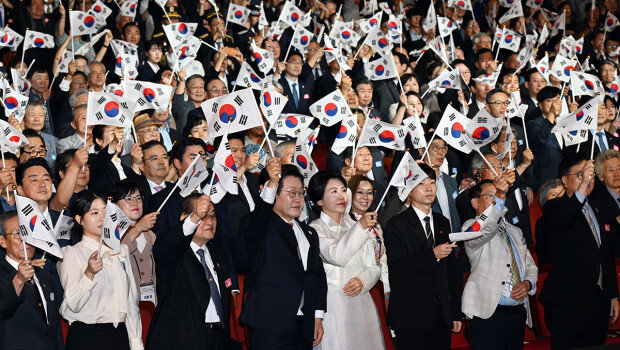
In his Liberation Day speech marking the 80th anniversary of Korea’s independence on Aug. 15, President Lee Jae-myung said South Korea must “move beyond outdated Cold War thinking and confrontation to open a new era of peace on the Korean Peninsula.” He vowed to respect North Korea’s system, ruling out any attempt at absorption-based unification or hostile acts, and announced plans to take proactive steps toward gradually restoring the Sept. 19 military agreement that the previous administration had scrapped. For Japan, he called it “a neighbor sharing the same yard and an important partner” and urged Tokyo to “face the painful history squarely and work to ensure bilateral trust is not undermined.”
Lee’s address outlined a foreign policy course built on patience toward North Korea and confidence toward Japan. He signaled a willingness to keep extending offers of dialogue to Pyongyang while prioritizing forward-looking cooperation with Tokyo. In the past, successive administrations have often swung sharply in their approaches to the two neighbors, narrowing distance with one while straining ties with the other. Lee’s remarks amounted to a declaration of his own brand of pragmatism, aiming to manage both relationships in a balanced way.
On North Korea, Lee revived two key principles long considered prerequisites for inter-Korean talks: respect for the North’s system and rejection of absorption-based unification. This marked a clear break from the previous administration, which promoted a doctrine of “advancing northward for freedom” that effectively endorsed absorption unification. Lee went further, pledging to maintain conciliatory measures such as halting leaflet launches and dismantling loudspeakers, as well as to restore the Sept. 19 military agreement. He said his administration would endure even ridicule as a “foolish dream” until the North responds.
For Japan, Lee reaffirmed a “two-track” approach, addressing historical issues on principle while strengthening cooperation for the future. He plans to make a brief stop in Japan next week before his first visit to the United States, a diplomatic move signaling flexibility. Japanese Prime Minister Shigeru Ishiba, in his address marking the anniversary of Japan’s defeat in World War II, mentioned “remorse” for the first time in 13 years, offering a measured response. Such small acts of trust, if accumulated, could help expand the foundation for mutually beneficial cooperation.
Balancing policy toward North Korea and Japan may be a strategic necessity for navigating the turbulent global order of a potential second Trump presidency. If U.S. President Donald Trump resumes direct dealings with Pyongyang, opening a channel for inter-Korean talks would be essential, while his transactional approach toward allies would make close coordination with Japan equally important. Even so, foreign policy has often drifted toward excess and bias, as seen under previous administrations, driven partly by partisan calculations that relied on support from divided domestic constituencies.
All government policies draw their strength from national unity, and foreign policy is no exception. Past failures stemmed from the divisions and conflicts fueled by accusations of being “pro-North” or “pro-Japan,” which led to one-sided policy implementation. The success of any policy—and of the government itself—depends on restoring genuine politics, meaning politics of integration. In his address, Lee said, “We must now break down the walls within us,” calling for an end to divisive politics and the creation of a politics of coexistence. That effort, of course, must begin with President Lee himself.




 About Dong-A Ilbo