

DEEPNOID, Preparing to Adopt FuriosaAI’s NPU: “Expectations for Optimizing Operational Costs and Service Applications”
DEEPNOID, Preparing to Adopt FuriosaAI’s NPU: “Expectations for Optimizing Operational Costs and Service Applications”
Posted August. 13, 2025 15:54,
Updated August. 14, 2025 16:14
- DEEPNOID plans to adopt FuriosaAI's NPU to optimize operational costs and
enhance their AI services, particularly for LLMs and vision recognition.
- They aim to expand their AI-based chest X-ray diagnostic support solution,
M4CXR, to various hospitals and international markets.
- By leveraging FuriosaAI's RNGD, DEEPNOID expects to improve performance and
energy efficiency while reducing operational costs.
When asked about the reasons for adopting FuriosaAI’s NPU, Tae-Gyu Kim, Executive Director of DEEPNOID, responded:
"FuriosaAI has the experience of mass-producing its first-generation chip for computer vision applications, so we trusted that they would be able to reliably supply the products. Additionally, we can utilize the second-generation semiconductor, RNGD (pronounced “renegade”), for processing large language models (LLMs) within our M4CXR AI functionalities. Starting next year, we plan to expand its use not only for LLM replacement but also for incorporating AI features like vision recognition, optimizing costs, and maximizing market potential."
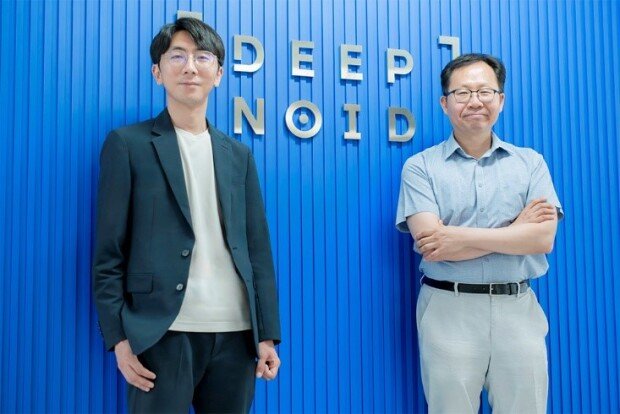
DEEPNOID, founded in 2008 as a software company, shifted its focus to developing deep learning technologies in 2015 and has since been recognized for its medical imaging expertise. In August 2021, the company was listed on the KOSDAQ under the technical special case.
As the company’s co-founder and CTO, Kim has been leading the business, and recently, he sees significant market potential in FuriosaAI’s Neural Processing Unit (NPU). He and Jihoon Hyun, Director of DEEPNOID’s AI Research Lab, discussed the background and implementation of the ‘AI Semiconductor Application Demonstration Support Project’ in detail.
M4CXR: AI Solution for Generating Chest X-ray Draft Reports
Kim provided an overview of DEEPNOID's solutions. He explained: "M4CXR is a solution that automatically generates draft reports for chest X-ray readings. We began deep learning research in 2015 and developed technologies for detecting brain aneurysms using magnetic resonance angiography (MRA) results, as well as detecting diseases such as colon, kidney, and stomach cancer through various pathological imaging."
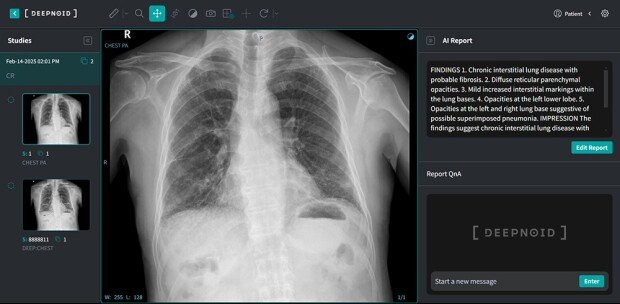
Building on this, DEEPNOID developed the AI-based chest X-ray diagnostic support solution, DEEP:CHEST, and has recently been upgrading it to M4CXR. They have also developed AI-based services like DEEP:NEURO for brain MRA and DEEP:LUNG for lung disease. Notably, DEEP:NEURO was selected as an innovative medical device and is eligible for insurance coverage. DEEPNOID has also created solutions such as Skymaru:Security, DEEP:Security, and DEEP:Factory for industrial X-rays.

When asked how DEEPNOID differentiates itself from similar companies in Korea and abroad, Kim responded: “The key technology is the use of generative AI to create draft reading reports. We’ve been publishing papers on generative AI for chest X-rays since 2023 and expect to receive product approval for it within this year. As a medical device company utilizing generative AI, we have unique and differentiated technological capabilities.” He added that while the solution is optimized for detecting lung diseases, it also assesses bronchial, heart, chest wall, bone, and other organs, highlighting DEEPNOID's comprehensive expertise.
Why Choose NPU Over GPU for Medical AI?
Though generative AI in healthcare may seem unfamiliar to the public, DEEPNOID has grown significantly, generating 10.8 billion KRW in revenue last year. As a result, the company is highly sensitive to AI inference cost as well as chip pricing.
Hyun explained: "From the user’s perspective, M4CXR analyzes chest X-rays and generates a draft report. The process involves encrypting and anonymizing X-ray data, which is then processed by our internal software. The AI model diagnoses most diseases visible in the X-ray and presents the results in a report format."
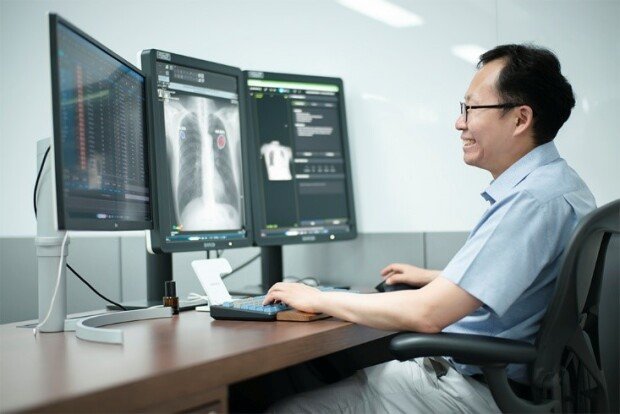
DEEPNOID currently uses NVIDIA’s A100 GPUs for computations but, with support from the National IT Industry Promotion Agency (NIPA) under the ‘AI Semiconductor Application Demonstration Support Project,’ they are transitioning to FuriosaAI’s RNGD. Hyun elaborated: "The project spans two years. This year’s phase, starting in May, will end in December, with the second phase following next year. We are replacing some M4CXR functionalities with FuriosaAI’s RNGD this year, and next year, we aim to integrate RNGD into the CT reading solution we’re developing."
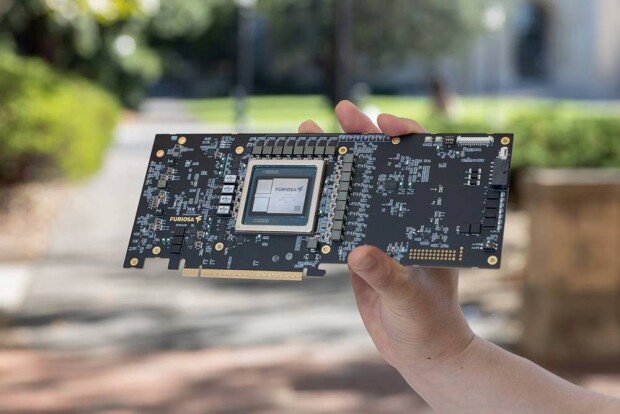
So, why is DEEPNOID considering FuriosaAI’s NPU? Hyun explained: “Despite in the early stages of the market, RNGD provide better performance and energy efficiency for LLM inference compared to existing GPU alternatives. The initial cost is similar or competitive with GPUs, and the operational costs are much lower. There are some on-going software optimization works though” He added, “We plan to test power consumption, latency, and accuracy with both A100 and FuriosaAI’s RNGD through rigorous trials to comprehensively assess the benefits.”
M4CXR Deployed in Large Hospitals and Gaining Attention Abroad
The goal of DEEPNOID’s AI Semiconductor Application Demonstration Support Project is to verify M4CXR in hospital settings. The demonstration hospitals selected are Seoul National University Hospital, Inha University Hospital, and Seoul Asan Medical Center. These hospitals will access the service via the cloud and generate use case examples. Kim said: "We aim to expand the number of demonstration sites during the project period. We’re also planning to introduce M4CXR to first-tier medical institutions and public healthcare institutions in countries like the Philippines, Vietnam, and the Middle East."
Progress is already visible. On June 17, DEEPNOID’s M4CXR was awarded the “Best Oral Presentation-Magna Cum Laude” at the European Society of Thoracic Imaging (ESTI) 2025, where a study on the performance of M4CXR’s generative AI-based chest X-ray draft report generation was evaluated. The study demonstrated a significant diagnostic accuracy rate of 85% and an average draft report generation speed of 3.4 seconds, proving its usefulness as a diagnostic support tool in clinical settings.
FuriosaAI’s RNGD will play a key role in generating the LLM-based draft reports for M4CXR. Hyun stated: "We expect to rely heavily on FuriosaAI as our key infrastructure partner. We feel comfortable with RNGD’s performance on LLMs, and we will begin additional replacement of GPUs with RNGD once FuriosaAI launches a RNGD variant even more optimized for vision recognition."
FuriosaAI Will Help with Global Expansion
The adoption of FuriosaAI’s NPUs by DEEPNOID will also assist with their overseas expansion. Hyun said: “Users don’t care whether the service is powered by NPU or GPU, but they just care about price and operational costs. If RNGD reduces operational costs, it will simply attract more users. We plan to present M4CXR at the Radiological Society of North America (RSNA 2025) in November and demonstrate how FuriosaAI’s RNGD powers LLM-based draft reports."
Kim commented: "The fact that the service is provided via the cloud is important. It allows us to quickly expand the service abroad, optimize operations, and speed up deployment. We plan to target North Africa from our Dubai office, and also Southeast Asia, starting with Vietnam and the Philippines, later expanding to Singapore and Malaysia."
FuriosaAI’s growing global recognition will also aid DEEPNOID’s expansion. FuriosaAI was recently selected for the KB Starters program in Singapore, where they will participate in programs supporting local institutional networks, investment infrastructure, and venture capital connections. On 18 of June, FuriosaAI promoted RNGD at the Super AI conference in Singapore, the Asia’s largest AI event held annually. FuriosaAI’s recognition will greatly help DEEPNOID’s expansion into the ASEAN market.
Environment for the Adoption of NPUs by Domestic and International AI Companies

For DEEPNOID, adopting NPUs is not just about cost savings, but also about promoting NPU adoption within Korea’s AI ecosystem. Hyun explained: "The AI industry is still in the early stages of NPU adoption. AI developers are accustomed to GPUs, so transitioning to NPUs involves effort and costs. However, since RNGD simply is a better solution than GPUs quantitatively, we need to actively experiment with it."
Kim also added: "We’ve been using GPUs since 2015, and what used to cost 1 million KRW now costs over 30 million KRW. Given NVIDIA’s monopoly, prices are likely to rise further in the long term. Whether domestic or foreign, NPU mass production needs to scale for it to gain market traction. We see that potential in FuriosaAI and believe they will play a crucial role."
By Si-hyun Nam (sh@itdonga.com)
enhance their AI services, particularly for LLMs and vision recognition.
- They aim to expand their AI-based chest X-ray diagnostic support solution,
M4CXR, to various hospitals and international markets.
- By leveraging FuriosaAI's RNGD, DEEPNOID expects to improve performance and
energy efficiency while reducing operational costs.
When asked about the reasons for adopting FuriosaAI’s NPU, Tae-Gyu Kim, Executive Director of DEEPNOID, responded:
"FuriosaAI has the experience of mass-producing its first-generation chip for computer vision applications, so we trusted that they would be able to reliably supply the products. Additionally, we can utilize the second-generation semiconductor, RNGD (pronounced “renegade”), for processing large language models (LLMs) within our M4CXR AI functionalities. Starting next year, we plan to expand its use not only for LLM replacement but also for incorporating AI features like vision recognition, optimizing costs, and maximizing market potential."
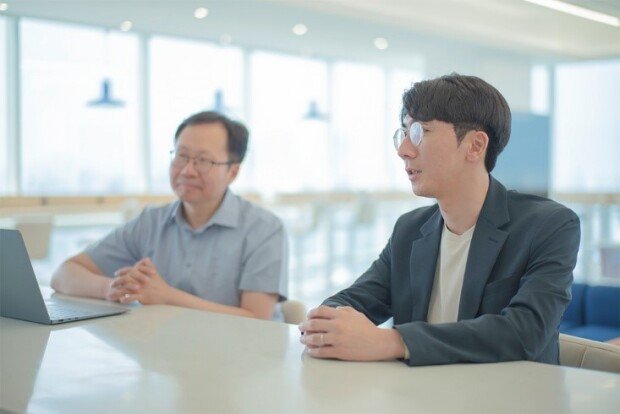
Ji-hoon Hyun, Director of DEEPNOID’s AI Research Lab(right), Tae-Gyu Kim, Executive Director of DEEPNOID(Left)
DEEPNOID, founded in 2008 as a software company, shifted its focus to developing deep learning technologies in 2015 and has since been recognized for its medical imaging expertise. In August 2021, the company was listed on the KOSDAQ under the technical special case.
As the company’s co-founder and CTO, Kim has been leading the business, and recently, he sees significant market potential in FuriosaAI’s Neural Processing Unit (NPU). He and Jihoon Hyun, Director of DEEPNOID’s AI Research Lab, discussed the background and implementation of the ‘AI Semiconductor Application Demonstration Support Project’ in detail.
M4CXR: AI Solution for Generating Chest X-ray Draft Reports
Kim provided an overview of DEEPNOID's solutions. He explained: "M4CXR is a solution that automatically generates draft reports for chest X-ray readings. We began deep learning research in 2015 and developed technologies for detecting brain aneurysms using magnetic resonance angiography (MRA) results, as well as detecting diseases such as colon, kidney, and stomach cancer through various pathological imaging."
DEEPNOID's chest data analysis and expanded opinion generation AI, 'M4CXR'
Building on this, DEEPNOID developed the AI-based chest X-ray diagnostic support solution, DEEP:CHEST, and has recently been upgrading it to M4CXR. They have also developed AI-based services like DEEP:NEURO for brain MRA and DEEP:LUNG for lung disease. Notably, DEEP:NEURO was selected as an innovative medical device and is eligible for insurance coverage. DEEPNOID has also created solutions such as Skymaru:Security, DEEP:Security, and DEEP:Factory for industrial X-rays.
DEEPNOID utilizes GPU for AI service computation processing
When asked how DEEPNOID differentiates itself from similar companies in Korea and abroad, Kim responded: “The key technology is the use of generative AI to create draft reading reports. We’ve been publishing papers on generative AI for chest X-rays since 2023 and expect to receive product approval for it within this year. As a medical device company utilizing generative AI, we have unique and differentiated technological capabilities.” He added that while the solution is optimized for detecting lung diseases, it also assesses bronchial, heart, chest wall, bone, and other organs, highlighting DEEPNOID's comprehensive expertise.
Why Choose NPU Over GPU for Medical AI?
Though generative AI in healthcare may seem unfamiliar to the public, DEEPNOID has grown significantly, generating 10.8 billion KRW in revenue last year. As a result, the company is highly sensitive to AI inference cost as well as chip pricing.
Hyun explained: "From the user’s perspective, M4CXR analyzes chest X-rays and generates a draft report. The process involves encrypting and anonymizing X-ray data, which is then processed by our internal software. The AI model diagnoses most diseases visible in the X-ray and presents the results in a report format."
Kim is demonstrating DEEPNOID's solution, the M4CXR
DEEPNOID currently uses NVIDIA’s A100 GPUs for computations but, with support from the National IT Industry Promotion Agency (NIPA) under the ‘AI Semiconductor Application Demonstration Support Project,’ they are transitioning to FuriosaAI’s RNGD. Hyun elaborated: "The project spans two years. This year’s phase, starting in May, will end in December, with the second phase following next year. We are replacing some M4CXR functionalities with FuriosaAI’s RNGD this year, and next year, we aim to integrate RNGD into the CT reading solution we’re developing."
FuriosaAI's second-generation NPU, RNGD (Renegade)
So, why is DEEPNOID considering FuriosaAI’s NPU? Hyun explained: “Despite in the early stages of the market, RNGD provide better performance and energy efficiency for LLM inference compared to existing GPU alternatives. The initial cost is similar or competitive with GPUs, and the operational costs are much lower. There are some on-going software optimization works though” He added, “We plan to test power consumption, latency, and accuracy with both A100 and FuriosaAI’s RNGD through rigorous trials to comprehensively assess the benefits.”
M4CXR Deployed in Large Hospitals and Gaining Attention Abroad
The goal of DEEPNOID’s AI Semiconductor Application Demonstration Support Project is to verify M4CXR in hospital settings. The demonstration hospitals selected are Seoul National University Hospital, Inha University Hospital, and Seoul Asan Medical Center. These hospitals will access the service via the cloud and generate use case examples. Kim said: "We aim to expand the number of demonstration sites during the project period. We’re also planning to introduce M4CXR to first-tier medical institutions and public healthcare institutions in countries like the Philippines, Vietnam, and the Middle East."
Users don't care whether a service is GPU- or NPU-based. What matters is the operating cost
Progress is already visible. On June 17, DEEPNOID’s M4CXR was awarded the “Best Oral Presentation-Magna Cum Laude” at the European Society of Thoracic Imaging (ESTI) 2025, where a study on the performance of M4CXR’s generative AI-based chest X-ray draft report generation was evaluated. The study demonstrated a significant diagnostic accuracy rate of 85% and an average draft report generation speed of 3.4 seconds, proving its usefulness as a diagnostic support tool in clinical settings.
FuriosaAI’s RNGD will play a key role in generating the LLM-based draft reports for M4CXR. Hyun stated: "We expect to rely heavily on FuriosaAI as our key infrastructure partner. We feel comfortable with RNGD’s performance on LLMs, and we will begin additional replacement of GPUs with RNGD once FuriosaAI launches a RNGD variant even more optimized for vision recognition."
FuriosaAI Will Help with Global Expansion
The adoption of FuriosaAI’s NPUs by DEEPNOID will also assist with their overseas expansion. Hyun said: “Users don’t care whether the service is powered by NPU or GPU, but they just care about price and operational costs. If RNGD reduces operational costs, it will simply attract more users. We plan to present M4CXR at the Radiological Society of North America (RSNA 2025) in November and demonstrate how FuriosaAI’s RNGD powers LLM-based draft reports."
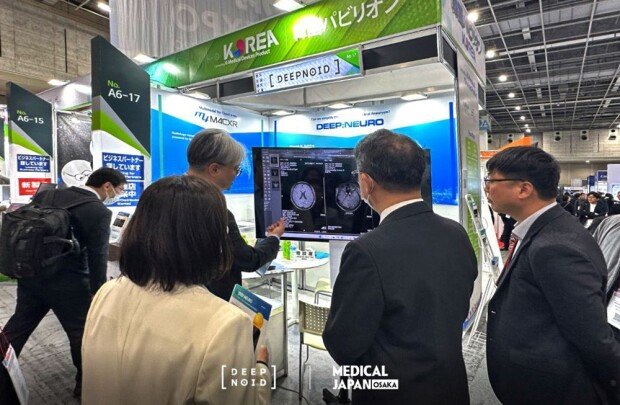
DEEPNOID introduced its Deep Neuro and M4CXR technologies to the Japanese market at Medical Japan Osaka 2025
Kim commented: "The fact that the service is provided via the cloud is important. It allows us to quickly expand the service abroad, optimize operations, and speed up deployment. We plan to target North Africa from our Dubai office, and also Southeast Asia, starting with Vietnam and the Philippines, later expanding to Singapore and Malaysia."
FuriosaAI’s growing global recognition will also aid DEEPNOID’s expansion. FuriosaAI was recently selected for the KB Starters program in Singapore, where they will participate in programs supporting local institutional networks, investment infrastructure, and venture capital connections. On 18 of June, FuriosaAI promoted RNGD at the Super AI conference in Singapore, the Asia’s largest AI event held annually. FuriosaAI’s recognition will greatly help DEEPNOID’s expansion into the ASEAN market.
Environment for the Adoption of NPUs by Domestic and International AI Companies
Kim hopes that DEEPNOID's NPU adoption case will serve as a catalyst for the domestic AI ecosystem
For DEEPNOID, adopting NPUs is not just about cost savings, but also about promoting NPU adoption within Korea’s AI ecosystem. Hyun explained: "The AI industry is still in the early stages of NPU adoption. AI developers are accustomed to GPUs, so transitioning to NPUs involves effort and costs. However, since RNGD simply is a better solution than GPUs quantitatively, we need to actively experiment with it."
Kim also added: "We’ve been using GPUs since 2015, and what used to cost 1 million KRW now costs over 30 million KRW. Given NVIDIA’s monopoly, prices are likely to rise further in the long term. Whether domestic or foreign, NPU mass production needs to scale for it to gain market traction. We see that potential in FuriosaAI and believe they will play a crucial role."
By Si-hyun Nam (sh@itdonga.com)








 About Dong-A Ilbo