

Bronze helmet returns as Sohn’s ‘second gold medal’
Bronze helmet returns as Sohn’s ‘second gold medal’
Posted July. 25, 2025 07:23,
Updated July. 25, 2025 07:23
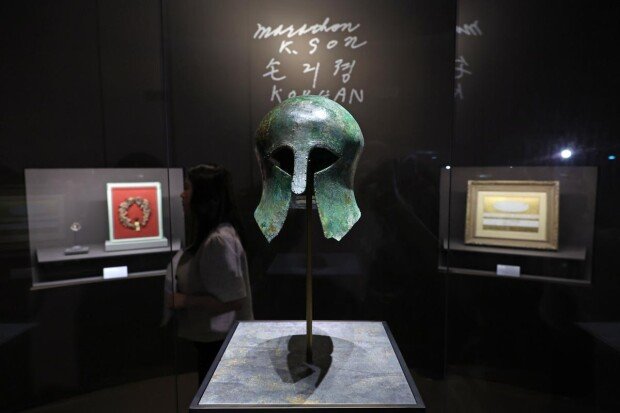
Sohn Kee-chung, South Korea’s legendary marathon gold medalist at the 1936 Berlin Olympics, received what he called his “second gold medal” 50 years after his historic win, a sixth-century BCE Greek bronze helmet.
Presented at a commemorative event in Berlin in 1986, the helmet had originally been prepared by a Greek newspaper as a special prize for the Olympic marathon champion. However, due to colonial-era complications, it was never delivered to Sohn, who had been forced to compete under the Japanese flag.
“It feels like I’m receiving a gold medal twice, once back then, and again with this bronze helmet today,” Sohn said at the time.
The bronze helmet, crafted in ancient Corinth as an offering to the gods during the Olympic festivals, is notable for its elegant curves and bluish-green patina. It is now recognized as a national treasure of South Korea.
Sohn finally received the helmet thanks to the efforts of Noh Soo-woong, a Korean resident in Germany who read about it in a 1976 Dong-A Ilbo article. Noh located the artifact in a Berlin museum, initiating a years-long effort to have it returned.
The helmet will now be displayed as part of the National Museum of Korea’s special exhibition, "Conquering the World on Two Feet," opening Friday. Marking the 80th anniversary of Korea’s liberation from Japanese rule, the exhibition features 18 artifacts from the Sohn Kee-chung Memorial Hall collection. Highlights include Sohn’s original Berlin Olympic gold medal, laurel wreath, and a New York Times article celebrating his victory.
“This is the first time since the 2011 Daegu World Athletics Championships that Sohn’s medal, wreath, and winner’s certificate are being displayed together,” a museum official said.
One newly revealed item is a postcard Sohn signed for a foreigner on August 15, 1936—exactly nine years before Korea’s liberation. He signed it in Korean as “Korean 손긔졍 (Sohn Kee-chung).” The postcard was acquired at a European auction in the 1970s by Heo Jin-do, a collector of Olympic memorabilia.
“According to Sohn’s autobiography, he often signed in Korean for foreigners to let the world know he was Korean, not Japanese,” said curator Kwon Hye-eun.
The exhibition traces Sohn’s journey from running under the Japanese flag with his homeland in his heart, to coaching Suh Yun-bok, who set a world record at the 1947 Boston Marathon while representing an independent Korea. That moment, when Sohn stood proudly with the Korean flag, is also recreated in an AI-powered video featured in the exhibition.
이지윤 기자 leemail@donga.com

![“카페 화장실서 대변 금지” 자영업의 이상과 현실[2030세상/박찬용]](https://dimg.donga.com/c/138/175/90/1/wps/NEWS/IMAGE/2026/05/17/133940152.1.jpg)




 About Dong-A Ilbo