

Why ‘Space & Bean’ believes that 'commercial parts' are the key to the future of the universe.
Why ‘Space & Bean’ believes that 'commercial parts' are the key to the future of the universe.
Posted June. 27, 2025 10:18,
Updated June. 27, 2025 10:30
- Space & Bean uses materials like polyimide, polyethylene, and aluminum to create effective shielding solutions that meet the stringent requirements of space missions.
- This technology aims to reduce costs and improve performance in the New Space era, where private companies are increasingly exploring space.
It has been nearly 13 years since NASA's fourth Mars rover, ‘Curiosity’, began its mission. Curiosity was launched from Earth on November 26, 2011, and landed on the surface of Mars in August 2012. It is still operational, far exceeding its original 2-year mission duration. While it is an exploration vehicle that embodies the pinnacle of technologies, its computing specifications are remarkably low when compared to those of modern smartphones.
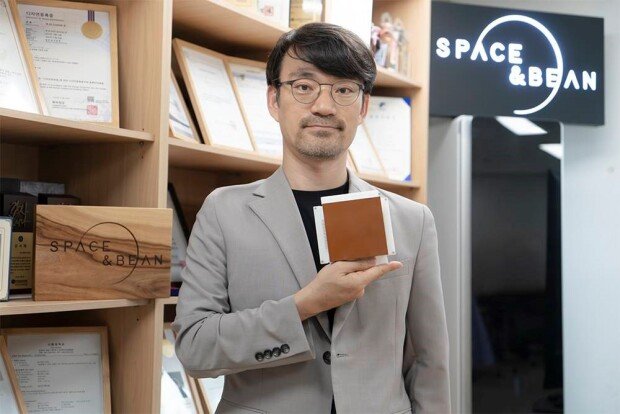
Yang-chan Cho, CTO of Space & Bean, is introducing a sample of the space radiation shielding solution 'Scutum R' / source=IT Dong-a
The RAD750 32-bit processor from BAE Systems, which is onboard the Curiosity rover, features a core clock speed of 200 MHz, 1 MB of L2 cache, and 256 MB of memory. It is manufactured using a process technology in the range of 150 to 250 nanometers. In comparison to the latest smartphones, its performance is only a fraction—about one-tenth to one-hundredth—of theirs. The Mars rover, ‘Perseverance’, which began its mission in 2021, has a performance level that is only about one-twentieth that of an Apple iPhone. Despite this, the reason for utilizing these outdated semiconductors lies in their exceptional resistance to high-energy radiation, a significantly wider operating temperature range, and very low power consumption. In other words, reliability, which allows for stable operation over more than a decade, is far more important than raw performance.
Attempts to utilize COTS instead of expensive space parts
Satellites and probes that will operate for decades to come will continue to be equipped with these processors. However, with the advent of the 'New Space' era, in which private companies are exploring space, there is a growing trend to utilize COTS(Commercial Off The Shelf) products instead of expensive, low-performance space parts. COTS refers to commercially available, standardized industrial products that can be mass-produced. All industrial products we commonly use, such as chipsets in smartphones and CPUs for computers, fall under the category of COTS.
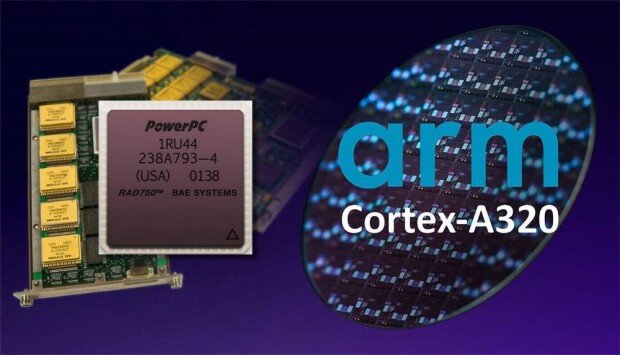
The price of the RAD750 is approximately $350,000 (as of 2024). In contrast, the Arm Cortex-A320, designed for autonomous navigation and the IoTs, costs only a few tens of dollars. / source=IT Dong-a
COTS is hundreds to thousands of times cheaper than space parts and meets the requirements for high performance, short development cycles, and cost ef
ficiency. However, all COTS are designed for mild environments without radiation resistance and magnetic shielding. Not to mention a decade, even short-term reliability has not been established. Nevertheless, if a comprehensive radiation shielding strategy is implemented, ultra-high efficiency and ultra-high performance can be anticipated. In the era of low-orbit satellites and commercial aerospace, the use of COTS presents a highly attractive option.
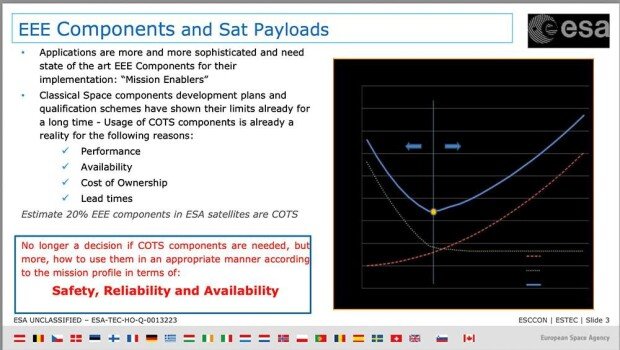
Approximately 20% of the electronic parts included in the European Space Agency satellite consist of COTS / source=European Space Agency
Straits Research has estimated the size of the radioactive shielding material market to be $1.5 billion in 2024, projecting an average annual growth rate of 6.6% through 2033. Fortune Business Insights also anticipates the shielding material market will reach $1.5 billion in 2024, with an average annual growth rate of 4.6% by 2032. While the market encompasses shielding materials for medical and industrial applications in addition to space radiation, all research institutions agree that the growth trend is robust.
COTS without shielding is useless
COTS is optimized for short development times, low material costs, affordable consumption, and repetitive tasks. Similar to SpaceX's Starlink, it is ideal for scenarios where the same space launch vehicle can be repeatedly launched or easily consumed. To achieve this, the design must be optimized using shielding materials. Typically, it is encased in polyethylene and aluminum composite materials that have a high hydrogen content. Additionally, optimal arrangement and design are determined by considering various types of COTS, their locations, and the thickness and density of the shielding materials. Furthermore, heat control of the housing, orbital environment analysis, and simulations based on all available data must be implemented.
However, as is the case in the aerospace field, the entire process is confidential. Companies that develop radiation shielding materials are unaware of which COTS they are shielding; they focus solely on meeting the radiation shielding performance requirements of their clients. Similarly, COTS manufacturers do not know whether their products are being used for space applications. Only the company that integrates the COTS into the space launch vehicle possesses all the relevant information. If it becomes known that a particular COTS has been utilized in the aerospace sector, COTS manufacturers will increase their unit prices, and competitors may launch the COTS into space without any research and development. In other words, the entire process of deploying COTS into space constitutes the core technology.
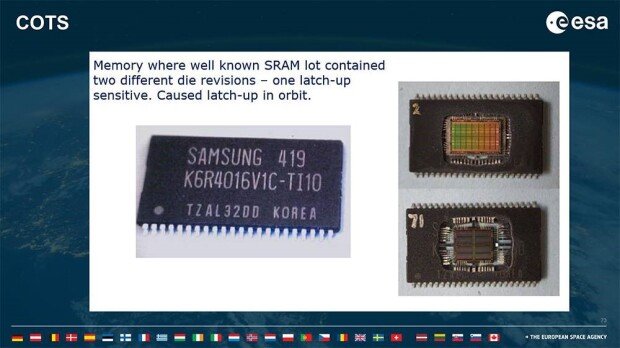
As a result of testing two Samsung Electronics S-RAMs with different production dates for use as COTS, one performed well while the other experienced a short circuit. Given the substantial budget allocated to the success and failure of the COTS and the entire testing process, security measures are necessarily stringent / source=ESTEC
In addition, most countries do not permit the export of radioactive shielding materials and related technologies, as they consider them to be major national assets. Materials and technologies that shield COTS products are also regulated in the same manner as spacecraft or rocket technology. In South Korea, Space & Bean is developing radiation shielding design technology. Space & Bean specializes in the Space Radiation Shielding Housing ‘SCUTUM R’ and ‘FRIDAY (Fast Radiation Impact Detection and Yield)’, a design process aimed at optimizing the COTS for space environments.
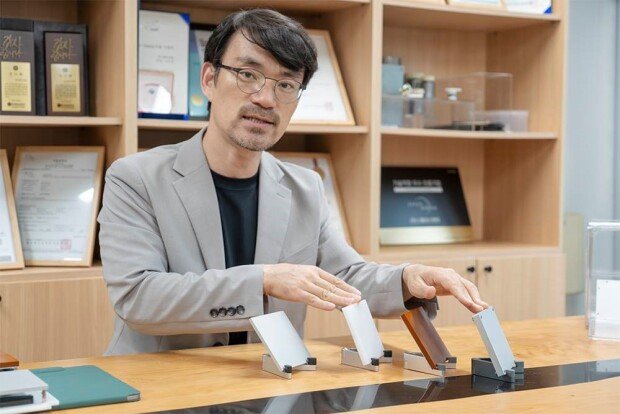
Currently, aluminum is widely used for shielding materials, and Space & Bean replaces it with specially processed polyimides and polyethylene / source=IT Dong-a
First of all, SCUTUM R is a shielding material based on polyimide and polyethylene plastics. Polyimide is a polymer material that exhibits excellent performance in terms of temperature, strength, and chemical resistance, but it lacks shielding capabilities on its own. Space & Bean combines polyimide, polyethylene, and aluminum, which are manufactured through a specific process, and optimizes the design with FRIDAY to ensure effective space radiation shielding against COTS.
From space analysis to system-tailored design and empirical validation
For example, let’s assume an aerospace company visits Space & Bean to launch a commercial semiconductor into space. Space & Bean does not know which semiconductors are being launched. It only adjusts the radiation shielding performance that the client requires. The first step is to analyze the orbital environment of the satellite mission based on data provided by NASA and the ESA(European Space Agency). The estimated radiation levels are considered in conjunction with the mission path. Then, based on the expected radiation values, the radiation irregularity of each material is analyzed, and calculations are made to determine which shielding material and thickness to use.
Once the material is confirmed, a shielding solution is derived, composite shielding materials are designed, and their performance is analyzed. Next, they begin the optimal housing design for COTS protection based on ECSS and NASA standards. Rather than simply applying a thick layer of shielding material to each COTS, the design incorporates features that can reduce secondary radiation, constructing it on both the outer and inner walls. Weight and structural optimization are essential, as the cost per kilogram for a space launch vehicle range from at least $1,500 to $10,000.
Once the housing is completed, the risks of space static electricity and sparks outside the satellite are analyzed in detail. Space static electricity differs from Earth's static electricity due to vacuum conditions, extreme temperature fluctuations, and space radiation. Furthermore, accurate risk assessment is essential, as it can lead to operational errors or damage to the spacecraft. Subsequently, the radiation impact on the internal components of the satellite is predicted with precision. Key data is gathered to determine whether effective radiation shielding is applied to the COTS loaded inside and to assess its effects on the internal parts. Finally, the launch impact, vibration, and temperature changes are simulated once more to ensure the system's viability under mechanical and thermal loads.
Once all processes are completed, the demonstration-based radiation shielding performance will be measured in accordance with the ESCC standard application process of the KAERI (Korea Atomic Energy Research Institute). The tests will be conducted at a low-dose proton beam facility with a 100 MeV output to assess the effects of space and natural radiation on electronic parts and biological systems. If the beam is fired at the COTS without shielding, irreversible errors will occur due to the protons. Space & Bean conducted the first tests of space materials in Korea using this accelerator and achieved results consistent with those from the FRIDAY analysis and the proton tests. COTS equipped with shielding material operated normally even when exposed to protons.
DTaQ begins the Material Impact Analysis and Development of a Guidebook According to Space Environment
The significance of Space & Bean's radiation shielding technology is substantial. South Korean companies such as Hanwha Aerospace, Satrec Initiative, KAI(Korea Aerospace Industries), and AP Satellites Inc are making strides in the space industry, while private space companies like Perigee Aerospace, Una Stellar, and Innospace are also advancing their space launch vehicle projects. If these domestic companies can fully leverage COTS instead of relying on expensive space radiation-grade parts, the pace of development in the Korean space industry could gain even greater momentum.
However, the Korean aerospace market is focused on launch vehicles and aviation, while the market for materials and components is still in its early stages. The KAA(Korea Aerospace Administration) prioritizes the localization of high value-added materials and components over radiation shielding materials. In February of 2025, the DTaQ(Defense Agency for Technology and Quality) announced the initiation of a project titled ‘Analysis of the Impact of Materials and Development of a Guidebook Based on the Space Environment’, aimed at establishing recommendations. Although there is still a long way to go compared to the ECSS, NASA, and the US Department of Defense standards, it is significant that a foundation for Korean aerospace has been established.
The material impact analysis and guidebook based on the space environment will serve as a standard for the national aerospace standards and certification system in the future. This will have a multifaceted impact on the entire industry, including ensuring the quality and reliability of space systems for technology sharing based on the guidebook, enhancing the capabilities of the Korean space industry, and addressing the demand for Korean satellites and satellite clusters.
In the ‘New Space’ era, the most important factor is ultimately cost. The traditional aerospace industry relied on government funding, which meant there was little concern about budget constraints. In contrast, the New Space era must be grounded in capital and profitability to survive. High-quality, highly reliable parts account for over 50% of satellite development costs, and simply replacing them with COTS can yield significant profits and performance improvements simultaneously. In the forthcoming New Space era, shielding solutions like Space & Bean will deliver results that are directly linked to corporate growth.
By Si-Hyun Nam (sh@itdonga.com)






 About Dong-A Ilbo