

Korean chicken chains renew China expansion drive
Korean chicken chains renew China expansion drive
Posted May. 21, 2025 07:21,
Updated May. 21, 2025 07:21
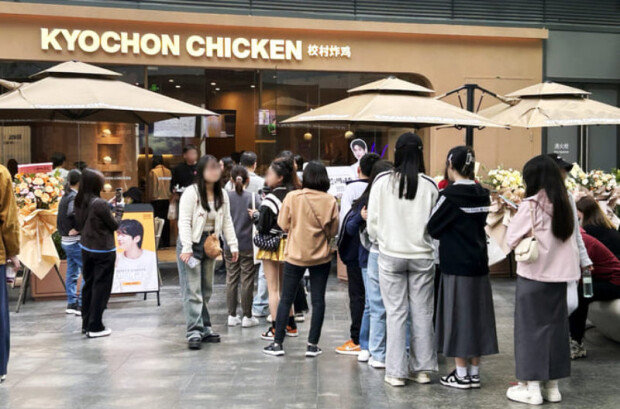
South Korean restaurant franchises, led by fried chicken brands, are ramping up efforts to reenter the Chinese market. These companies had scaled back operations amid China’s unofficial restrictions on Korean cultural exports—part of a broader “Korean Wave” clampdown—but are now returning as domestic growth slows, Chinese consumption policies turn favorable, and interest in Korean food rises again.
BBQ said May 20 it recently signed master franchise (MF) agreements with operators in eight Chinese regions, including Beijing, Qingdao, and Jinan. Under the MF model, local partners receive operating rights and raw materials in exchange for royalties. BBQ, which first entered China in 2003, once operated more than 400 stores there, but saw that number decline due to the cultural ban. The company now plans to open a directly managed store in Chengdu and expand to over 1,000 locations across China.
Kyochon Chicken is also resuming its China expansion. The company, which first entered the market in 2008, recently established a corporate entity in Shenzhen and opened a store in the Qianhai MixC shopping mall. It currently operates 18 stores in China and plans to expand from major cities such as Shanghai, Hangzhou, and Shenzhen to provincial capitals. A Kyochon representative said the brand aims to appeal to Chinese consumers with a distinctively Korean flavor profile built on 30 years of sauce expertise, including soy, red, and honey varieties.
BHC Group is weighing a move into the Chinese mainland, beginning with its presence in Hong Kong. The company opened its first Hong Kong store in 2018 and added a second last year. While BHC has no current outlets in mainland China, it said it is considering future expansion into Southeast Asia and the Chinese market.
CJ Foodville’s bakery chain, Tous Les Jours, entered China in 2005 with a store in Beijing and now operates about 200 franchised locations. The company grants local partners operational rights and partial ownership in exchange for royalties.
Franchise operators are encouraged by signs of easing in China’s unofficial ban on Korean content and growing demand for Korean food among younger Chinese consumers. Kang Jun-young, a professor at Hankuk University of Foreign Studies, said, “There is clear demand for K-food among young Chinese consumers, and the ‘chimaek’ [chicken and beer] culture is one of its most prominent themes.” He added that while the Korean Wave restrictions have not been fully lifted, Beijing’s hardline stance has softened since last year.
Stagnation in the domestic market is also prompting Korean companies to look abroad. According to the Bank of Korea, the nation’s Consumer Sentiment Index fell to 88.4 in December and remained below the neutral level of 100 through April. “With domestic growth stagnating, China is regaining attention due to its large market and geographic proximity,” said a franchise industry official.
China’s pro-consumption policies and rapidly growing food service sector, expanding more than 10% annually, are also attracting interest. At a key economic meeting in December, Beijing called for the expansion of “first-launch economy” initiatives to boost consumption. Under this policy, companies that debut new products or open new locations can receive subsidies and streamlined administrative procedures. Park Seung-chan, head of the China Management Research Institute, said, “As China promotes the first-launch economy, local firms are actively seeking licensing deals with Korean and other foreign franchise brands.”
김다연기자 damong@donga.com


![[단독]韓정부, 하메네이 장례식 불참…“이란측에서 난색 표해”](https://dimg.donga.com/c/138/175/90/1/wps/NEWS/IMAGE/2026/07/05/134237981.1.jpg)




 About Dong-A Ilbo