

Richard Ogles Smart World
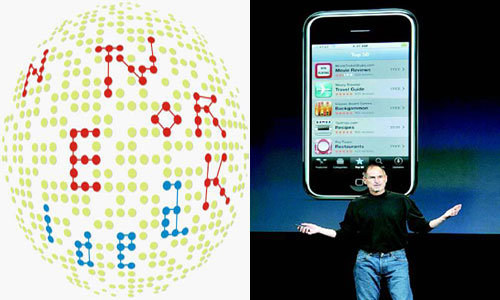
Intelligence stays out of human mind. Human thinking does not take place in brain.
It is the provocative statement from written by Richard Ogle. The author takes the example of technology. When cars were first rolled out, people had to mechanically deal with the ignition time, air release valve and brakes pressure. At present, however, when people control airplanes, much more complicated than cars, a computer control mechanism performs most of the thought processes of human brains. In short, thoughts are extended beyond the boundary of human minds.
Ogle explains that technology is a sort of idea space consisting of networks and claims that the source of creativity stays in that idea space located out of the human brain, not inside the brain. It is hard to swallow Ogles argument immediately. In order to understand the statement, we have to understand network science.
Links are relationships. A node means a network of relationships (The term node refers to a point of data communication network or a connection point of terminals). In human networks, people become nodes. A node that is connected with numerous links is the hub. In network science, the world where we live is explained with nodes, hubs and links.
The idea space can be a domain viewed from the perspective of intelligence or art. It is a world where science, institutions, myths, business models and culture are interwound. Ideas, which inspire creativity, move around nodes and hubs via links. This is the smart world.
Ogle says it is impossible to generate creative ideas only with outstanding minds, without considering the networks. On the other hand, the writer argues that creativity requires a capability to capture ideas, which interact while moving around nodes and hubs in the network space, with imagination, insight and intuition.
Consider the case of genius painter Pablo Picasso. In his early days, Picasso visited the Musée dEthnographie du Trocadéro in Paris where musical instruments and masks made in Africa and the South Pacific, which were refused to be exhibited in the Louvre, were displayed. Suddenly, he got it. That same day, he began thinking of "Les Demoiselles d`Avignon."
Picasso could get the insight into non-representational geometry, which abstractly describes the essence of the subject from African art. Since Picasso visited the museum, he could free himself from the Western art in which people should be described as accurately as possible, and create the masterpiece.
Ogle explains that Picassos breakthrough did not solely come from his gifted mind but he could achieve it since he intuitively understood the idea space of African art displayed at the museum.
Ogle introduces nine laws of idea space through a variety of examples. The laws help to make a good use of idea space and make creative leaps.
The law of tipping points: Tipping point refers to a phenomenon in which an increase in quantity rapidly changes into an increase in quality. When lots of appropriate ideas are found, they interact with one another and generate creativity.
The law of fit gets richer: It means that synergy can be generated only when good ideas fit for creative thoughts are collected and interact with one another. If it happens, ideas are spontaneously interacting with one another and establishing relationships. (The law of spontaneous generation)
If is hard to find the way leading to creativity when too many relations are generated. The creativity of ideas appears when ideas are engaged with the spirit of the times. (The law of navigation)
A prime example is the doll of Barbie made by Ruth Handler, co-founder of Mattel, in the mid-1950s. Barbie, which was different from general dolls for babies, incited girls to admire grown-up women. The doll reflected the spirit of the times represented by women who work and have self-confidence.
A series of conditions should be prepared for an idea to succeed. (The law of small-world networks) Printing technology was first invented in Asia. However, Johannes Gutenbergs press succeeded in the market thanks to a variety of conditions such as the market, capital and mold technology. The writer also introduces the law of integration in which a variety of ideas should be integrated properly.
The author of is linguist-cum-consultant Richard Ogle.
zeitung@donga.com


![[사설]“尹 계엄 하려 北 도발 유도”… 무지한 건지, 무모한 건지](https://dimg.donga.com/c/138/175/90/1/wps/NEWS/IMAGE/2026/06/12/134104085.1.jpg)





 About Dong-A Ilbo