

"We Will Cross the Bering Strait This Time, Says Park
"We Will Cross the Bering Strait This Time, Says Park
Posted December. 22, 2007 05:41,
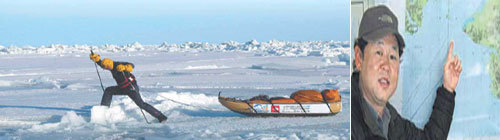
The famous mountaineer and explorer Park Yeong-seok, 44, will attempt to cross the Bering Strait on foot next February once again.
I did my best last time, so that I think that failure laid the groundwork for another success. I will make it this time as long as there is no natural disaster, he said.
Park, the director of Gold Win Korea and a former member of the mountaineering club of Dongguk University, failed to cross the strait in March this year.
Pointing to the Bering Strait on the map tacked on the wall of his office in Seoul, he exhibited confidence about the future success of another try, saying, At the moment I failed at my first attempt, my brain was already planning to try it again.
Lee Hyeong-mo, 28, and Hong Seong-taek, 41, will join the expedition this time. Lee, a former member of the mountaineering club of Gwandong University, had joined Park in the first attempt, and Hong, a former member of the mountaineering club of Yongin University, has conquered Mt. Everest, and the North and South poles.
The Bering Strait is located between the east end of Eurasia and the west end of North America. The shortest distance is 88 kilometers between Siberia and Alaska.
The strait, which borders the Arctic Ocean at 65-67 degrees north latitude, is covered with large chunks of floating ice. Explorers can use the ice like a steppingstone to cross the strait.
However, the strait has opened the way for explorers only twice in a total of 20 attempts in history due to unpredictable strong winds and tides. Moreover, global warming is melting the ice, making the crossing harder. Polar bears are being threatened as well.
Parks first attempt was hampered by high winds. As the direction of winds decides the movement of floating ice chunks, explorers walk in a zig-zag pattern. Parks expedition team left the Russian coast and traveled for three days, 21 hours and 30 minutes, but had to give up their plans due to a typhoon when they were 27 km away from their destination. The wind sent the floating ice moving on the Pacific at speeds of up to 5.8 km/h.
Park said, We could make it if we had left a day earlier and avoided the typhoon. An accurate weather forecast, including the direction of the wind, is the key to success.
The expedition will leave Korea as early as February 15, 2008, set up its first base camp in Alaska near the Bering Strait, and then decide when to begin their exploration while adapting to the climate.
kimsk@donga.com


![“고인 통장에서 장례비 꺼냈는데”…상속포기 무효될 수 있나 [상속리포트]](https://dimg.donga.com/c/138/175/90/1/wps/NEWS/IMAGE/2026/06/26/134181179.3.jpg)
![[단독]계엄때 “서강대교 넘지말라” 했던 대령도 내란수사](https://dimg.donga.com/c/138/175/90/1/wps/NEWS/IMAGE/2026/06/27/134192351.1.jpg)




 About Dong-A Ilbo