

New Novel
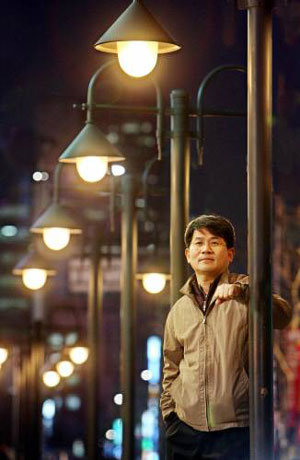
If youre expecting a Sung Seok-jae-ish novel, youre in for a big surprise. Composed of seven short and medium-length stories, the new novel series is called, A Really Fine Day, published by Munhakdongne. The quirky, witty writing is still there, but there is a changed sense of feeling and substance.
The lives portrayed in the books, like the man who lost his home and rent money to the landlord (Blooming at a distance) and the man who fights with his brother and son over the inheritance (It was nothing), are dark and gloomy, never bigger than life.
Why has he changed so? On December 14, I met the author Sung Seok-jae (46) and sat down for a chat.
―The title is A Really Fine Day, but the days in the book arent fine, theyre depressing. Even the short story, Sometime On a Bright Day, feels like there should be some warmth and laughter when the main character goes home after a long leave, but instead its full of painful memories.
The title is from the story itself. The grandmother says, Hey, the weather is so bright today, and the coffee shop manager even says, The weather is sure as hell bright today. They may be talking about the weather, but it may represent the many days we go on living. Maybe its because I started out as a poet, but I like titles with layered meanings. Frankly, in the past two years that Ive written this book, I tried to take life as candidly as possible. There are the good days, but there are also dark spots we dont want to see. I wanted to write about that.
―When we think of a Sung Seok-jae novel, we automatically think of uncontrollable laughter and ironic pathos. The new novel series is void of any jokes, the sentences are brief, and the plot is heavy. Have you changed?
Maybe its the side-effects of taking life face-to-face. In terms of kimchi, its dicing the ingredients raw and sprinkling salt over it. After I finished the book, I was startled at the grimy atmosphere, too. I think Ive changed.
―Perhaps youve grown older?
Now that you mention it, the main characters are mostly a married man in his forties, like me. They have a family, but something about them is struggling. Yet at the same time they are innately positive. Before, I tried to change the point of views and speakers in diverse ways, but now I want to show the lives of my friends, who I meet often, or myself. I want to show the lives of the people around me, as they are. So its painful, because the main character and I are one and the same frequently. Its probably the price I have to pay for being a novelist.
―Theres a person whos a real well-being type, but gets in a car accident (Noble Obligation) and theres also a guy who gets angry at his family after competing for an apartment with his brothers (It was nothing). Before, you would have illustrated their absurd circumstances in a cheerful tone.
The Noble Obligation story I wrote after reading about a health freak who was hit by lightning in a 1980s newspaper article, and It was nothing could happen quite easily because of the apartment craze. It exposed problems like greed, selfishness, and wrecked homes. I dont think those things could have been hidden and ignored behind the words. I used to kill off my characters, but now I dont. (Laughs) Tragedy is that kind of stuff. But I think Im changing nowadays. I wrote in my first short-story series called, There are Unmentionables Living There, that life is something that comes and goes. I think thats true. Im not one to take a walk down tragedy lane. In the future, Ill most likely be writing about slightly heavy subjects, things that leave a lingering note, things that speak of hope.
―Your works have changed, but youre as youthful as ever.
I go to the graveyard and dig up human livers. (Laughs) Writers just dont age that dramatically. Its not just me.
kimjy@donga.com






 About Dong-A Ilbo