

Call Me a Virtuous Woman? Thats Cruel and Unusual Punishment!
Call Me a Virtuous Woman? Thats Cruel and Unusual Punishment!
Posted June. 04, 2004 22:10,
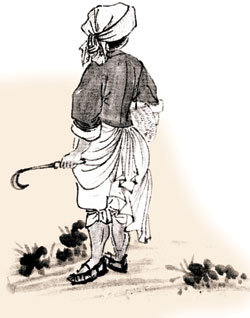
Hyanglang: Withers as a Mountain Flower
By Chung Chang-kwon
236 pp. 10,800 won. Published by Pulbit.
The Josun Dynasty, in year 28 of King Suk-jongs reign (1702). In Sanghyeong-gok, Seonsan-bu in Gyeongsang-do (todays Hyeonggok-dong, Gumi-si, Gyeongsangbuk-do), there was an incident involving the suicide of a woman from the Yang-in class (a social class composed of farmers and other working classes, below the Yang-ban and above the Cheon-in). The woman, named Hyanglang, had lost her mother as a young child and had been raised by a stepmother. At age 17, Hyanglang was married to Chilbong, a 14-year-old living in the same village, who became a philandering and abusive husband. After three years, Hyanglang obtained a divorce and returned to her maiden home.
However, her parents refused to take her in. She entrusted herself to her uncle, but soon afterwards, he also pressed her to remarry. Hyanglang reluctantly returned to her husbands family, but her husbands maltreatment continued, and this time even her father-in-law urged her to marry anew. Left with no recourse, she went to the Otae River, which branches into the Nakdong River, narrated her lifes story to a girl gathering firewood nearby, sang a song entitled Mountain Flower, then threw herself into the rivers churning waters.
Upon hearing of the suicide, the local magistrate submitted her name to the central government as a Woman of Virtue, saying that Hyanglang took her own life in order to defend her honor and remain faithful to her husband. In two years, the king officially dubbed her a Woman of Chastity and ordered a stone monument to be erected at her gravesite.
The rationale ran, Hyanglang, an ignorant commoner born in the countryside, understood that it was the moral duty of a woman to marry but once, and kept her honor by choosing death. A woman of virtue whose name is entered in the pages of Samgang Haengshil-to (a.k.a. The Three Bonds and True Examples of their Practice, with Illustrations) could not do better than this.
Thus, Hyanglang was famed throughout the land as a model of chastity, and eighteenth- and nineteenth-century men of letters celebrated her life in some 20 biographies, poems, novels, and other miscellaneous records. The tomb of this woman of virtue is still found at San 21, Hyeonggok-dong, Gumi-si, Gyeongsangbuk-do, and a yearly rite is held there on the anniversary of her death, on September 6 of the lunar calendar.
The author, Chung Chang-kwon (a research fellow at the Korean Literature Research Institute at Korea University), retraces the series of events surrounding Hyanglangs suicide, arguing that she was not a woman of virtue, but the tragic victim of the transition of eighteenth-century Josun into a patriarchal society.
According to Chung, Hyanglang was not someone who devoted herself unconditionally to her husband but someone who strenuously fought through the realities of the day. She resisted her husbands abuses and infidelities and won her divorce, only to be thoroughly ostracized by a society increasingly prone to condemning divorcees. Her suicide, Chung offers, was the last resort of an outcast.
The author focuses on the fact that, until the early Josun period, married couples often lived with the wifes family and both sexes worked as equals in the fields. There was no significant status difference between men and women in matters of matrimonial relations, inheritance, divorce or remarriage.
Following Josuns foundation on the principles of Neo-Confucianism, the Neo-Confucianist family system spread across Josun society during the fifteenth and sixteenth centuries. When the Imjin Japanese Invasion (1592) and the Byeongja Ching Invasion (1636) left the country in disarray, the ruling classes sought to reconstruct the social system with an emphasis on propriety and etiquette. This eventually led to the establishment of a rigidly patriarchal structure.
Chung illustrates how Korean patriarchy was born in the eighteenth century through his investigation of divorce, remarriage, adultery, and domestic violence.
The author is so intent on critically reevaluating the false ideals and harmful practices that plagued Josuns patriarchal society that sometimes the line between fiction and nonfiction, argument and fact, surrounding Hyanglangs life becomes obscured. Nonetheless, his story is well worth following for the new perspective it grants on our own family system in the 21st century.
Review by Kim Hyung-chan, khc@donga.com







 About Dong-A Ilbo