

Learning a Lesson from Home-Building of Animals
Learning a Lesson from Home-Building of Animals
Posted August. 30, 2002 22:06,
Architecture of Organism
Written by Hasegawa Takashi, translated by Park E-yeop
264p. W7500, Hyeonam Publishing Co.
Eumenidae make their houses in the perfect form of white porcelain. Gardener birds build their nest with straws and decorate them with shells. These have frequently introduced in scientific documentary programs.
Such books as `Architecture of animals (1974) have drawn keen interest from the public in animals that build their houses. But this book is differentiated from other books in that it is written not by a biologist but by a architecture historian. In a nutshell, he wants to say that now is time for mankind to learn architecture from animals.
Of course, you might think, "Architecture built by human beings is more diversified and magnificent than that by animals."
But the construction work by men is as simple as that by other animals. Men harden the ground, erect pillars, set up walls and make a roof. House buildings in different times and different civilizations are just a variation of this simple principle.
The author says that this simplicity comes from the resistance to the rule of gravity.
For fear of collapse, men became to have the simple geometrical diagram and that in turn led to the damage caused by rationalism without emotion in the modern times.
To the contrary, the architecture of animals is more environmentally-friendly and use less materials and energy. A number of birds and insects don`t erect their houses. They hang down their houses. Such hanged-down houses conform to the gravity, enabling them to preserve their original shape.
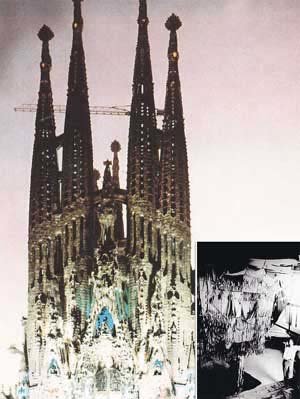
Men, of course, cannot live in woven houses. But this `hanging-down` technology learned from the nature has already been reflected in great buildings constructed by men. The case in point, says the author, is `La Sagrada Familia` set up in Barcellona by Antonio Gaudi.
This building is characterized by its non-geometrical curves and organic structure, which are unexplicable with conventional wisdom.
Then how did Gaudi design this building in the 1880s, when the modern structural engineering and structural mechanics? Gaudi discovered the mechanically stable curves after he hung a number of small bags down from the ceiling of his workroom.
There is a lesson from white ants as well. The house of white ants emits carbon dioxide through an air-circulating system, which also cools down the temperature in their houses.
White ants might laugh at men for squandering a huge amount of air-conditioning fee by using firm and thick outer walls and insulating materials.
Beehives also show the way to effectively use small spaces with scarce resources.
"Living devices of men are too aggressive to the environment. Nests of animals are fundamentally defensive, but realize conveniences inside with simplicity outside. Now we have reached at the door of the nests of animals and looking forward a guide to usher in.
Yoon-Jong Yoo gustav@donga.com








 About Dong-A Ilbo