

`Superiorities We Haven`t Appreciated So Far`
`Superiorities We Haven`t Appreciated So Far`
Posted August. 18, 2001 09:45,
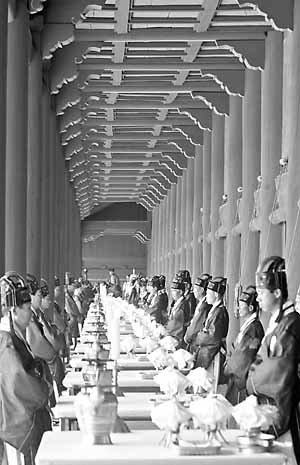
Our Cultural Assets with science
The novel, `Roots`, was broadcast as a blockbuster TV series long time ago. It described a story of tracing a record of his 7th ancestor, who was a slave sold into America. This moved so many viewers that many may remember the scenes vividly.
However, such novel that looks for the old generations is not to be written in Korea because the Korean genealogies are well collected. For example, if Alex Haley, author of `Roots`, had been born in Korea, he could have found the record of his 7th ancestor quite easily.
The `bulldozer-like` modernization, which was driven through the 1960s – 1970s in Park Chung-Hee`s` regime, produced an admiration toward foreign culture and materials. The `elephant brand cooker` was a symbol of worshipping foreign objects because so many wealthy housewives tried to purchase the cooker competitively.
In contrast, our tradition, whose superiorities call for the acclamations of foreigners, was badly treated as `rustic feudal remains`. In an extreme case, while our genealogy, which is one of the precious world history assets, has been put aside, those of foreign dogs have been maintained in good condition.
The author, who majored in science, tries to rediscover the superiorities of our cultural assets that had been neglected by us through various books he wrote in the past. In the same spirit, he is trying to place the interpretations about folk and mind cultures scientifically and reasonably in the book.
The merits of `Hanji`, which is made of paper mulberry, are amazing. According to the `Life` magazine in 1997, the most important event in the last millennium human history was selected to be the bible printing using the metal letters Gutenberg had invented. However, the bible, which was printed more than 500 years ago, is impossible for us to physically examine because the paper quality raises a big concern related to preservation. Meanwhile, the books written on `Hanji` were not to be worn or rott even after thousands of years.
The author is not only taking pride in the `Hanji`, but also showing scientific evidences in the book. For Hanji, our ancestors contrived a new paper surface treatment technique, which is called `Dochim`. In `Dochim`, several pasted papers are overlapped and were hammered uniformly by `Dochim` machine, which leads the paper surface to be smooth and tight. Then, once a lacquer is added onto several `Hanji`, this can serve as armor clothes, which is so strong that even an arrow cannot penetrate. According to experiments, the `Changhoji`, made of several `Hanji`, is much more effective than expensive double-shielded glass-panes in terms of insulation and anti-humidity, which appears unbelievable.
Geomantic principles (also known as `Feng-Shui`) are shown to be not entirely non-scientific through soil analysis results. While normal soils are acidic, the soils from the `propitious site` are neutral so that even the eggs in these places might not get rotten for a long time. Interestingly, the claim was also presented with the soil analysis results of Egyptian dummies.
Although there are various interesting topics in the book, there are not so many scientific subjects, as the title has indicated. Not only historical evidences but also unrefined materials, which might have been directly cited, are scattered in many parts. Some stories, which are not appropriate in terms of `cultural assets`, are excessively listed so that the consistency of the book appears obscure. For example, in a chapter titled `Korea dinosaur contributing significantly to a blockbuster Jurassic Park`, the explanation about Korea dinosaur was brief in the early part. Most of the parts were filled with generic dinosaur stories about fossil footprint, cold-blooded animal dispute, and extinction theory. Some unrefined parts of the book, which may appear `material collection`, seem to damage the quality of the book.
Written by Lee, Jongho
320 pages, 13,000 won Culture line
Yun Jeong-Hoon digana@donga.com







 About Dong-A Ilbo