

Canada loss offers defense industry lessons
Canada loss offers defense industry lessons
Posted July. 08, 2026 08:32,
Updated July. 08, 2026 08:32
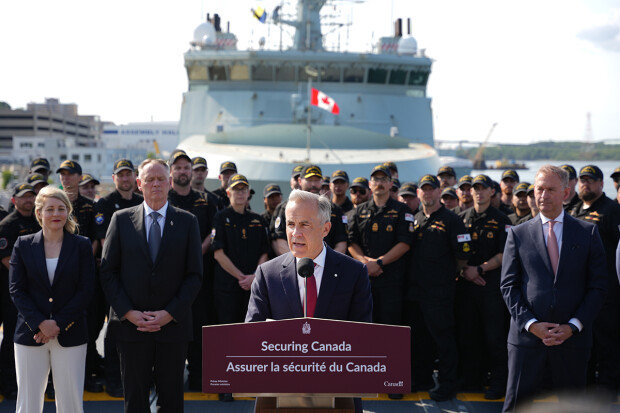
South Korea's failure to win Canada's 60 trillion won submarine contract is a disappointment, but it should also be seen as a milestone for the country's defense industry. Canadian Prime Minister Mark Carney announced Monday that Germany's Thyssenkrupp Marine Systems (TKMS) had been selected as the preferred bidder for the Canadian Patrol Submarine Project. President Lee Jae-myung said South Korea may not have secured the deal, but its performance in the competition demonstrated the strength of its defense industry. Lee is attending the North Atlantic Treaty Organization (NATO) summit in Ankara on Tuesday and Wednesday, where he is expected to promote South Korea's defense exports to alliance members.
South Korea waged an all-out campaign to win the Canadian contract, with the government and industry joining forces and even dispatching a submarine across the Pacific for on-site demonstrations. The bid underscored how far the country's submarine technology has advanced. Having once relied on German expertise to build its submarine capabilities, South Korea went toe to toe with Germany until the final round of the competition. Carney himself noted that both TKMS and Hanwha had met Canada's stringent requirements, underscoring just how closely fought the contest had been.
Ultimately, however, South Korea ran into the reality of alliance politics. As the supplier of roughly one-third of NATO's submarines, TKMS was able to offer seamless interoperability within the alliance, particularly through its common platform with Germany and Norway. For Canada, selecting a submarine already embedded in the NATO ecosystem was the logical choice.
South Korea has emerged as a major force in the global arms market by offering reliable weapons, competitive prices and fast delivery. Demand for Korean-made tanks, self-propelled howitzers and air defense systems has surged in recent years as wars around the world have fueled a sharp rise in military spending. But competing on cost and delivery alone will no longer be enough. To sustain its momentum, South Korea must develop more advanced weapons systems, deepen cooperation through joint development and local production, and position itself as a trusted security partner rather than simply an arms exporter.
The NATO summit offers South Korea a chance to deepen its presence in the world's largest defense market. Europe has been ramping up military spending as Russia's invasion of Ukraine and growing uncertainty over U.S. security commitments drive a sweeping military buildup. For now, South Korean defense companies are well positioned to benefit. European manufacturers are still scaling up production, while U.S. suppliers remain stretched by wartime demand. But that window of opportunity will not stay open indefinitely. The long-term future of K-defense will depend not only on selling competitive weapons, but also on forging the kind of enduring strategic partnerships that have long bound NATO allies together.






 About Dong-A Ilbo