

China cannot stay silent on North Korea
China cannot stay silent on North Korea
Posted June. 10, 2026 08:28,
Updated June. 10, 2026 08:28
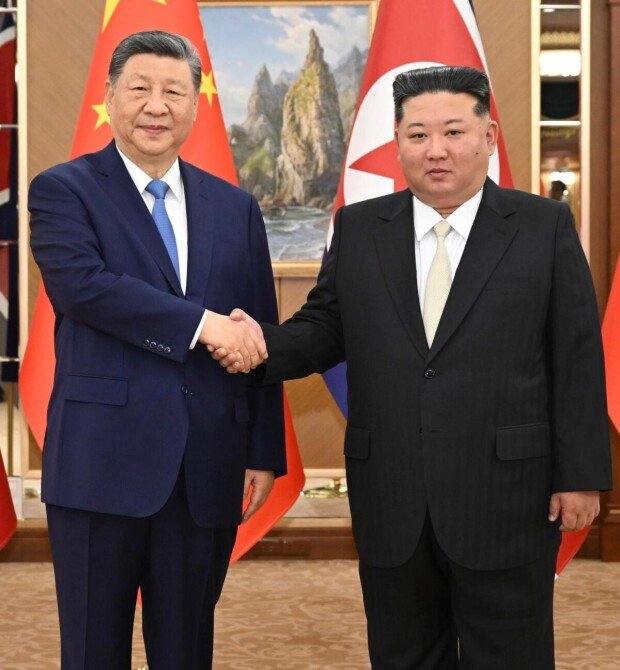
Chinese President Xi Jinping returned home June 9 after a two-day visit to North Korea. Xi and North Korean leader Kim Jong Un used the occasion to underscore closer ties, describing the relationship as a "new historical starting point" and "a new chapter" in bilateral relations. North Korean state media said the two leaders reached a "satisfactory consensus" on defending their countries' sovereignty and security. Chinese media reported that Xi also called for expanded military exchanges. Yet neither side mentioned North Korea's nuclear program or the Korean Peninsula.
The absence of the word "denuclearization" was no surprise. When Kim Jong Un visited Beijing in September last year, the term had already disappeared from official statements, unlike during the previous five North Korea-China summits. Ahead of Xi's visit, Kim toured a new uranium-enrichment facility and had his sister, Kim Yo Jong, publicly declare that North Korea's status as a nuclear weapons state was irreversible. Under those circumstances, Xi was unlikely to raise an issue that Pyongyang views as nonnegotiable.
More noteworthy was the disappearance of the Korean Peninsula itself from the official narrative. After the summit nine months ago, China said Xi was willing to work for peace and stability on the Korean Peninsula, while Kim praised Beijing's "fair and impartial position." This time, references to the "Korean Peninsula" and "peninsula issues" were nowhere to be found. The omission appeared to reflect Pyongyang's "hostile two-state" policy, which rejects the notion of a single peninsula framework encompassing both Koreas.
That does not mean China has accepted North Korea as a nuclear weapons state. Even as the summit was taking place on June 8, China's Foreign Ministry reiterated that Beijing's policy remains consistent and stable, signaling that it has not abandoned its commitment to denuclearization of the Korean Peninsula. For now, China appears content to avoid the issue rather than confront North Korea over it.
Beijing's calculations are understandable. As rivalry with the United States intensifies and tensions with Japan persist, China sees strategic value in maintaining close ties with North Korea. It is also likely mindful of the role it could play in any future negotiations between Pyongyang and Washington.
But silence carries risks. Avoiding the nuclear issue may encourage further misjudgments in Pyongyang while deepening concern among countries already alarmed by North Korea's weapons programs. China should not allow itself to be seen as shielding a rogue state. As a major power, it has a responsibility to use its influence to steer North Korea back toward dialogue and diplomacy.








 About Dong-A Ilbo