

Turn today's windfalls into tomorrow's growth
Turn today's windfalls into tomorrow's growth
Posted June. 09, 2026 08:15,
Updated June. 09, 2026 08:15
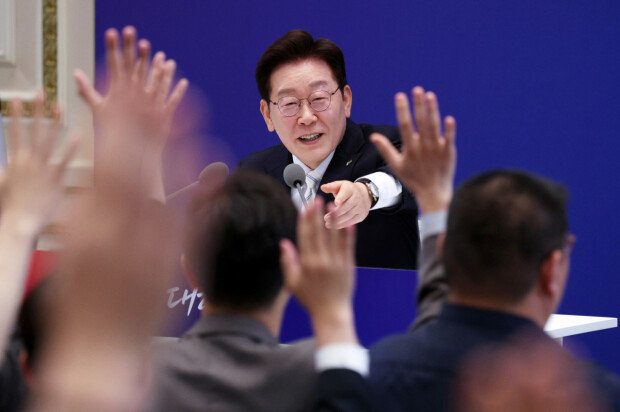
President Lee Jae-myung said Monday at a news conference marking his first year in office that simply spending excess tax revenue as it arrives would be "not policy, but foolishness." He argued that such revenue should be directed toward strengthening South Korea's long-term growth potential for future generations. His remarks offered a clear perspective on the growing debate over tax windfalls and outsized profits generated by the semiconductor boom.
An AI-driven semiconductor supercycle is expected to deliver a sharp rise in tax receipts as major chipmakers reap record earnings. Samsung Electronics and SK hynix alone are projected to pay more than 120 trillion won in corporate taxes this year. That prospect has triggered debate in government and industry alike over how the additional revenue should be used. At the same time, soaring corporate profits have fueled calls for broader profit-sharing schemes, with labor groups pushing for performance-based distributions. The controversy has only intensified after the labor minister publicly raised the issue of sharing excess profits.
The problem is that neither tax windfalls nor unusually strong corporate earnings can be counted on to last. Just two years ago, Samsung Electronics and SK hynix paid virtually no corporate taxes, while the government faced a revenue shortfall exceeding 30 trillion won. For both governments and businesses, periods of exceptional earnings provide a cushion against future downturns and a source of capital for maintaining competitiveness. They are not money to be spent simply because it happens to be available.
Using temporary revenue gains to expand cash benefits or other recurring spending may generate immediate political rewards, but the economic impact is likely to be fleeting. Investing the proceeds of today's semiconductor boom in the industries that will drive tomorrow's growth offers a far greater payoff. That is how South Korea can create the next generation of globally competitive industries and raise a potential growth rate that has languished near 1%.
The same holds true for corporate profits. Across the globe, particularly among major U.S. technology companies, competition is intensifying in emerging fields such as artificial intelligence and space. Companies that fail to keep up could see even today's enormous profits disappear far more quickly than expected. The ongoing arguments over how to divide tax windfalls and excess earnings serve little purpose. What South Korea needs now is investment, execution and a clear focus on the industries that will underpin future growth.

![[속보]트럼프 “이란과 14일 합의 서명”…혁명수비대 “절대 없을 것”](https://dimg.donga.com/c/138/175/90/1/wps/NEWS/IMAGE/2026/06/14/134105551.1.jpg)





 About Dong-A Ilbo