

Nvidia deepens partnerships with Korean firms
Nvidia deepens partnerships with Korean firms
Posted June. 09, 2026 08:15,
Updated June. 09, 2026 08:15
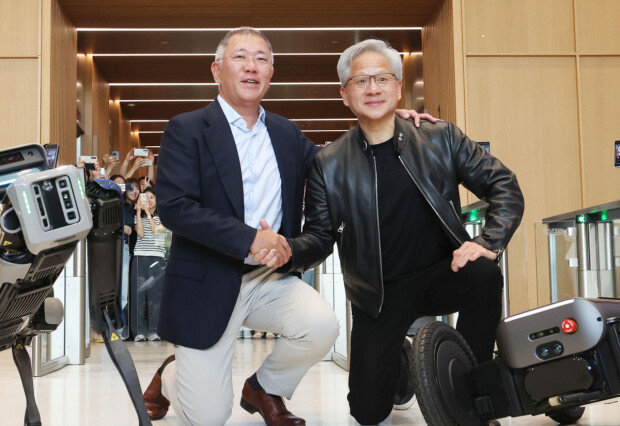
Nvidia CEO Jensen Huang said Monday that Saemangeum in North Jeolla Province is being developed into an "AI Valley" similar to Silicon Valley, underscoring South Korea's growing role in the emerging field of physical AI. The initiative would capitalize on the country's access to renewable energy and large-scale development sites.
Wrapping up a four-day visit to South Korea, Huang spent Monday meeting executives from major Korean companies including SK Group, Hyundai Motor Group, LG Group and Naver. The meetings highlighted Nvidia's efforts to deepen cooperation with Korean partners in semiconductors, robotics and AI infrastructure.
● Jensen Huang: 'Saemangeum will become AI Valley'
Huang met Hyundai Motor Group Executive Chair Chung Eui-sun at the company's headquarters in Seoul's Yangjae district, where the two held talks for about an hour. Speaking to reporters afterward, Huang said they discussed building a new manufacturing ecosystem powered by artificial intelligence.
"Just as the United States has Silicon Valley, South Korea is building an AI Valley in Saemangeum," Huang said.
The two also exchanged views on mobility and robotics. Huang said Nvidia and Hyundai are working together to accelerate the adoption of robotics technologies in industrial settings. Chung said it was an honor to be collaborating with Huang on mobility and robotics after first meeting him 15 years ago.
Earlier in the day, Huang met LG Group Chairman Koo Kwang-mo at LG Twin Towers in Seoul to discuss cooperation in physical AI. The companies agreed to expand collaboration in areas including robotics data, simulation, training and autonomous systems.
"We work with LG Group as one team across nearly every area of Nvidia's business, from robotics systems to AI factories," Huang said. Koo said the two sides had extensive discussions about the future direction of their partnership.
A day earlier, Huang also reached an agreement with Doosan Robotics to incorporate Nvidia's autonomous driving technologies into industrial equipment produced by Doosan Bobcat.
● Expanding semiconductor and infrastructure partnerships
Huang also sought closer cooperation in semiconductors and data center infrastructure, key foundations of the AI industry.
Beginning at 8:30 a.m. Monday, he met SK Group Chairman Chey Tae-won at SK's headquarters in central Seoul. The two sides agreed to expand their high-bandwidth memory partnership beyond memory supply to include chip design, manufacturing and data center operations.
"SK hynix has been Nvidia's largest memory partner, and it will remain so," Huang said. Chey said the companies would elevate cooperation to the group level, jointly develop future AI factories and share research and development roadmaps.
Under the expanded partnership, SK hynix will work with Nvidia on customized memory products for next-generation chipsets, while SK Telecom plans to build a gigawatt-scale AI cloud platform targeted for launch in 2027.
Later Monday, Huang visited Naver's 1784 headquarters in Seongnam, where he met Global Investment Officer Lee Hae-jin and CEO Choi Soo-yeon. The companies agreed to jointly pursue a gigawatt-scale AI factory project.
The partnership will also combine Naver's street-view mapping data with Nvidia's next-generation world model, Cosmos, to develop a "Seoul World Model" designed to help AI understand real-world environments with greater precision.
Huang later held working-level meetings with Samsung Electronics executives, including Jun Young-hyun, head of the company's Device Solutions division, at the Shilla Hotel in Seoul. He also met Science and ICT Minister Bae Kyung-hoon before concluding his visit with a private dinner attended by South Korean tech startup founders.
Industry experts said Nvidia appears to be pursuing a lock-in strategy aimed at drawing South Korea's advanced manufacturing sector more deeply into its ecosystem. Much as the company encouraged widespread adoption of its CUDA software platform among AI developers, analysts say Nvidia is seeking to apply a similar strategy to physical AI.
"It is encouraging that Nvidia, which leads the AI ecosystem, is working with Korean companies to strengthen its position in this field," said Lee Kyung-mook, a professor at Seoul National University's College of Business Administration. "At the same time, we should be mindful of the risk that Korean companies could become dependent on Nvidia if their bargaining power weakens in the future."
이동훈 기자 dhlee@donga.com

![[속보]트럼프 “이란과 14일 합의 서명”…혁명수비대 “절대 없을 것”](https://dimg.donga.com/c/138/175/90/1/wps/NEWS/IMAGE/2026/06/14/134105551.1.jpg)




 About Dong-A Ilbo