

Government weighs earlier end-of-life decisions
Government weighs earlier end-of-life decisions
Posted June. 03, 2026 08:32,
Updated June. 03, 2026 08:32
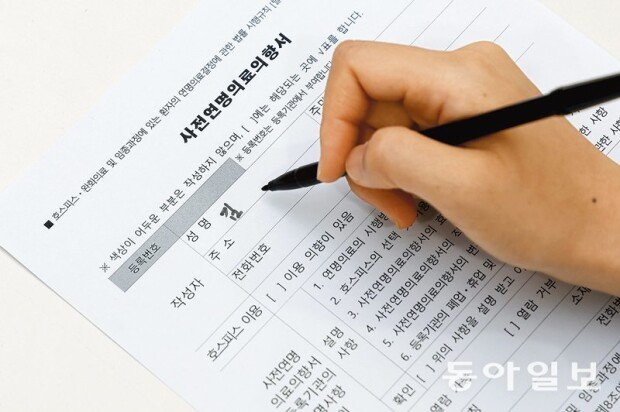
The government plans to allow patients with no prospect of recovery to forgo life-sustaining treatment earlier than is currently permitted, moving the decision point from the final days of life to the terminal stage of illness. It also intends to introduce online registration for advance directives on life-sustaining treatment, eliminating the need for in-person visits to designated institutions. At the same time, officials will develop a hospice model tailored to long-term care hospitals and expand hospice bed capacity.
The Ministry of Health and Welfare announced the measures Monday after the National Hospice and Life-Sustaining Treatment Committee approved the 2026 implementation plan under the Second Comprehensive Plan for Hospice and Life-Sustaining Treatment. Health and Welfare Minister Chung Eun-kyung had previously told this newspaper in an interview published May 11 that the government would begin public discussions on allowing earlier decisions to withdraw life-sustaining treatment and launch a full-scale hospice program at long-term care hospitals next year.
The government plans to bring the issue before the seventh National Bioethics Committee, which begins its term Thursday, and open a public debate on broadening eligibility for the withdrawal of life-sustaining treatment. Under the proposal, eligibility would be expanded from patients in the final stage of life, where death is expected within days, to terminally ill patients whose prognosis is measured in months. Medical experts have long argued that limiting medically futile treatment is key to ensuring a dignified death.
Advance directives, which allow individuals to record their wishes regarding life-sustaining treatment and hospice care before they become seriously ill, will be made available online. The move is designed to make end-of-life planning more accessible and encourage people to consider such decisions while they are still healthy. The government also plans to launch full-scale hospice services at long-term care hospitals as early as next year to prevent gaps in care that can leave patients unable to access hospice treatment promptly after ending life-sustaining measures, a problem commonly referred to in South Korea as that of "hospice refugees."
조유라 jyr0101@donga.com

![[속보]트럼프 “이란과 14일 합의 서명”…혁명수비대 “절대 없을 것”](https://dimg.donga.com/c/138/175/90/1/wps/NEWS/IMAGE/2026/06/14/134105551.1.jpg)



 About Dong-A Ilbo