

Researchers uncover new Ulleungdo inscriptions
Researchers uncover new Ulleungdo inscriptions
Posted June. 03, 2026 08:32,
Updated June. 03, 2026 08:32
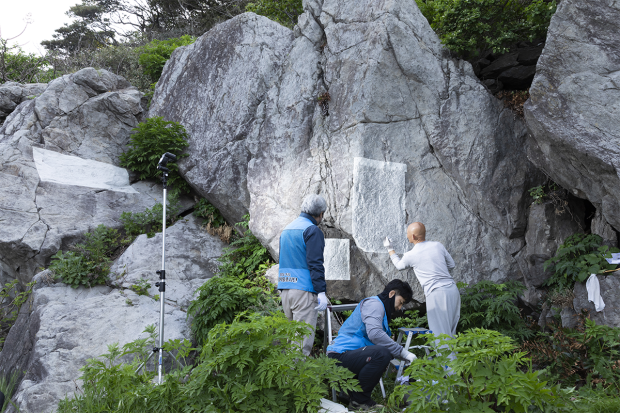
Names believed to belong to captains of Joseon-era government vessels that visited Ulleungdo in the early 19th century have been identified through a comprehensive survey by the Northeast Asian History Foundation. Researchers also documented previously unrecorded stone inscriptions on the island, adding fresh evidence that the Joseon government exercised administrative authority over Ulleungdo and nearby Dokdo.
The foundation on Monday presented the findings of its April 20-24 field survey at a symposium titled "Ulleungdo and Dokdo Through Joseon-Era Inspection Missions." The project carried on the legacy of the Korean Alpine Club's landmark 1947 expedition and included a full review of stone inscriptions left by government inspectors on Ulleungdo. Researchers also uncovered new historical materials and produced 15 high-quality ink rubbings.
One of the most notable discoveries came from the Taeha-ri inscriptions, where several previously unidentified characters were found. The inscriptions, carved by government inspectors, are scattered across a cliff face stretching more than 30 meters and comprise about 11 separate records. According to Ko Kwang-ui, a senior research fellow at the foundation, two names identified as those of "sagong," or ship captains, were newly confirmed in an inscription attributed to Lee Bo-guk. Lee served as commander of the Samcheok garrison in Gangwon Province in 1804 and conducted an official inspection of Ulleungdo the following year. Because a sagong was the officer responsible for a vessel, the discovery suggests at least two ships took part in the mission. It also points to an inspection force that may have numbered around 100 personnel.
Researchers also identified a nearby inscription believed to refer to individuals holding military-related positions. Additional characters newly confirmed at the Taeha-ri site include two instances of the surname Kim and the place name Gangneung. Ko said time constraints prevented the team from taking rubbings of all the newly identified inscriptions, but added that further research could uncover additional names linked to the inspection missions. Beginning in the late 17th century, the Joseon court dispatched inspectors to Ulleungdo on a regular basis for nearly 200 years to survey conditions and report back to the government.
The survey also enabled researchers to refine readings of several inscriptions. Ko said characters in the Taeha-ri "Gwangseo inscription," dated 1890 and 1893, have been reinterpreted following closer examination. A character previously read as "sa" was identified as "hu," another once interpreted as "gong" was determined to be "jeol," and a character formerly read as "tang" was reclassified as "chu."
Under the revised interpretation, the inscription is understood to read: "The benevolent rule of the sovereign reached even this eastern island. Our magistrate came from the western mainland. His devotion to carrying out royal governance was sincere, and his care for the people was deep and generous." Ko said the passage offers a rare glimpse into both local administration and residents' perceptions of governance in late Joseon-era Ulleungdo.
The project also enlisted Ven. Heungseon, a master craftsman and former director of the Buddhist Central Museum, to produce ink rubbings of the inscriptions. The Gwangseo inscription was reproduced as a single large-format rubbing measuring 210 centimeters by 266 centimeters. A faint bloodstain left when the monk injured himself during the painstaking process was visible on the rubbing displayed at the symposium.
Participants at the symposium also called for better preservation of the historic sites. They argued that an observation deck installed near the Taeha-ri inscriptions has, in some cases, obscured or damaged carvings linked to the inspection missions. Moon Sang-myung, a research fellow at the foundation, said more in-depth study of the area's geological features and historical and cultural assets should support efforts to have Ulleungdo and Dokdo designated together as a UNESCO Global Geopark.
The foundation plans to produce additional rubbings and expand its research to other areas associated with the inspection missions, including Uljin in North Gyeongsang Province. Park Ji-hyang, chairperson of the Northeast Asian History Foundation, said rigorous historical verification remains "the strongest academic shield and weapon for safeguarding our territorial sovereignty."
Jong-Yeob JO jjj@donga.com

![[속보]트럼프 “이란과 14일 합의 서명”…혁명수비대 “절대 없을 것”](https://dimg.donga.com/c/138/175/90/1/wps/NEWS/IMAGE/2026/06/14/134105551.1.jpg)




 About Dong-A Ilbo