

Seoul, Washington open nuclear security negotiations
Seoul, Washington open nuclear security negotiations
Posted May. 30, 2026 08:29,
Updated May. 30, 2026 08:29
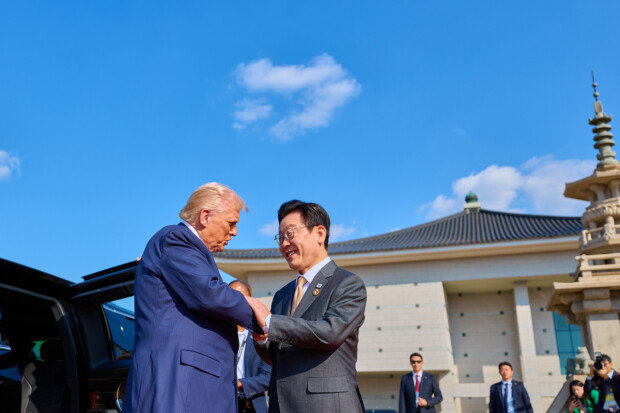
South Korea and the United States will hold their first official talks in Seoul from June 2 to 3 on a range of major security issues, including nuclear-powered submarines and South Korea’s push to secure uranium enrichment rights.
The meeting comes eight months after the South Korea-U.S. summit in Gyeongju last October, where the allies adopted a Joint Fact Sheet outlining follow-up security measures. With Seoul aiming to strike agreements on key issues before the U.S. midterm elections in November, the first round of talks is expected to focus on setting a negotiating framework and timeline.
South Korea’s Foreign Ministry said Friday that the two countries would formally launch consultations on implementing the security measures laid out in the Joint Fact Sheet. Seoul will send an interagency delegation led by First Vice Foreign Minister Park Yoon-joo, accompanied by officials from the presidential National Security Office, the Foreign Ministry, the Defense Ministry, the Ministry of Climate and Energy, the Ministry of Science and ICT, the Ministry of Trade, Industry and Energy, and the Nuclear Safety and Security Commission.
The U.S. delegation will be headed by Allison Hooker, undersecretary of state for political affairs, and include officials from the White House National Security Council, the State Department, the Energy Department and the Defense Department. The earlier-than-expected visit by the U.S. delegation has drawn attention, as the trip had originally been anticipated later next month.
The U.S. State Department also said Friday that Hooker would travel to Seoul with an interagency delegation to advance U.S. President Donald Trump’s “nuclear cooperation initiative.” The department said the two sides would discuss ways to strengthen the South Korea-U.S. alliance, including broader security and economic cooperation.
The talks are expected to focus heavily on nuclear-powered submarine development, shipbuilding cooperation, and South Korea’s efforts to secure authority over uranium enrichment and spent nuclear fuel reprocessing. Seoul has already signaled its determination to accelerate the submarine program. On May 26, President Lee Jae-myung chaired a meeting of the Future Defense Strategy Committee, where the government unveiled its basic roadmap for developing nuclear-powered submarines.
Under the plan, South Korea intends to build three or four 8,000-ton nuclear-powered submarines domestically. The government aims to begin full-scale design work next year, launch the first submarine in the mid-2030s and complete deployment by the late 2030s.
The most sensitive issues are expected to be where the submarines would be built and how military nuclear fuel would be supplied. Seoul has maintained that the submarines must be constructed in South Korea.
The fuel issue is closely linked to South Korea’s efforts to secure uranium-use rights. Building nuclear-powered submarines would require military nuclear fuel supplied by the United States. However, the revised South Korea-U.S. nuclear agreement signed in 2015 bars South Korea from using nuclear fuel for weapons-related purposes. As a result, the two countries would likely need a separate agreement granting an exception for submarine development.
Another major sticking point is the uranium enrichment level. The South Korean government has said it plans to develop submarines powered by low-enriched uranium, or LEU, with enrichment levels below 20%.
Some in Washington remain wary that South Korea could divert nuclear fuel for military purposes, raising the prospect of tough negotiations over enrichment levels, permitted uses and post-use monitoring.
Attention is also focused on whether the talks will address possible revisions to the bilateral nuclear agreement needed to secure uranium enrichment and spent fuel reprocessing rights. The Foreign Ministry said it had coordinated closely with U.S. officials behind the scenes in preparation for the meeting and would work to secure meaningful progress from the opening round of talks.
Na-Ri Shin journari@donga.com


![[오늘의 운세/6월 14일]](https://dimg.donga.com/c/138/175/90/1/wps/NEWS/IMAGE/2026/06/13/134104335.1.jpg)



 About Dong-A Ilbo