

South Korea prepares for heat at World Cup
South Korea prepares for heat at World Cup
Posted May. 29, 2026 08:25,
Updated May. 29, 2026 08:25
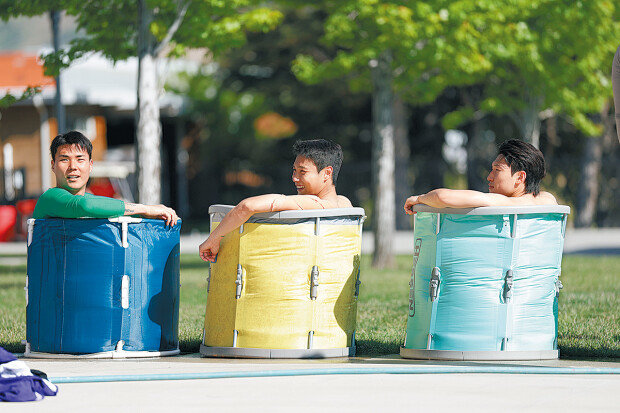
Several single-person tubs lined the edge of the training ground at Ute Soccer Field in Salt Lake City, Utah, where the South Korean national football team held its first training camp ahead of the 2026 FIFA World Cup.
After intense workouts, players slipped into the tubs one by one. They were not trying to cool off. The water was heated to 40 degrees Celsius.
“We spend about 10 minutes in the hot water to help our bodies adjust to the heat,” midfielder Baek Seung-ho of Birmingham City said in training footage released by the Korea Football Association.
The tubs were nowhere to be seen at the team’s second camp in Herriman, Utah. The Zions Bank Training Center already has sauna facilities, making the portable tubs unnecessary. Once training ends, players head straight to the sauna to continue their heat-acclimatization program.
Led by head coach Hong Myung-bo, South Korea has spent the past two camps preparing not only for high-altitude conditions but also for the intense heat expected in Mexico, where the team will play all three group-stage matches.
Guadalajara, which will host South Korea’s opening two matches, reached 35 degrees Celsius at 3 p.m. local time on May 27. The city sits about 1,600 meters above sea level. Monterrey, the site of the team’s third group-stage match at an altitude of roughly 450 meters, recorded humidity levels above 70 percent.
Song Jun-seop, the national team’s senior physician, said post-workout heat exposure can improve the body’s ability to cope with extreme temperatures. “When athletes stay in hot water while their body temperature is still elevated after exercise, their heat adaptation improves,” Song said.
The process takes time. Players typically need at least two weeks of heat-acclimatization training to see meaningful results. One exercise physiology study involving runners found that participants who followed a two-week post-run sauna program improved their performance in races held under extreme heat. South Korea’s altitude training has also gone smoothly.
Medical staff check players’ condition four times a day. Players are weighed before and after training sessions, and anyone who loses more than 2 percent of body weight is classified as being at risk of dehydration and placed under special monitoring.
Bae-Jung Kim wanted@donga.com



![“코 스프레이 2번 뿌렸더니 기억력 쑥”…치매 치료 가능성 [노화설계]](https://dimg.donga.com/c/138/175/90/1/wps/NEWS/IMAGE/2026/05/29/134018314.3.jpg)


 About Dong-A Ilbo