

Channel A takes election coverage outdoors
Channel A takes election coverage outdoors
Posted May. 29, 2026 08:25,
Updated May. 29, 2026 08:25
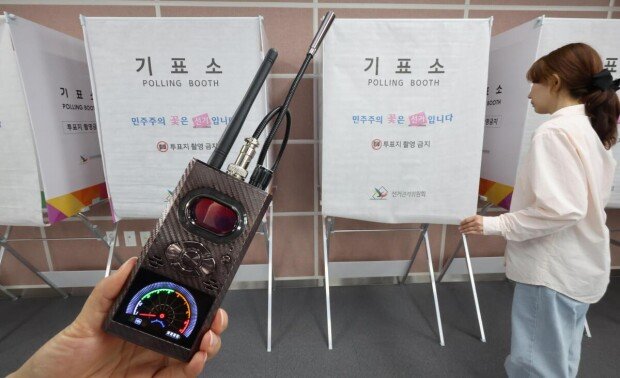
South Korea will begin two days of early voting Friday for the June 3 local elections, the first nationwide electoral test since President Lee Jae-myung took office.
With polls set to open in less than a day, leaders and candidates from both major parties spent Thursday crisscrossing the country, urging supporters to turn out and consolidating their voter base ahead of the closely watched vote.
The National Election Commission said early voting will run from 6 a.m. to 6 p.m. on May 29 and 30 at 3,571 polling stations nationwide. Unlike election day voting, which restricts voters to polling stations tied to their registered addresses, early voting allows citizens to cast ballots anywhere in the country with a valid ID.
Voters will receive seven ballots covering races for metropolitan and provincial governors, heads of local governments, metropolitan council members elected through district and proportional representation, local council members chosen through district and proportional systems, and superintendent of education posts. Only one candidate may be selected on each ballot. Voters in the 14 constituencies holding parliamentary by-elections will cast ballots eight times.
Democratic Party of Korea leader Chung Cheong-rae, speaking at a campaign rally in Seoul’s Gangdong District on Thursday, urged supporters to unite behind the party. “They say conservatives are regrouping not only around ‘Yoon Again,’ but also around Park Geun-hye and Lee Myung-bak once more. We need to unite even more strongly,” Chung said.
People Power Party leader Jang Dong-hyuk, campaigning in Nonsan, South Chungcheong Province, cast the election as a pivotal moment for the country. “Are you worried about the future of this country? Then you must go to the polls and vote for No. 2 in this local election to protect the Republic of Korea,” Jang said, referring to the People Power Party’s ballot number.
Political observers say both parties are treating turnout as a decisive factor, especially in tightly contested regions where a small difference in mobilization could shape the outcome.
The early voting rate itself is also being closely watched as a possible barometer for the broader election mood. Early turnout stood at 20.6 percent in the 2022 local elections.
In Seoul, widely seen as a political bellwether, Democratic Party of Korea candidate Jung Won-oh and People Power Party candidate Oh Se-hoon each held press briefings Thursday in a final push for support.
In Busan, Democratic Party of Korea candidate Jeon Jae-soo met with small-business owners, while People Power Party candidate Park Heong-joon toured traditional markets including Goejeong Market and Danggam Market, stressing economic recovery.
In the Daegu mayoral race, Democratic Party of Korea candidate Kim Boo-kyum and People Power Party candidate Choo Kyung-ho both visited the planned site of the Daegu-Gyeongbuk New Airport project, underscoring their competing policy visions.
Meanwhile, in Ulsan, a last-minute unification deal among pro-government candidates was reached Thursday, following a similar agreement in South Gyeongsang Province a day earlier. The development has emerged as a possible late variable in key Yeongnam races.
Efforts to unify conservative opposition candidates in Ulsan, however, appeared headed for collapse.
Dong-Joo Cho djc@donga.com


![“코 스프레이 2번 뿌렸더니 기억력 쑥”…치매 치료 가능성 [노화설계]](https://dimg.donga.com/c/138/175/90/1/wps/NEWS/IMAGE/2026/05/29/134018314.3.jpg)


 About Dong-A Ilbo