

Infofla Bets on Homegrown 'Factory AI' at AWS Summit
Infofla Bets on Homegrown 'Factory AI' at AWS Summit
Posted May. 27, 2026 09:59,
Updated May. 27, 2026 10:00
- Infofla has expanded its award-winning "Selto" AI agent from office tasks to manufacturing, providing high-speed (under 0.5s), 99%-accurate real-time quality control.
- By offering on-premises security and easy customization for proprietary enterprise systems, Infofla successfully solves needs that general-purpose Big Tech models cannot cover.
- Leveraging South Korea's advanced manufacturing infrastructure as a proving ground, the company is positioning its specialized solutions for rapid global expansion.
AWS Summit Seoul 2026, an event offering a glimpse into the present and future of cloud computing and artificial intelligence (AI), kicked off on May 20 at Coex in Seoul. With more than 25,000 attendees expected for the event running through May 21, the enthusiasm was palpable as over 12,000 people registered on the morning of the first day alone.
Amid the massive crowds, the most prominent topic at this year's event was undoubtedly "AI Agents." This signifies an evolution beyond the limitations of traditional AI, which merely answers user queries, into a stage where AI autonomously assesses situations and acts to achieve specific goals.
While numerous global tech giants scrambled to showcase advanced AI agents at the AWS Summit, booths of startups armed with unique ideas and technologies also caught the eye. Infofla, a company specializing in AI-driven workflow automation solutions led by CEO In-mook Choi, was among them.
Moving Beyond the Office to the Production Floor: 'Selto Factory' Expands the Realm of Automation
Infofla has steadily upgraded Selto, its AI agent that automates office tasks by recognizing images on computer screens and controlling mice and keyboards based on Vision AI. Unlike conventional automation solutions vulnerable to layout changes or unexpected pop-up windows, Selto has accumulated significant experience and expertise as an "office agent" that understands context and responds flexibly like a human. Furthermore, the company proved its capabilities by winning the CES 2026 Innovation Award and the iF Design Award 2026.
Selto Factory, introduced by Infofla at this year's AWS Summit 2026, is the result of expanding its stage into manufacturing sites where actual products are made, leveraging its proven technological prowess in office environments.
In an interview with reporters, CEO In-mook Choi candidly shared his field observations. "When we took Selto AI to actual manufacturing sites, the demands were overwhelming. Because it is a sector that young people are reluctant to enter and labor shortages persist, factories desperately wanted an AI transformation (AX). However, practically speaking, there were almost no places where AI was actively applied."
Recently, production floors have been undergoing a shift toward smart factories, with various IoT sensors installed to measure temperature, humidity, pressure, or motor RPM, collecting vast amounts of data. However, the quality control (QC) process to determine whether the final finished product is normal or defective still ultimately had to rely on manual visual inspection by operators.
Regarding this, Choi emphasized, "In semiconductor lead frame production lines, products are stamped out once every second. This means the maximum time window to detect defects and resolve them is only 0.5 seconds. In the past, humans had to do this manually, but now, an AI-based agent performs real-time detection, judgment, and execution, automatically logging the results into the system."
According to In-mook Choi's explanation, Infofla's Selto Factory platform has already verified both a processing time of under 0.5 seconds per step and an accuracy rate of over 99% through Proof of Concept (PoC) projects conducted on production floors. Furthermore, it is slated to be implemented soon in the expanded production lines of a certain KOSPI-listed semiconductor enterprise. Choi expressed confidence, saying, "Among all manufacturing processes, semiconductor fabrication is the most complex and precise. If successfully applied to semiconductors, it can be deployed across most manufacturing lines, including secondary batteries, renewable energy, and precision components."
How to Survive Among Giants: 'Security' and 'Customization'
The current AI agent market is a massive battlefield where global Big Tech firms are pouring in immense capital and infrastructure. In this environment, how can a startup like Infofla remain competitive? Paradoxically, In-mook Choi revealed that the inherent limitations of models from global corporations became an opportunity for Infofla.
The first weapon is robust security. Public institutions and the financial sector, which are highly sensitive to technology leaks and regulatory compliance, find it burdensome to use external cloud models. This explains why Sovereign AI—where nations or corporations independently build their own artificial intelligence to safeguard data sovereignty—has recently emerged as a key phrase. Choi explained, "Because our model is installed directly inside the company as an on-premises package, there is absolutely no worry about data leaking to the outside."
The second is customized learning specialized for enterprise systems. Choi emphasized a clear point of differentiation from global models. "General-purpose AI models from global Big Tech automate well-known software and programs very smoothly. However, they have no way of knowing the proprietary internal systems (such as ERP or MES) that individual companies have developed and utilized through SI processes. Conversely, our model finishes learning simply by having a regular worker demonstrate their routine task on the screen once, allowing anyone to easily implement customized automation."
"Success in South Korea's Factories is Immediately a Global Reference"
When asked about the survival strategy as a startup amid fierce competition with global conglomerates, Choi replied in a calm yet confident tone.
"In fact, it is crucial to focus on what a startup can do best. Our strength lies in agility—developing technology faster than conglomerates, rapidly entering the market for validation, and iteratively improving performance. It is genuinely difficult to find another case nearby that started with AI agents and expanded its territory into manufacturing this swiftly. It was possible because we nimbly embraced customer demands."
Concluding the interview, he touched upon the potential of South Korea's manufacturing industry. "South Korea is a manufacturing powerhouse with global competitiveness. Therefore, a successful track record built on South Korea's manufacturing floors can directly translate into a powerful global reference that works in the world market. As we have rapidly entered the sector we excel at most, we will continue to deliver clear results."
At the AWS Summit Seoul 2026 venue, one could witness firsthand the intense technological rivalry among generative AI and frontier foundation models being pumped out at a terrifying pace by global giants. In a battlefield of titans armed with capital and infrastructure, the standing room for startups might appear narrow.
However, Infofla’s trajectory demonstrates that what ultimately matters more than technological weight class is "on-site proximity." Their strategy involves digging into the blind spots of proprietary systems unique to each company and industry—areas where massive general-purpose models struggle to penetrate—to provide definitive, tailored solutions. It is well worth watching the steps of this homegrown startup as it nimbly carves out microscopic niches on the manufacturing floor that general-purpose AI fails to cover.
By Young-woo Kim (pengo@itdonga.com)
- By offering on-premises security and easy customization for proprietary enterprise systems, Infofla successfully solves needs that general-purpose Big Tech models cannot cover.
- Leveraging South Korea's advanced manufacturing infrastructure as a proving ground, the company is positioning its specialized solutions for rapid global expansion.
AWS Summit Seoul 2026, an event offering a glimpse into the present and future of cloud computing and artificial intelligence (AI), kicked off on May 20 at Coex in Seoul. With more than 25,000 attendees expected for the event running through May 21, the enthusiasm was palpable as over 12,000 people registered on the morning of the first day alone.
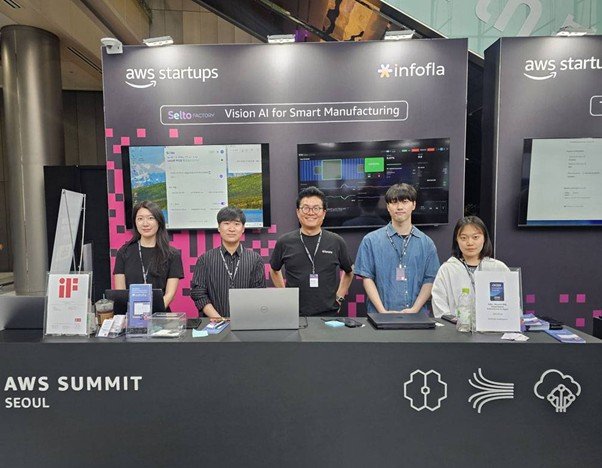
Infofla CEO In-mook Choi(center) and executives and staff members at their booth inside the AWS Summit Seoul 2026 venue. / Source = IT DongA
Amid the massive crowds, the most prominent topic at this year's event was undoubtedly "AI Agents." This signifies an evolution beyond the limitations of traditional AI, which merely answers user queries, into a stage where AI autonomously assesses situations and acts to achieve specific goals.
While numerous global tech giants scrambled to showcase advanced AI agents at the AWS Summit, booths of startups armed with unique ideas and technologies also caught the eye. Infofla, a company specializing in AI-driven workflow automation solutions led by CEO In-mook Choi, was among them.
Moving Beyond the Office to the Production Floor: 'Selto Factory' Expands the Realm of Automation
Infofla has steadily upgraded Selto, its AI agent that automates office tasks by recognizing images on computer screens and controlling mice and keyboards based on Vision AI. Unlike conventional automation solutions vulnerable to layout changes or unexpected pop-up windows, Selto has accumulated significant experience and expertise as an "office agent" that understands context and responds flexibly like a human. Furthermore, the company proved its capabilities by winning the CES 2026 Innovation Award and the iF Design Award 2026.
Selto Factory, introduced by Infofla at this year's AWS Summit 2026, is the result of expanding its stage into manufacturing sites where actual products are made, leveraging its proven technological prowess in office environments.
In an interview with reporters, CEO In-mook Choi candidly shared his field observations. "When we took Selto AI to actual manufacturing sites, the demands were overwhelming. Because it is a sector that young people are reluctant to enter and labor shortages persist, factories desperately wanted an AI transformation (AX). However, practically speaking, there were almost no places where AI was actively applied."
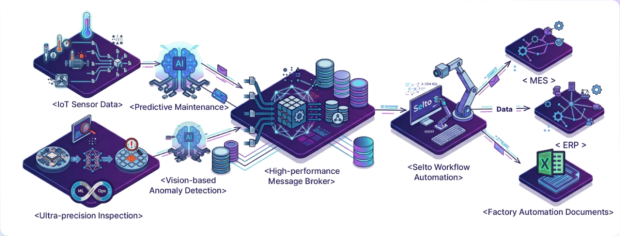
Overview of the Selto Factory platform / Source = Infofla
Recently, production floors have been undergoing a shift toward smart factories, with various IoT sensors installed to measure temperature, humidity, pressure, or motor RPM, collecting vast amounts of data. However, the quality control (QC) process to determine whether the final finished product is normal or defective still ultimately had to rely on manual visual inspection by operators.
Regarding this, Choi emphasized, "In semiconductor lead frame production lines, products are stamped out once every second. This means the maximum time window to detect defects and resolve them is only 0.5 seconds. In the past, humans had to do this manually, but now, an AI-based agent performs real-time detection, judgment, and execution, automatically logging the results into the system."
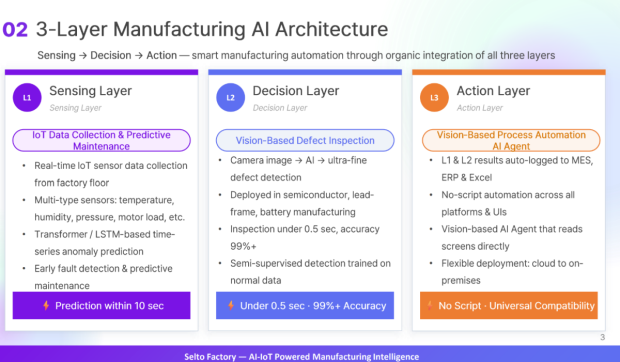
The three-layer manufacturing AI architecture applied to Selto Factory / Source = Infofla
According to In-mook Choi's explanation, Infofla's Selto Factory platform has already verified both a processing time of under 0.5 seconds per step and an accuracy rate of over 99% through Proof of Concept (PoC) projects conducted on production floors. Furthermore, it is slated to be implemented soon in the expanded production lines of a certain KOSPI-listed semiconductor enterprise. Choi expressed confidence, saying, "Among all manufacturing processes, semiconductor fabrication is the most complex and precise. If successfully applied to semiconductors, it can be deployed across most manufacturing lines, including secondary batteries, renewable energy, and precision components."
How to Survive Among Giants: 'Security' and 'Customization'
The current AI agent market is a massive battlefield where global Big Tech firms are pouring in immense capital and infrastructure. In this environment, how can a startup like Infofla remain competitive? Paradoxically, In-mook Choi revealed that the inherent limitations of models from global corporations became an opportunity for Infofla.
The first weapon is robust security. Public institutions and the financial sector, which are highly sensitive to technology leaks and regulatory compliance, find it burdensome to use external cloud models. This explains why Sovereign AI—where nations or corporations independently build their own artificial intelligence to safeguard data sovereignty—has recently emerged as a key phrase. Choi explained, "Because our model is installed directly inside the company as an on-premises package, there is absolutely no worry about data leaking to the outside."
The second is customized learning specialized for enterprise systems. Choi emphasized a clear point of differentiation from global models. "General-purpose AI models from global Big Tech automate well-known software and programs very smoothly. However, they have no way of knowing the proprietary internal systems (such as ERP or MES) that individual companies have developed and utilized through SI processes. Conversely, our model finishes learning simply by having a regular worker demonstrate their routine task on the screen once, allowing anyone to easily implement customized automation."
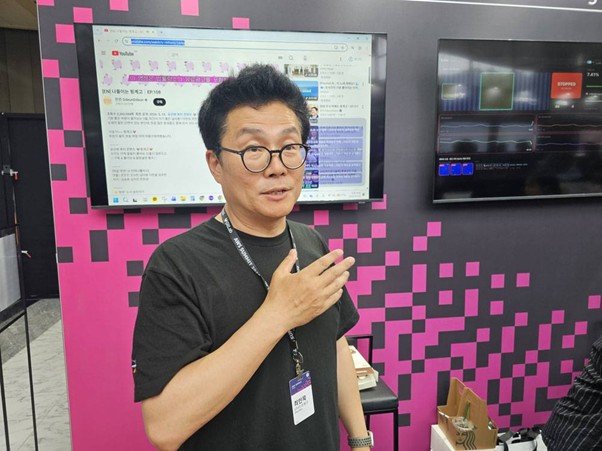
Infofla CEO In-mook Choi answering questions from reporters. / Source = IT DongA
"Success in South Korea's Factories is Immediately a Global Reference"
When asked about the survival strategy as a startup amid fierce competition with global conglomerates, Choi replied in a calm yet confident tone.
"In fact, it is crucial to focus on what a startup can do best. Our strength lies in agility—developing technology faster than conglomerates, rapidly entering the market for validation, and iteratively improving performance. It is genuinely difficult to find another case nearby that started with AI agents and expanded its territory into manufacturing this swiftly. It was possible because we nimbly embraced customer demands."
Concluding the interview, he touched upon the potential of South Korea's manufacturing industry. "South Korea is a manufacturing powerhouse with global competitiveness. Therefore, a successful track record built on South Korea's manufacturing floors can directly translate into a powerful global reference that works in the world market. As we have rapidly entered the sector we excel at most, we will continue to deliver clear results."
At the AWS Summit Seoul 2026 venue, one could witness firsthand the intense technological rivalry among generative AI and frontier foundation models being pumped out at a terrifying pace by global giants. In a battlefield of titans armed with capital and infrastructure, the standing room for startups might appear narrow.
However, Infofla’s trajectory demonstrates that what ultimately matters more than technological weight class is "on-site proximity." Their strategy involves digging into the blind spots of proprietary systems unique to each company and industry—areas where massive general-purpose models struggle to penetrate—to provide definitive, tailored solutions. It is well worth watching the steps of this homegrown startup as it nimbly carves out microscopic niches on the manufacturing floor that general-purpose AI fails to cover.
By Young-woo Kim (pengo@itdonga.com)




![“코 스프레이 2번 뿌렸더니 기억력 쑥”…치매 치료 가능성 [노화설계]](https://dimg.donga.com/c/138/175/90/1/wps/NEWS/IMAGE/2026/05/29/134018314.3.jpg)



 About Dong-A Ilbo