

"AI From Website Creation to Operation": WEVEN's 'Zaemit' Dreams of Becoming the 'Next Figma'
"AI From Website Creation to Operation": WEVEN's 'Zaemit' Dreams of Becoming the 'Next Figma'
Posted May. 19, 2026 15:44,
Updated May. 20, 2026 09:45
- WEVEN’s Zaemit is an AI-powered website platform that combines conversational “vibe coding” with professional-grade design and editing tools to simplify both website creation and management.
- Built on WEVEN’s own web-specialized AI models, Zaemit aims to deliver faster, cheaper, and higher-quality results than existing web builders while also expanding into automated image generation and future website operations.
- With growing user adoption, patent-backed technology, and partnerships focused on Japan and other global markets, WEVEN hopes Zaemit will become the “next Figma” for web creation and operation.
It is now an era of conversing with generative AI to create text, images, and even code. In particular, "Vibe Coding," which generates outputs by instructing AI in natural language, has changed the paradigm of development. According to Google and Microsoft, approximately 46% of websites worldwide are being produced through the vibe coding method.

Amid fierce competition among global companies such as Lovable and Cursor, the South Korean startup "WEVEN" has introduced "Zaemit," a vibe coding platform that generates high-quality, design-based websites through AI conversations. WEVEN aims for an integrated platform that goes beyond website creation, providing "beyond-AI-level" results through an expert-oriented, collaboration-based vibe coding studio, and ultimately automating future operations.
Jeong-hwan Kim, CEO of WEVEN, is an expert who has experienced diverse roles, from designer, developer, and planner to agency CEO. While executing projects at a web agency and witnessing the inefficiency of the design confirmation process, he has pondered a system where anyone could reasonably own a high-quality website. He stated, "I thought an environment capable of providing unique yet high-quality design was necessary," adding, "The emergence of AI played a decisive role in resolving this awareness of the issue." CEO Kim founded WEVEN, directly developed an AI model for automatic website generation, secured patents, and unveiled Zaemit last year.
Zaemit, Embodying the Advantages of AI Web Builders and Vibe Coding
While AI web builders provide productivity by automatically selecting themes and inputting content when a user responds to a survey, they additionally required the learning and editing of a separately provided professional editor for modifications. On the other hand, vibe coding boasts high flexibility by creating code through free conversations with generative AI; however, it had limitations such as lacking or severely insufficient editor functions, as well as inconsistent design quality.
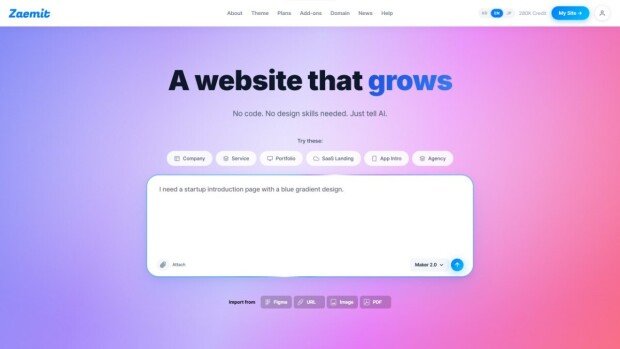
Zaemit has resolved the limitations of both methods and brought their advantages together. It is equipped with a professional-grade editor featuring sophisticated and diverse functions compared to existing web builders, while realizing expert-level design quality. Thanks to this, both methods are now possible: customizing via vibe coding after selecting a theme, or building a website by conversing with AI from the initial stage. WEVEN plans to provide web operation infrastructure functions here, supporting a one-click implementation from generation to deployment and operation.
The core of Zaemit is its self-developed, web-specialized AI model. The company explains that it has built a specialized model that is about three times faster and twice as cheap as hyper-scale LLM services, utilizing a model directly tuned based on an industry-specific classification system. Kim stated, "It is not simply at the level of integrating with ChatGPT or Claude; rather, the website planning and design stages are internalized within the AI," and emphasized, "The degree of completion, looking as if an expert made it directly in the field, is our point of differentiation." He also added, "Performance will continue to be highly advanced as infrastructure expands in the future."
Beyond website generation, Zaemit is equipped with an automatic image generation model. Previously, when bringing in free stock images from external sources, there was a problem of images breaking on the website if the original images were deleted. To solve this, WEVEN developed a high-quality automatic image generation model suitable for the web, and over the past six months, it has secured an image library of over 300,000 images by generating 3,000 images daily. Furthermore, the company plans to provide a generation service that responds in real-time to user-input prompts.
Expanding to a VS Code-based Web Editor for Experts
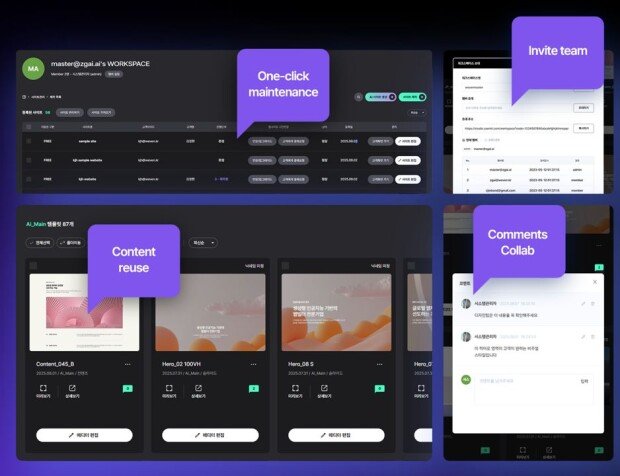
Zaemit’s business model is largely divided into two pillars, placing particular emphasis on targeting the professional market. While providing subscription plans for general users, it introduced an extension for Microsoft VS Code in February 2026 for skilled experts. Kim explained, "HTML codes generated by various LLMs such as ChatGPT, Claude, and Gemini can be loaded into the Zaemit editor and freely edited, making it far more versatile than existing editors."
Notably, it features the ability to enable vibe coding by directly connecting to AI services the user is subscribing to through MCP (Model Context Protocol) integration. In this case, code ownership is granted to the creator. Requesting only image generation is also possible. Kim noted, "Experts can increase efficiency by using their existing work tools and Zaemit in combination." Additionally, WEVEN plans to provide a collaborative environment for experts, as well as a library function to share outcomes.
Moving forward, Zaemit aims to automate operations beyond website creation and image generation. This signifies a hyper-personalized operation service that issues all operational directives through a single AI chat window instead of a complex administrator screen, and automatically changes content to suit the age, gender, or local weather of consumers accessing the website. Kim explained, "Ultimately, users will seek services that are easy to operate," and elaborated, "It will become a global integrated platform that automates all areas of the web and helps even startups provide optimized and personalized services through specialized AI models for each sector."
Accelerating Global Market Entry, Centered on Japan

WEVEN launched the beta version of Zaemit in May 2025 and commenced its official service in October of the same year. As of February 2026, its MAU (Monthly Active Users) surpassed 20,000, with cumulative users exceeding 200,000. It has also proven its technological prowess by securing over 30 patents related to AI and no-code. Kim said, "Instances of cutting production costs by more than 50% in the actual field of SMEs and startups have surpassed 1,000 cases, drawing continuous favorable reviews for its convenience."
WEVEN is focusing on advancing into the global market beyond South Korea. It plans to showcase its services through partnerships with local companies, primarily centering on the Japanese market, where local demand is high. It also aims to target the US and European markets by highlighting the strength of its high-quality design. Kim explained, "As of 2026, we have already signed more than 15 global partnerships," adding, "Through our self-tuning technology, we can easily advance into the global market, as we can provide customized designs tailored to industrial categories as well as country-specific localization."
He continued, "We are now in the era of agent competition, moving beyond the competition of LLMs, and WEVEN is preempting the web sector," and stated, "Zaemit aims to be the 'Next Figma,' intending to become the standard for website creation and operation by automating the entire process from design to development and operation."
By Ye-ji Kim(yj@itdonga.com)
- Built on WEVEN’s own web-specialized AI models, Zaemit aims to deliver faster, cheaper, and higher-quality results than existing web builders while also expanding into automated image generation and future website operations.
- With growing user adoption, patent-backed technology, and partnerships focused on Japan and other global markets, WEVEN hopes Zaemit will become the “next Figma” for web creation and operation.
It is now an era of conversing with generative AI to create text, images, and even code. In particular, "Vibe Coding," which generates outputs by instructing AI in natural language, has changed the paradigm of development. According to Google and Microsoft, approximately 46% of websites worldwide are being produced through the vibe coding method.
Jeong-hwan Kim, CEO of WEVEN / source=IT Dong-A
Amid fierce competition among global companies such as Lovable and Cursor, the South Korean startup "WEVEN" has introduced "Zaemit," a vibe coding platform that generates high-quality, design-based websites through AI conversations. WEVEN aims for an integrated platform that goes beyond website creation, providing "beyond-AI-level" results through an expert-oriented, collaboration-based vibe coding studio, and ultimately automating future operations.
Jeong-hwan Kim, CEO of WEVEN, is an expert who has experienced diverse roles, from designer, developer, and planner to agency CEO. While executing projects at a web agency and witnessing the inefficiency of the design confirmation process, he has pondered a system where anyone could reasonably own a high-quality website. He stated, "I thought an environment capable of providing unique yet high-quality design was necessary," adding, "The emergence of AI played a decisive role in resolving this awareness of the issue." CEO Kim founded WEVEN, directly developed an AI model for automatic website generation, secured patents, and unveiled Zaemit last year.
Zaemit, Embodying the Advantages of AI Web Builders and Vibe Coding
While AI web builders provide productivity by automatically selecting themes and inputting content when a user responds to a survey, they additionally required the learning and editing of a separately provided professional editor for modifications. On the other hand, vibe coding boasts high flexibility by creating code through free conversations with generative AI; however, it had limitations such as lacking or severely insufficient editor functions, as well as inconsistent design quality.
Zaemit page / source=WEVEN
Zaemit has resolved the limitations of both methods and brought their advantages together. It is equipped with a professional-grade editor featuring sophisticated and diverse functions compared to existing web builders, while realizing expert-level design quality. Thanks to this, both methods are now possible: customizing via vibe coding after selecting a theme, or building a website by conversing with AI from the initial stage. WEVEN plans to provide web operation infrastructure functions here, supporting a one-click implementation from generation to deployment and operation.
The core of Zaemit is its self-developed, web-specialized AI model. The company explains that it has built a specialized model that is about three times faster and twice as cheap as hyper-scale LLM services, utilizing a model directly tuned based on an industry-specific classification system. Kim stated, "It is not simply at the level of integrating with ChatGPT or Claude; rather, the website planning and design stages are internalized within the AI," and emphasized, "The degree of completion, looking as if an expert made it directly in the field, is our point of differentiation." He also added, "Performance will continue to be highly advanced as infrastructure expands in the future."
Beyond website generation, Zaemit is equipped with an automatic image generation model. Previously, when bringing in free stock images from external sources, there was a problem of images breaking on the website if the original images were deleted. To solve this, WEVEN developed a high-quality automatic image generation model suitable for the web, and over the past six months, it has secured an image library of over 300,000 images by generating 3,000 images daily. Furthermore, the company plans to provide a generation service that responds in real-time to user-input prompts.
Expanding to a VS Code-based Web Editor for Experts
WEVEN plans to provide a collaboration-based vibe coding platform for professionals / source=WEVEN
Zaemit’s business model is largely divided into two pillars, placing particular emphasis on targeting the professional market. While providing subscription plans for general users, it introduced an extension for Microsoft VS Code in February 2026 for skilled experts. Kim explained, "HTML codes generated by various LLMs such as ChatGPT, Claude, and Gemini can be loaded into the Zaemit editor and freely edited, making it far more versatile than existing editors."
Notably, it features the ability to enable vibe coding by directly connecting to AI services the user is subscribing to through MCP (Model Context Protocol) integration. In this case, code ownership is granted to the creator. Requesting only image generation is also possible. Kim noted, "Experts can increase efficiency by using their existing work tools and Zaemit in combination." Additionally, WEVEN plans to provide a collaborative environment for experts, as well as a library function to share outcomes.
Moving forward, Zaemit aims to automate operations beyond website creation and image generation. This signifies a hyper-personalized operation service that issues all operational directives through a single AI chat window instead of a complex administrator screen, and automatically changes content to suit the age, gender, or local weather of consumers accessing the website. Kim explained, "Ultimately, users will seek services that are easy to operate," and elaborated, "It will become a global integrated platform that automates all areas of the web and helps even startups provide optimized and personalized services through specialized AI models for each sector."
Accelerating Global Market Entry, Centered on Japan
Jeong-hwan Kim, CEO of WEVEN / source=IT Dong-A
WEVEN launched the beta version of Zaemit in May 2025 and commenced its official service in October of the same year. As of February 2026, its MAU (Monthly Active Users) surpassed 20,000, with cumulative users exceeding 200,000. It has also proven its technological prowess by securing over 30 patents related to AI and no-code. Kim said, "Instances of cutting production costs by more than 50% in the actual field of SMEs and startups have surpassed 1,000 cases, drawing continuous favorable reviews for its convenience."
WEVEN is focusing on advancing into the global market beyond South Korea. It plans to showcase its services through partnerships with local companies, primarily centering on the Japanese market, where local demand is high. It also aims to target the US and European markets by highlighting the strength of its high-quality design. Kim explained, "As of 2026, we have already signed more than 15 global partnerships," adding, "Through our self-tuning technology, we can easily advance into the global market, as we can provide customized designs tailored to industrial categories as well as country-specific localization."
He continued, "We are now in the era of agent competition, moving beyond the competition of LLMs, and WEVEN is preempting the web sector," and stated, "Zaemit aims to be the 'Next Figma,' intending to become the standard for website creation and operation by automating the entire process from design to development and operation."
By Ye-ji Kim(yj@itdonga.com)



![[사설]“김수현 녹취는 AI 조작”… 엄벌 없인 ‘악마적 범죄’ 더 판칠 것](https://dimg.donga.com/c/138/175/90/1/wps/NEWS/IMAGE/2026/05/22/133979690.1.jpg)
![[단독]조부 살해 20대女 “피 엄청 많이…빨리 와주세요” 119 신고](https://dimg.donga.com/c/138/175/90/1/wps/NEWS/IMAGE/2026/05/22/133978390.1.jpg)



 About Dong-A Ilbo