

Seoul urges talks as Samsung strike risks grow
Seoul urges talks as Samsung strike risks grow
Posted May. 16, 2026 08:22,
Updated May. 16, 2026 08:22
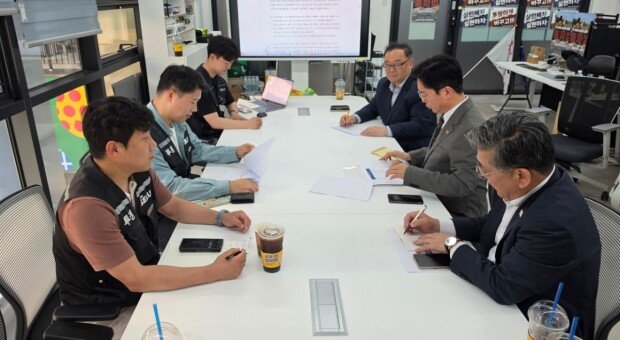
South Korea’s Labor Minister Kim Young-hoon has called for an urgent resolution to the escalating labor dispute at Samsung Electronics, warning that management and the union must return to negotiations to avert a strike that could disrupt semiconductor production.
“Companies do not exist without workers, and unions are not formed to make companies fail,” Kim said, adding that unless a strike is the intended goal, the dispute should be resolved at the bargaining table.
The appeal came as 18 senior Samsung Electronics executives issued a public apology and pledged to enter talks “with an open mind and without conditions.” Both Kim and Samsung executives met union representatives separately on Friday, urging a resumption of negotiations.
Despite growing calls for a settlement, the risk of a strike is rising, with early signs of economic disruption already emerging. Samsung Electronics has begun a gradual “warm-down” process, scaling back production in anticipation of a potential shutdown.
Semiconductor plants operate continuously, and even brief interruptions can lead to significant losses. South Korea’s Minister of Trade, Industry and Energy Kim Jung-kwan warned that a full stoppage could cost up to 1 trillion won per day in lost output. He added that if all wafers currently in production were damaged, total losses could reach as much as 100 trillion won.
Within the government, officials are also considering emergency arbitration powers as a last-resort option to suspend industrial action. Since the system was introduced in 1963, it has been used only four times.
Given semiconductors’ central role in the South Korean economy, officials say there is a strong case for intervention. Still, they emphasize that a negotiated settlement between labor and management remains the preferred outcome.
While South Korea grapples with labor tensions, global semiconductor rivals are rapidly expanding their capabilities.
In the United States, companies are accelerating development of next-generation artificial intelligence chips designed to function without high-bandwidth memory (HBM), a segment currently dominated by South Korean firms. Meanwhile, competitors in the U.S., China and Taiwan are expanding production capacity to capture potential supply gaps.
The global AI chip boom represents a key opportunity for South Korea to reinforce its technological edge. But officials and analysts warn that a prolonged labor dispute could undermine that advantage at a critical moment for the industry.







 About Dong-A Ilbo