

Seoul must respond wisely after Hormuz attack
Seoul must respond wisely after Hormuz attack
Posted May. 12, 2026 07:56,
Updated May. 12, 2026 07:56
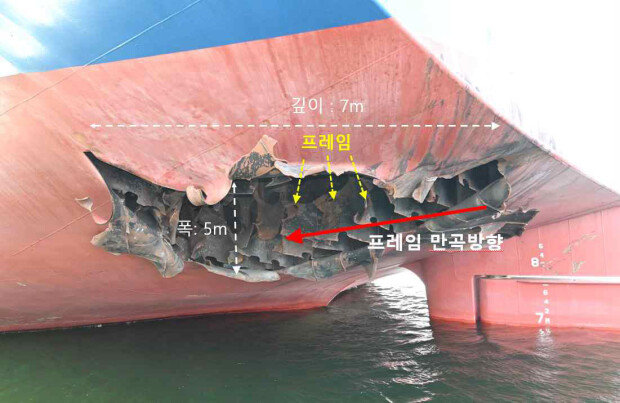
A South Korean government investigation has found that the explosion aboard the HMM cargo vessel Namu in the Strait of Hormuz on May 4 was caused by a coordinated strike involving two unidentified aerial objects. The attack severely damaged the ship’s left stern hull, tearing a section roughly 5 meters wide and 7 meters deep, puncturing the engine room floor and triggering a fire.
The presidential office condemned the incident Monday, saying attacks on civilian vessels “cannot be tolerated.” It added that Seoul would move to identify both the perpetrators and the type of aircraft involved through a thorough investigation before considering additional response measures.
Although the government has avoided directly naming those responsible, much of the evidence points toward Iran. Ahead of the announcement, Seoul summoned the Iranian ambassador to the Foreign Ministry for an explanation, a move widely seen as reflecting suspicions of Iranian involvement.
Iranian authorities and media outlets, however, have offered conflicting explanations. Iranian state television claimed the Korean vessel had been targeted for violating maritime regulations, while the Iranian Embassy in Seoul denied any involvement by Iranian forces.
With the preliminary investigation concluding that the Namu was deliberately attacked, a more detailed probe is now essential. Investigators need to determine whether the aircraft involved were suicide drones or cruise missiles, and whether the strike was carried out by the Iranian military, the Islamic Revolutionary Guard Corps or an Iran-backed militant group.
Only clear and undeniable evidence can strengthen Seoul’s diplomatic response and support demands for accountability and measures to prevent similar attacks in the future.
Still, any response must be calibrated carefully within a broader strategic framework. While South Korea has every right to pursue a principled and proportional response, its foremost priority should be the safety of the 26 South Korean vessels and 160 Korean sailors still operating or stranded near the Strait of Hormuz, including the Namu.
Iran views the conflict as a matter of national survival. An excessively hard-line response could expose South Korean ships to the danger of indiscriminate retaliation. Even France and China, whose vessels have also come under attack, have refrained from military action.
Since the outbreak of the U.S.-Iran conflict, Seoul has sought to preserve diplomatic channels with Tehran by maintaining its embassy there and dispatching a special envoy from the Foreign Ministry.
At the same time, South Korea has participated in British- and French-led multinational efforts aimed at ensuring safe passage through the Strait of Hormuz, while cautiously considering involvement in the U.S.-led Maritime Freedom Coalition.
Seoul must now strike a careful balance among backchannel diplomacy with Iran, close South Korea-U.S. coordination and broader cooperation with the international community. The crisis has become a defining test for South Korean diplomacy.


![[단독]계엄때 “서강대교 넘지말라” 했던 대령도 내란수사](https://dimg.donga.com/c/138/175/90/1/wps/NEWS/IMAGE/2026/06/27/134192351.1.jpg)




 About Dong-A Ilbo