

Labor law tilts balance toward subcontractor unions
Labor law tilts balance toward subcontractor unions
Posted April. 10, 2026 09:05,
Updated April. 10, 2026 09:05
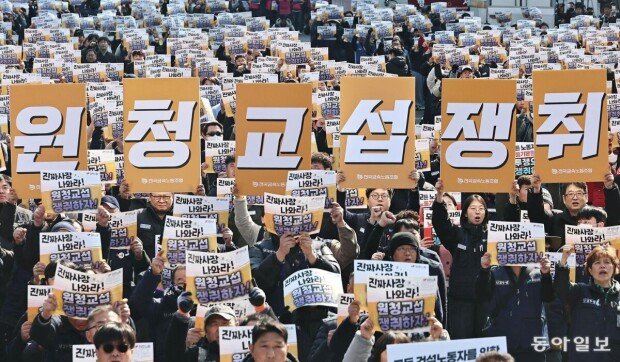
South Korea’s revised Trade Union Act, known as the “yellow envelope law,” has completed its first month in effect, with subcontractor unions gaining momentum in disputes with employers.
Labor authorities have consistently ruled that primary contractors qualify as the “real employer” and must engage in direct negotiations with subcontractor unions when talks fail. So far, all decisions have favored labor.
According to the Ministry of Employment and Labor, 987 subcontractor unions representing 144,805 workers have sought negotiations with 368 primary contractors. The data cover the period from March 10, when the law took effect, through April 7, reflecting a surge of nearly 1,000 requests within a month.
Only 31 primary contractors have formally acknowledged the requests by issuing public notices to begin negotiations. Meanwhile, 279 cases have been referred to the labor relations commission after talks stalled, seeking a ruling on employer status.
As of April 8, the commission had determined in 10 cases that primary contractors must be treated as employers and negotiate with subcontractor unions. The rulings involved seven public institutions, including the Korea Institute of Nuclear Safety, along with one private company, POSCO, and two universities. All decisions sided with the unions.
The commission has also issued a series of rulings allowing multiple subcontractor unions to negotiate separately with the same primary contractor.
Business groups warn that the trend could tilt the balance toward labor and weaken industrial competitiveness.
이문수 doorwater@donga.com



![비타민도 과하면 독…몸이 보내는 ‘과다 섭취’ 신호 5가지[건강팩트체크]](https://dimg.donga.com/c/138/175/90/1/wps/NEWS/IMAGE/2026/04/09/133705034.3.jpg)



 About Dong-A Ilbo