

BTS blends tradition and pop at Gwanghwamun
BTS blends tradition and pop at Gwanghwamun
Posted March. 23, 2026 08:48,
Updated March. 23, 2026 08:48
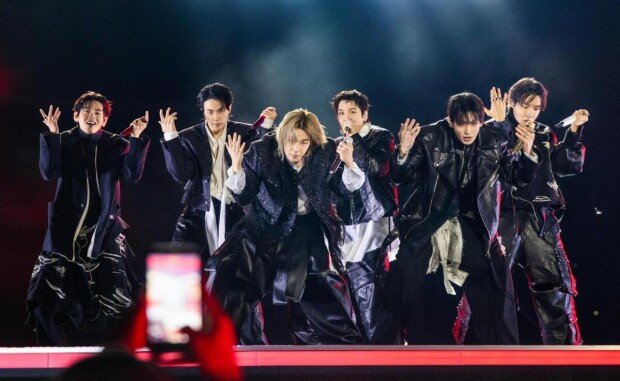
“It is a true honor to perform at Gwanghwamun, one of the most historic places in South Korea,” BTS member Suga said.
BTS took the stage at 8 p.m. on March 21 at Gwanghwamun Square in Seoul’s Jongno District for “BTS Comeback Live: Arirang,” repeatedly sharing their sense of pride and emotion about performing at the landmark venue. The members also conveyed a palpable sense of responsibility as they performed before a global audience in a setting deeply rooted in Korean history.
The concert was livestreamed to more than 190 countries via Netflix, firmly establishing Gwanghwamun as a global stage for cultural events. Despite drawing an estimated 104,000 people, according to organizers, the event concluded safely and in an orderly manner, reinforcing the venue’s stature.
● Gwanghwamun immersed in the sound of Arirang
“Hello, Seoul. We’re back,” leader RM said.
The opening sequence, rich in Korean aesthetics, underscored why BTS chose Gwanghwamun as the site of their first performance in about four years. Drone cameras swept over Mount Bugak, tracing the so-called royal route from Geunjeongmun and Heungnyemun gates of Gyeongbokgung Palace to Gwanghwamun, capturing sweeping views of the plaza. As BTS emerged on stage with Gwanghwamun visible behind a large open cube structure, the crowd erupted in cheers.
The group opened with “Body to Body,” a track infused with the melody of the traditional folk song “Arirang.” A powerful hip-hop arrangement blended seamlessly with harmonies performed by musicians and vocalists from the National Gugak Center. The exterior walls of Gwanghwamun were transformed by media art evoking the texture of ink brush strokes.
The setting of Gwanghwamun drew nearly as much attention as the performance itself. As the members sang and danced, the landmark appeared within the cube structure like a framed painting. Three layers of LED lighting surrounding the stage, combined with the glow of ARMY Bomb light sticks, created shifting waves of color that recast Gwanghwamun in changing tones. Deep reds pulsed with intensity at times, while soft yellow hues settled across the plaza.
● Korean identity reflected from costumes to stage
Stage direction inspired by the four trigrams of the Korean flag also stood out. The performance of the title track “SWIM,” visualizing the trigram “Gam,” which symbolizes water, featured restrained choreography and a more subdued tone, reflecting the group’s intention to present a new phase.
The stage costumes, modern reinterpretations of traditional hanbok, added another visual highlight. They were created by South Korean brand Songzio. The New York Times noted that BTS’s choice of the brand, like its selection of Gwanghwamun Square and the theme “Arirang,” reflected an effort to highlight Korean culture and identity beyond fashion. In an interview, Songzio CEO Song Jae-woo said each member was assigned a character under the theme of “heroes,” describing RM as a leader, Jin as an artist and Jimin as a poet.
BTS, which paused group activities in June 2022 citing burnout, showed renewed confidence throughout the performance. RM said the group sought to listen more closely to its own voice and to express its concerns, anxieties and moments of uncertainty with greater honesty.
The final song was “Mikrokosmos,” a staple closing number from the group’s world tours. “Each person has their own history, each person has their own star. 8.4 billion lights, 8.4 billion worlds.”
Reflecting the passage of time, BTS updated the original lyric “7 billion” to “8.4 billion” and asked the audience to turn on their phone lights. The square soon filled with a constellation-like display of LEDs and purple ARMY Bombs, transforming Gwanghwamun into a luminous night sky.
사지원 기자 4g1@donga.com



![“무릎엔 운동이 답?”…‘발끝 각도’만 달라져도 통증 줄어든다[노화설계]](https://dimg.donga.com/c/138/175/90/1/wps/NEWS/IMAGE/2026/05/08/133872914.3.jpg)




 About Dong-A Ilbo