

Lee calls for fair markets to support SMEs
Lee calls for fair markets to support SMEs
Posted March. 21, 2026 09:27,
Updated March. 21, 2026 09:27
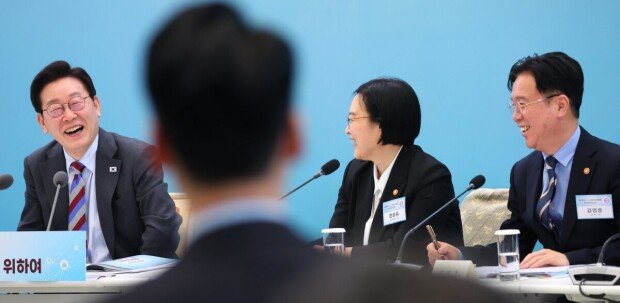
President Lee Jae-myung said Thursday that South Korea has a “structural problem of exploitation,” warning that practices such as technology theft and corporate abuse are weakening the innovative capacity of small and medium-sized enterprises.
Speaking at a meeting with SME leaders at the Blue House guesthouse, Lee said that even when smaller firms improve their management performance, they often face pressure to cut supply prices or risk having their achievements taken away. In such an environment, he said, companies may devote more effort to lobbying executives at client firms than to pursuing innovation or expanding into new markets. He described this as a factor that undermines the competitiveness of the broader economy. Lee called for establishing a fair market order, saying South Korea must become a society where unjust gains through unfair competition are no longer possible.
Addressing business owners, Lee also urged a model of shared growth based on rational coordination of interests with workers. “From a management standpoint, labor is an important issue, and I myself come from a labor background,” he said. “Workers should assert their rightful share, while companies should present their position as employers. What is needed is a reasonable adjustment of interests.” He added that open dialogue and cooperation, grounded in a balance of power, are essential to ensure that neither side suffers unreasonable losses.
Lee also pointed to persistent negative perceptions of labor unions. “There was a time when unions were treated as subversive, when the very concept of labor was viewed through an ideological lens, and workers were seen as targets of suppression,” he said. “Such attitudes do not help strengthen corporate competitiveness.” He added that productivity cannot improve without a sense of commitment among employees, emphasizing that companies grow stronger when workers believe their own interests are aligned with the company’s success.
He stressed that coordination among government ministries is critical to achieving these goals. Lee said he had instructed the ministers of trade, SMEs and labor to engage in frequent discussions, even if disagreements arise. “They may hold different positions and even clash, and I told them to argue more,” he said. “When ministers argue, workers and businesses are less likely to clash on the ground.” He reiterated the need to establish a fair market order in which unfair gains through anti-competitive practices are not possible.
Lee also shared an anecdote from his meeting last year with U.S. President Donald Trump. “I told him our economy was facing serious difficulties and even experiencing negative growth, and he replied, ‘South Korea has many strong companies. How could that be?’” Lee said. “From the outside, large and successful corporations stand out. But while they are important, they are not the whole economy. It is the less visible small and medium-sized businesses that account for most employment and sustain the South Korean economy.”
윤다빈 empty@donga.com


![[사설]“김수현 녹취는 AI 조작”… 엄벌 없인 ‘악마적 범죄’ 더 판칠 것](https://dimg.donga.com/c/138/175/90/1/wps/NEWS/IMAGE/2026/05/22/133979690.1.jpg)

![[단독]조부 살해 20대女 “피 엄청 많이…빨리 와주세요” 119 신고](https://dimg.donga.com/c/138/175/90/1/wps/NEWS/IMAGE/2026/05/22/133978390.1.jpg)



 About Dong-A Ilbo