

Six parties push amendment plan despite PPP opposition
Six parties push amendment plan despite PPP opposition
Posted March. 20, 2026 08:59,
Updated March. 20, 2026 08:59
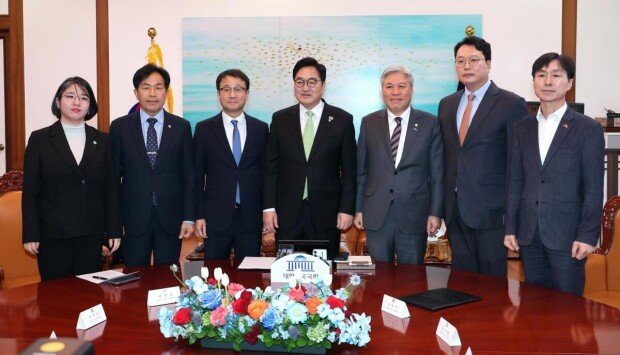
Six parliamentary parties, excluding the People Power Party, have agreed to pursue a constitutional amendment that would scale back the president’s authority to declare martial law, with plans to propose the bill by April 7 and put it to a national referendum alongside the June 3 local elections.
National Assembly Speaker Woo Won-shik met with floor leaders from the Democratic Party of Korea, Rebuilding Korea Party, Progressive Party, Reform Party, Basic Income Party and Social Democratic Party at the National Assembly on March 19, where they reached the agreement. The proposed amendment would include provisions to limit presidential martial law powers, enshrine the spirit of the May 18 Gwangju Democratization Movement and the Buma Democratic Uprising in the Constitution’s preamble, and reinforce the principle of local decentralization.
Woo said that if a sweeping constitutional overhaul proves difficult, lawmakers should begin with issues that command broad bipartisan support and public consensus. He added that revisions to the structure of power, including the presidential term, should be taken up after the local elections.
The parties are aiming to formally introduce the amendment by April 7 and plan to persuade the People Power Party to participate ahead of a second meeting scheduled for March 30. Approval of a constitutional amendment requires the support of two-thirds of the National Assembly, or 197 out of 295 members. Even with backing from all lawmakers affiliated with the six parties and independents, the total would reach only 187, leaving at least 10 votes needed from the People Power Party. If passed, it would mark the first constitutional revision in 39 years since 1987.
The People Power Party has made clear its opposition to holding a constitutional referendum in tandem with the local elections. Floor leader Song Eon-seok said at a party meeting on March 19 that linking constitutional revision to an election risks turning it into a political tool and could cause future elections to be overshadowed by constitutional issues.
Dong-Joo Cho djc@donga.com



![[단독]꾸벅꾸벅 고속도 운전… 넉달간 사망 73% 급증](https://dimg.donga.com/c/138/175/90/1/wps/NEWS/IMAGE/2026/05/06/133874827.1.jpg)




 About Dong-A Ilbo