

Remains of Korean War soldier identified after decades
Remains of Korean War soldier identified after decades
Posted March. 19, 2026 08:40,
Updated March. 19, 2026 08:40
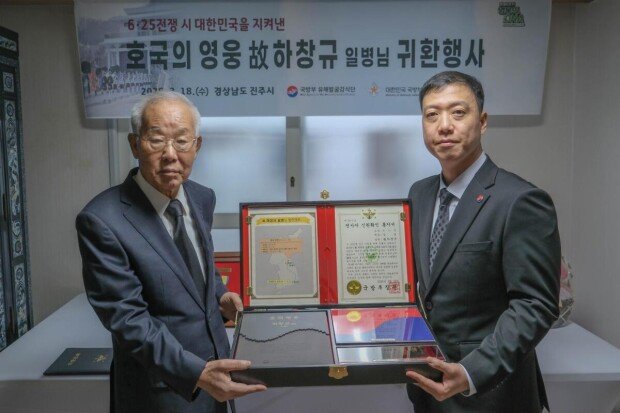
The remains of a South Korean soldier killed during the Korean War, excavated last April near Geummulsan in Hongcheon County, Gangwon Province, have been identified as Private Ha Chang-kyu, who was 24 at the time, the Ministry of National Defense’s recovery and identification unit announced on March 18.
The identification was made possible by a DNA sample provided in 2011 by Ha’s son, Ha Jong-bok, 74. After a detailed genetic analysis comparing the remains, recovered 15 years later, with the sample, father-son kinship was confirmed. A native of Sacheon, South Gyeongsang Province, Ha left behind a pregnant wife and his first daughter when he enlisted alongside his older brother in November 1950. His brother returned home due to illness, but Ha completed training in Busan and was assigned to the 10th Regiment of the 8th Division. He was killed in action about three months later, on February 9, 1951, during the Battle of Hoengseong.
The Battle of Hoengseong was a fierce engagement during the Chinese Fourth Offensive. South Korea’s 3rd, 5th, and 8th divisions fought against Chinese 39th, 40th, 42nd, and 66th armies, along with North Korea’s 5th Corps, in the Hongcheon and Hoengseong areas. The 10th Regiment of the 8th Division suffered heavy casualties, with most of its command, including the regiment commander, killed or missing.
On March 18, the Ministry of National Defense presented Ha’s family with a “Return of the Nation’s Hero” plaque and his personal effects, explaining the process from excavation to identification. Ha’s son, Jong-bok, said, “My mother, who passed away in 2022, left a wish that if my father were ever found, he should be buried together with her. We had a symbolic tomb near my mother’s grave, and now we can finally lay them together. I feel a deep sense of closure.”
Sang-Ho Yun ysh1005@donga.com

![[단독]초봉 5000만원 환경미화원 ‘밀실 면접’ 논란… 81등 역전 합격도](https://dimg.donga.com/c/138/175/90/1/wps/NEWS/IMAGE/2026/06/30/134205664.1.png)


 About Dong-A Ilbo