

Kurdish fighters launch ground assault inside Iran
Kurdish fighters launch ground assault inside Iran
Posted March. 06, 2026 08:09,
Updated March. 06, 2026 08:09
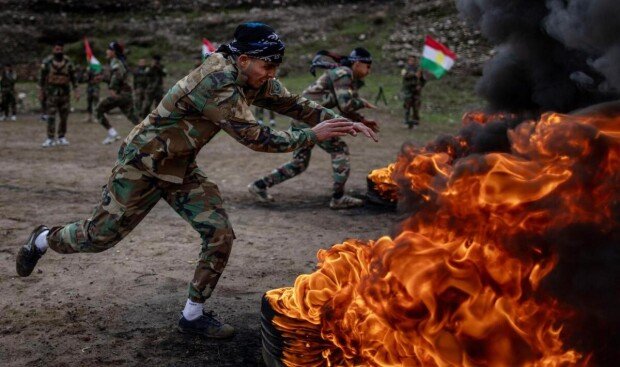
Thousands of Kurdish fighters from across the Middle East have reportedly entered Iran from Iraq and launched a ground assault, according to Fox News, The Jerusalem Post and The Associated Press, which cited officials from the United States and Israel. The reports were published Tuesday local time. The development marks the first effective ground combat in the war that began after U.S. and Israeli airstrikes on Iran on Feb. 28.
The move has fueled assessments that the administration of U.S. President Donald Trump, reluctant to deploy American troops directly into Iran, has effectively opened a proxy ground front by relying on Kurdish forces. The White House said the same day that President Trump had spoken with Iraqi Kurdish leaders, a development widely interpreted as signaling Washington’s potential interest in Kurdish involvement in operations against Iran.
According to Fox News, many of the fighters who entered Iran are ethnic Kurdish Iranians who had lived in Iraq for years. Under Iran’s theocratic system led by the Shiite establishment, Kurds, who are largely Sunni Muslims and an ethnic minority, have long faced discrimination. The current conflict could therefore provide an opening for a large-scale popular uprising among Kurdish communities. In such a scenario, other ethnic minorities in Iran, including Azerbaijanis, Arabs and Armenians, could also be affected. This dynamic poses a significant challenge for the Iranian regime, which emphasizes Shiite fundamentalism and maintains a system that merges religious and political authority. Kurds are widely regarded as the world’s largest ethnic group without an independent state. Their population is estimated at roughly 30 million to 40 million and is spread across Iraq, Syria, Iran and Türkiye.
The Kurdish forces are believed to have secured substantial support from the United States and Israel ahead of their participation in the conflict. CNN reported that the U.S. Central Intelligence Agency provided weapons to the fighters. The Associated Press also reported that Kurdish leaders said they had been contacted by U.S. officials regarding potential operations in Iran. Fox News further reported that Israel has already been supporting Kurdish militias operating inside Iran.
For President Trump, who has been wary of a prolonged conflict because of mounting financial costs and the risk of deteriorating public opinion in the United States, Iran’s resistance appears stronger than initially expected. Relying solely on airpower may have been judged insufficient to disable Iran’s nuclear and missile capabilities. Analysts therefore say Washington may have opted to work with Kurdish forces to introduce a ground element to the campaign while minimizing U.S. military casualties.
Another factor behind the apparent U.S. decision to coordinate with Kurdish forces may lie in Iran’s emerging leadership succession. After Iran’s Supreme Leader Ali Khamenei was killed in the U.S. and Israeli airstrikes, his son Mojtaba Khamenei has been widely mentioned as a leading candidate to become the next supreme leader. Mojtaba is regarded as a hard-liner with strong anti-American views similar to those of his father. If he assumes power, controlling Iran’s nuclear and missile facilities or pursuing negotiations could become even more difficult. That possibility may be encouraging Washington to rely on Kurdish forces to exert additional pressure through ground operations.
Jin-Woo Shin niceshin@donga.com

![[속보]트럼프 “이란과 14일 합의 서명”…혁명수비대 “절대 없을 것”](https://dimg.donga.com/c/138/175/90/1/wps/NEWS/IMAGE/2026/06/14/134105551.1.jpg)






 About Dong-A Ilbo